Noteworthy Keynote Address by Dr. Ray Raymond

Portrait photograph of Raymond Ray

Dr. Ray Raymond has been a well-known professor at SUNY Ulster since 2005. He teaches government, politics, international relations, and American history. In addition, he is an adjunct professor of comparative politics and international relations at the US Military Academy. He is known for riveting lectures complete with an eloquent English air about them.

Teaching students at SUNY Ulster is one of many commitments Dr. Raymond is regularly engaged in. He is also a regular visiting lecturer at the US Air Force Academy and Fellow of the Pell Center for International Relations and Public Policy. He is also the Director of the Katt Institute for Constitutional Studies. His efforts have been recognized numerous times, including by the Times Herald Record Online.

An Address of Importance

On Saturday, April 13, Dr. Raymond gave the keynote address at the World Affairs Council of the Hudson Valley’s 6th annual student conference. He illuminated the diffusion of power in the international system since the turn of the century and suggested that that US international leadership has to be collaborative, not unilateral.

The outline of an eagle is filled with red and white stripes and a blue pattern containing white stars

Dr. Raymond suggested that the US does not have the power it once did. He also defended the liberal rules-based world order and recommended reforms in the US intelligence process to ensure that we avoid blind spots, in hopes that this will improve our understanding of the new strategic political environment.

Curious about this man and what the feel of his lectures are? Worry not, because he has contributed mini-lectures to AcademicMinute.org which are broadcast on WAMC Public radio from Albany. His broadcasts set out his views on US foreign policy and explain some key points of commitment and co-dependence between the United States and the United Kingdom. Listen to one of his broadcasts below.

The U.K.’s and The U.S.’s Special Relationship

Dr. Raymond’s Background

So where does our noteworthy professor get his skills from?
First, he is a former British diplomat who held a Post-Doctoral Fellowship at Yale University in American History. Secondly, before coming to SUNY Ulster, Dr. Raymond spent twenty years in Her Majesty’s Diplomatic Service as a specialist on the United States. During that time, he analyzed US government and politics, US defense and national security issues as well US trade policy. Between 1997 and 2005, he advised then British Prime Minister Tony Blair on US politics as well as secondary and higher education. He also served as policy adviser and speech writer for High Royal Highness, The Duke of York. In recognition of his diplomatic work, he was honored by Her Majesty Queen Elizabeth II with the Order of the British Empire.

A flag is bisected diagonally, the upper half depicting a partial american flag and the lower half depicting a aprtial uk flag

 As political officer of the British Consulate General, New York he played an integral role in the UK’s response to the terrorist attacks of September 11th, 2001 when 77 British nationals were killed in the World Trade Center. This included organizing events and giving speeches conveying the message to the United States that the United Kingdom would support it fully in the war on terror. One of them was at SUNY Ulster when Dr. Raymond gave the Howard St. John Lecture in late September 2001.

Dr. Raymond’s research  has been published by The Atlantic Council and the National Interest. Currently, Dr. Raymond is working on a new book which will be published late next year by the US Naval Institute Press. It is about five of West Point’s most courageous young officers and their heroic service in Iraq and Afghanistan.  

Political Influence Aside

Dr. Raymond’s top priority has always remained his students, however.  In addition to teaching, he has mentored many SUNY Ulster students long after they graduated, helping them win places and often scholarships at the Fletcher School of Law and Diplomacy at Tufts University, Columbia University, the University of Pennsylvania, Cornell University, and New York University among others.

This influential man also has a high satisfaction rating from his students. He has multiple inspiring reviews on sites such as RateMyProfessors.com. One anonymous reviewer, a political science student, left a rating of five out of five, saying, “Dr. Raymond always remained very professional, and he is thorough. He will explain it a second or third time if needed and always responds to my emails in a timely manner… I personally enjoyed learning from him. A stand up man/professional if there ever was one.”

His Method

A student in cap and gown puts his thumb up with a wide smile

Dr. Raymond says he gets students into history by making it stimulating. He stresses the importance and relevance of political history in ways that ensure students will be able to make an argument using facts long after they’ve forgotten details of the lesson. “If you’re not excited about it yourself, you can’t expect students to be excited,” he commented.

4 Tips to Power Through Textbook Reading

Three walls of books are shown leading up to a bright invisible sky, the book shelves are slightly covered by clouds and books protruding from the sky. It gives the viewer a feeling of standing in a library nook and looking up to see the heavens.

For most students, getting through that weekly textbook reading can be a real challenge. Believe it or not, there are a few ways to make that nonfiction assignment easier. Learning the ways to power through reading that can feel daunting or impossible is a great skill, a skill that is bound to follow you through life wherever you may need it, for another degree or just a relaxed educational reading session. Here are some tips to boost your GPA through the roof with the power of effective studying.

A teal hard covered book is laying with the pages open on a table, as if someone was reading, pictured with two pages folded up and together toward the  seam that looks like a heart. The backdrop is a bold yellow.

#1. Start Your Engines, Prepare to Learn

When sitting down with your book make sure you are ready to learn. You should have a writing tool and some note paper. No one that I’ve ever heard of was sorry that they took too many notes. You want to be ready to learn, but you also don’t want to dive in headfirst. Ease your way into submersion. Preview the topic and material you intend to research. Read the front cover, back cover, the preface, the inner flaps, boldfaced prints, pictures, and diagrams so you are aware of what you’re supposed to learn. You should gather a clear picture of what the text is about, if not, predict what you will be learning. Write your ideas down and see if your initial feeling is right later.

According to Live Your Legend this step is “akin to warming up before a big game.” You wouldn’t hit the field without a good warm up. Why then would you skip these equivalent steps for a research project? Being prepared when you start your research can help you perform better, just like a good stretch! Take the time to prep your brain and your grades will thank you.

#2. Use The Author’s Organization to Understand

Start off by separating the facts from opinion in the text as you read. Remembering that facts are only the stuff that you can prove, opinions just tend to float around and cannot be proven. Finding the facts is a good practice because that’ll likely be where the answers you seek are living.

Four cartoon looking textbooks are shown with various colors and objects on the cover. One shows a math equation, one an atom, one a microscope and the other a simple pattern. No words are visible anywhere.

Next, look at the way the author presents the material, it may be pretty informative. The order of events can vary as well as the style it’s put together in. In biographies and autobiographies, events are usually in chronological order. Other pieces may have an arrangement that is centered around the main idea (a.k.a. the topic you need to learn). If you can pick up on the organization and utilize it, you can predict what will come next. Pick up on the arrangement of info and where the important bits are, what the point is, and what to study for the big test!

#3. Stop, Drop, Summarize

After each section you read you should stop and put the book down for a minute to summarize the main point(s). This not only keeps you from falling asleep from reading the same book for a while, it also sticks that information you just read, but almost forgot, down in your mind.

A portion of a dark table top is pictured with sticky notes, flashcards, highlighters, markers, pencils and pens scattered across it. The office supplies are very brightly colored. There is also a roll of tape and a small compass in the picture.

Another sweet tip: if you create questions to summarize by and put your answers on the other side, it makes the most amazing study flashcards later on. The most bang for your study bucks, I like to say. I don’t know about you, but I like to remember what I read the first time and not have to search the whole book or chapter for answers down the road.

#4. Ask Questions & Analyze Your Work

Two cartoon heads look at each other, the space where their brains should be are filled with a white space. One head has a light bulb in the space and light bulbs rising from the head. The other head has a question mark in the space and more question marks rising up from his head. They could be having a fascinating conversation about reading a textbook.

Go big or go home, right? So finish strong by reaching for that notebook you have nearby and jotting down some thoughts. ASK QUESTIONS! Get those thinking muscles warmed up and actually ponder a little bit about what you just read. Check and see if those initial topic predictions we covered in Step 1 were right. One of my favorite things to do is to go discuss what I just learned with someone and have a good conversation about the subject. They can help provide some questions that might make you want to hop back into reading that book.

This is the ultimate adhesive to your brain for study material. The bread to your test’s butter. One of the more important steps, I assure you.

When you move on to the next section, read and repeat steps 3 & 4. You won’t get lost in timelines and jargon if you understand the chain of events, organization, and topic.

Good Luck!

If things between you and the textbook start to get hairy, take a breather. I’m not suggesting getting lost down the rabbit hole of social media. I am suggesting that you take less than five minutes to relax your mind and refresh your perspective. Get out of your chair, stretch your arms and legs, breath in and out deeply. If you’re not ready to jump back in, try taking a short walk or tidying up the house a bit by completing a chore. Your mood tends to improve with such activities and enables you to jump back into the ring with that textbook and win with a knockout.

Being a student and having to study informational material is not always the most fun thing you have to do, but skirting around the knowledge by only skimming texts will ultimately not benefit you. It might only waste your time, honestly. If you really learn the material, you can’t go wrong.

A cartoon looking man is shown wearing a graduation cap and gown. He points to a piece of paper that looks like a diploma with his left hand and points to a phone with the other. Around his is  circle that has various objects surrounding the man. There is a pen, a tablet with a pencil, another phone with headphones and a small pile of books that will encompass a lot of reading. The background is bright teal and a portion of an atom is shown in one corner, a portion of a gear set is pictured in the opposite bottom left corner.

Utilizing The SUNY Ulster Macdonald Dewitt Library.

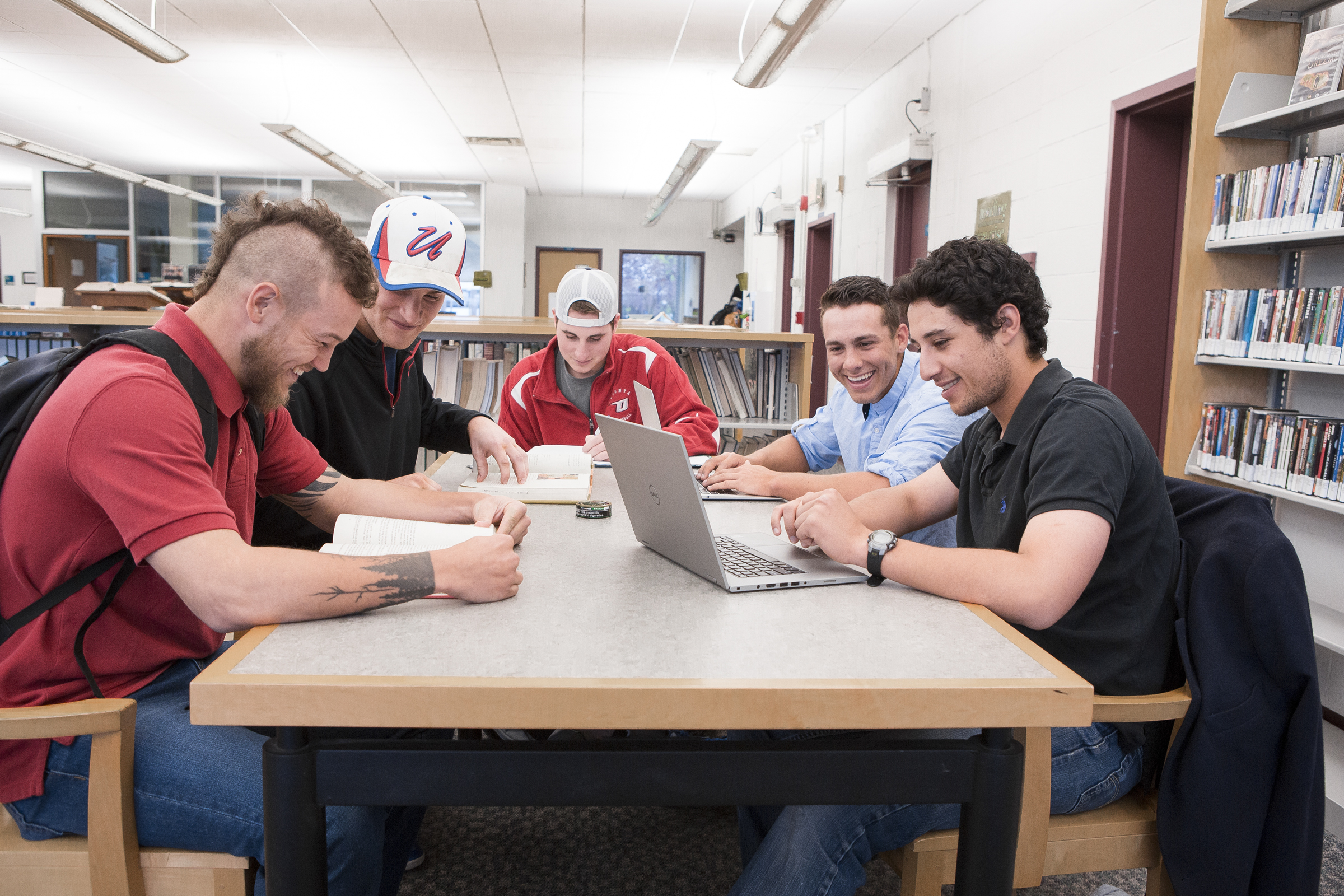
Group of students doing homework together in the library

As final exam pressure begin to mount you may find yourself looking for a place to host a group study group, or rehearse a group presentation without disturbing your peers that may be seeking quiet. Did you know that right here on our SUNY Ulster campus there are rooms you can reserve as a student?

The Macdonald Dewitt LibraryMedia Room (DEW 017) has approximately 24 chairs, a computer, LCD projector, DVD, and VCR player. The projector image is large scale predicted to be “-around 8ft by 10 ft.” by Kari Mack the Director of Library Service. This room is the perfect place to practice any presentations, or group presentations that you and your peers may have.  

At The Macdonald Dewitt Library There are 3 student group study rooms available to be booked: DEW101A – main level next to Circulation Desk, DEW012 – lower level near back exit, Mt View Room – second level adjacent to Catskill Mountain View Room. The Student Group Study Rooms have tables that comfortably seats about 6 people. 

Reservations must be made at least 1 hour in advance. There is a 2 hour time limit for each reservation. Only one reservation may be made per day. When the room is not booked, it will be available on a first-come first-served basis. Dry erase markers and eraser available for checkout at the Circulation Desk.

Step-By-Step-Guide on How to Book a Library Room.

One you have logged on to your SUNY Ulster Portal you will first CLICK Library Resources.

Scroll Down to the sectioned titled Contact the Library and CLICK Book a Room in The Library. From here you can select either the Media Room or Student Study Group Room and CLICK your option.

From here you will be presented with a page that enables you to select the desired date on the calendar. Separate days require separate bookings. 3. Click ‘Continue’ and fill in the required fields. Select ‘Submit My Booking’. To cancel a reservation, use the link provided in your confirmation email.

For more information you can contact the Macdonald DeWitt Library.
Reference Desk: 845-687-5208
Circulation Desk: 845-687-5213
Fax: 845-687-5220
askref@sunyulster.edu
http://www.sunyulster.edu/library/contact.php