Choosing The Right Classes For Your Future.

A bright red apple sits atop a stack of three hard cover books, we cannot see their titles or covers. This display sits atop a table in front of a smoky grey background.

Some people dive into college with set intentions, knowing exactly what they will choose and graduate with, and that’s great! Then there’s the rest of us. It can be hard to fill up your semester’s class schedule. Especially when you aren’t sure where your time and energy would best be spent.

The big idea is to go to college and get a degree. That will give your career (and income) the kick start or boost that you want, right? That initiative alone is all you need to get started. The rest is figuring out what it is you want to study. Then finding a way to make it happen. As they say, where there’s a will there’s a way!

Students with undeclared majors are more common than you might think. The amount of choices can be overwhelming. Courses are often offered on hundreds of different subjects with varying levels of expertise. Some classes are reserved for specific students while others require more courses to be taken first. Navigating the sea of learning can be daunting!

A black and white image of someone's upper abdomen in a sweatshirt as they hold up a large piece of paper over their face depicting a large white question mark.

A study on the “Developmental Disconnect in Choosing a Major” states that an estimated 20 to 50 % of students enter college as “undecided” and an estimated 75 % of students change their major at least once before graduation (Gordon, 1995). So don’t worry, you’re definitely not alone. Turns out a lot of people get frustrated when spinning that big wheel of life. Fortunately, reality doesn’t have to play out like a game show and we have the power to choose the right courses to lead to ultimate success.

It’s completely okay to start without knowing where to begin, most people do!

A very generic picture of a stack of five thick textbooks on a white background

When first starting out, make sure to take some general education (often called “gen ed” on campuses) credits. Every student is required to take these courses regardless of major. They consist of basic knowledge stuff any collegian should know like psychology, algebra, history, etc. It can be a win-win situation; getting these classes out of the way will free up time later on for the good stuff. Not to mention there is potential to fall in love with an area of research.

An extra literature or writing class is always helpful to have under your belt. These skills are used in every class and you’ll want to hone them early on. While signing up for those general classes, be sure to review the college catalog and pick a few courses that seem fun or interesting to take. Once you start those and learn more about them from a professor, you may have found your major!

Background: A man stands in front of a wall almost covered in various pieces of visual art. He seems to be lecturing as he holds his hands in to his chest as if ready to throw them open, next to him appears to be a television. Foreground: Students sit with their head faced away from the camera, watching the man talk, we see the back of their heads.
courtesy of: 祝 鹤槐

An uncommon resource that not everyone thinks of is the professor of the class you might register for. You could always reach out to them and ask any questions you may have that an adviser can’t answer. They are typically happy to help and tend to respond pretty quickly in my experience.

It’s time to plan ahead!

Planning a semester schedule for college classes can be a tricky task. Some people prefer to have all their classes back to back in one or two days a week to coincide with other nonacademic schedules. Some prefer to have only a class or two every day to spread out the work load and study time. As long as you don’t sign up for courses that overlap or occur at the same time, you should be fine. Most colleges have advisers that would make sure that a scheduling faux pas wouldn’t happen anyway. If you have room in your schedule throw in some bonus microcredentials. Make sure to consider factors like distance from your house and your method of transportation. Schedules can be changed in the first few weeks of classes, but planning ahead, so that the first schedule you make will be a good fit, is important and saves a lot of undue hassle.

A weekly planner lays open in a table, the book lays atop a sheer piece of toole next to a scented wax melter and a handful of pens and markers. The book is littered with small posted notes and drawn on with a highlighter over all dates. The right page underneath the weekend says in bold "be happy and smile"
Photo by Bich Tran from Pexels

A good way to make sure you have the most options and opportunities available to you is to register as early as you can. More classes will be presented with available seats for students like you!

A woman stands with her hands held out, throwing glitter at the camera. She holds her head up high and wears a large smile, a graduation cap, and what appears to be a doctors jacket.

Free Tuition With the College Scholars Program

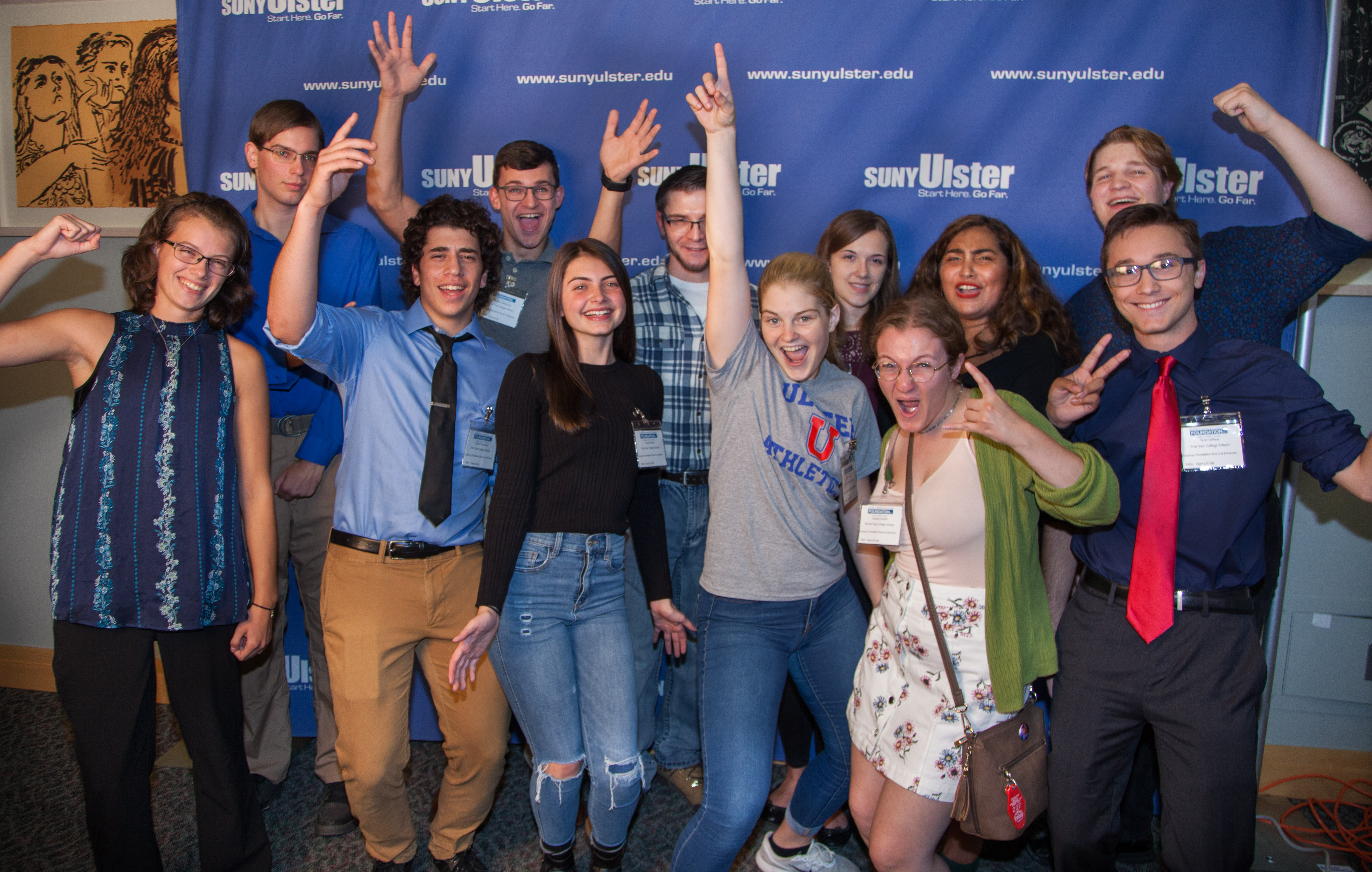
An excited group of twelve students from various ulster county high school hold action poses and smiles.

Getting good grades in high school doesn’t just look good to colleges. It can also get you a free ride to SUNY Ulster with the College Scholars Program. Students who maintain a status in the top 10% of their high school class qualify for free tuition upon getting their diploma.

A fair skinned girl with blonde hair sits in a brick walled reading room. She wears a deep blue hoodie with stars on it and has a pair of green headphones hanging around her neck. She sits at a desk with a pile of books to her left and leaning her head on her hand which is propped on the desk. In front of her she has an open faced, large, hardcover book with a small bright green apple sitting on top of one of the open pages.

College scholars have a significant step ahead of the other students they are joining at college. Not only are they extraordinarily studious and devoted to learning. They’ve also earned the chance to get up close and personal with Dr. Al, our college president. While all other students eventually have the same opportunity, it’s a bit different for these few. College scholars are privy to a small meeting with executives. During which everyone is introduced and the program awards are given out. Their footholds on campus are strong before they start courses since they’ve made like-minded friends ahead of time.

Get Your Head in the Game Early

Mary Sommers was a recipient of this scholarship thanks to her hard work and diligence. Before she became a collegiate, she always made sure to maintain the best grades and study habits. She says, “It’s something that I’ve always worked for; the option to go to SUNY Ulster for free was so important and attainable.” Her family inspired her from a young age to be an excellent student and make the most out of her potential. They’ve given her the foundation she needs to attain her desired masters degree in child development so she can become a guidance counselor one day. As for where she will end up, she says, “I don’t know exactly where it will take me, but it’s going to be far.”

Stay Focused on What’s Important

A dark skinned man sits at a mac computer and holds his hands on the mouse touch pad and keyboard. He is wearing a grey shirt with a dark blue collar, a watch, and has an earring in his right ear. We cannot see his face

Another conscientious college scholar, Bradley Westervelt, currently uses the program’s funding toward his music degree at SUNY Ulster. He realizes that the program has had a big impact on his education and life. He says, “I definitely believe I was able to achieve more as a student because of my tuition being funded by the school. I think SUNY Ulster is a great place to go to college. I’ve had really wonderful teachers and many cool experiences since coming here.” The time Bradley spends at SUNY Ulster is in preparation to transfer. He wants to earn a Bachelor’s degree before starting his career as a music instructor.

Something to Aspire To

So for those of you high school students and parents out there, make sure to keep those grades up and the motivation high! The chance to attend one of the top five community colleges, as ranked by BestColleges.com, is nothing to pass up on. The even bigger opportunity to attend that college for free is certainly something to pursue. Mary summed it up well when she stated: “I strived and worked hard to make it into the program, and I think that anyone can set the same goal. As long as you make your deadlines and do what you need to do, you can do it too.”

See the application here.

a cartoon notepad lays open with two arms laying on top of it, one holding a pen. There is also a cup of coffee present and a white smart phone with a dark blank screen. The notepad is blank.
Photo by Mohamed Hassan from Pixabay

4 Tips to Power Through Textbook Reading

Three walls of books are shown leading up to a bright invisible sky, the book shelves are slightly covered by clouds and books protruding from the sky. It gives the viewer a feeling of standing in a library nook and looking up to see the heavens.

For most students, getting through that weekly textbook reading can be a real challenge. Believe it or not, there are a few ways to make that nonfiction assignment easier. Learning the ways to power through reading that can feel daunting or impossible is a great skill, a skill that is bound to follow you through life wherever you may need it, for another degree or just a relaxed educational reading session. Here are some tips to boost your GPA through the roof with the power of effective studying.

A teal hard covered book is laying with the pages open on a table, as if someone was reading, pictured with two pages folded up and together toward the  seam that looks like a heart. The backdrop is a bold yellow.

#1. Start Your Engines, Prepare to Learn

When sitting down with your book make sure you are ready to learn. You should have a writing tool and some note paper. No one that I’ve ever heard of was sorry that they took too many notes. You want to be ready to learn, but you also don’t want to dive in headfirst. Ease your way into submersion. Preview the topic and material you intend to research. Read the front cover, back cover, the preface, the inner flaps, boldfaced prints, pictures, and diagrams so you are aware of what you’re supposed to learn. You should gather a clear picture of what the text is about, if not, predict what you will be learning. Write your ideas down and see if your initial feeling is right later.

According to Live Your Legend this step is “akin to warming up before a big game.” You wouldn’t hit the field without a good warm up. Why then would you skip these equivalent steps for a research project? Being prepared when you start your research can help you perform better, just like a good stretch! Take the time to prep your brain and your grades will thank you.

#2. Use The Author’s Organization to Understand

Start off by separating the facts from opinion in the text as you read. Remembering that facts are only the stuff that you can prove, opinions just tend to float around and cannot be proven. Finding the facts is a good practice because that’ll likely be where the answers you seek are living.

Four cartoon looking textbooks are shown with various colors and objects on the cover. One shows a math equation, one an atom, one a microscope and the other a simple pattern. No words are visible anywhere.

Next, look at the way the author presents the material, it may be pretty informative. The order of events can vary as well as the style it’s put together in. In biographies and autobiographies, events are usually in chronological order. Other pieces may have an arrangement that is centered around the main idea (a.k.a. the topic you need to learn). If you can pick up on the organization and utilize it, you can predict what will come next. Pick up on the arrangement of info and where the important bits are, what the point is, and what to study for the big test!

#3. Stop, Drop, Summarize

After each section you read you should stop and put the book down for a minute to summarize the main point(s). This not only keeps you from falling asleep from reading the same book for a while, it also sticks that information you just read, but almost forgot, down in your mind.

A portion of a dark table top is pictured with sticky notes, flashcards, highlighters, markers, pencils and pens scattered across it. The office supplies are very brightly colored. There is also a roll of tape and a small compass in the picture.

Another sweet tip: if you create questions to summarize by and put your answers on the other side, it makes the most amazing study flashcards later on. The most bang for your study bucks, I like to say. I don’t know about you, but I like to remember what I read the first time and not have to search the whole book or chapter for answers down the road.

#4. Ask Questions & Analyze Your Work

Two cartoon heads look at each other, the space where their brains should be are filled with a white space. One head has a light bulb in the space and light bulbs rising from the head. The other head has a question mark in the space and more question marks rising up from his head. They could be having a fascinating conversation about reading a textbook.

Go big or go home, right? So finish strong by reaching for that notebook you have nearby and jotting down some thoughts. ASK QUESTIONS! Get those thinking muscles warmed up and actually ponder a little bit about what you just read. Check and see if those initial topic predictions we covered in Step 1 were right. One of my favorite things to do is to go discuss what I just learned with someone and have a good conversation about the subject. They can help provide some questions that might make you want to hop back into reading that book.

This is the ultimate adhesive to your brain for study material. The bread to your test’s butter. One of the more important steps, I assure you.

When you move on to the next section, read and repeat steps 3 & 4. You won’t get lost in timelines and jargon if you understand the chain of events, organization, and topic.

Good Luck!

If things between you and the textbook start to get hairy, take a breather. I’m not suggesting getting lost down the rabbit hole of social media. I am suggesting that you take less than five minutes to relax your mind and refresh your perspective. Get out of your chair, stretch your arms and legs, breath in and out deeply. If you’re not ready to jump back in, try taking a short walk or tidying up the house a bit by completing a chore. Your mood tends to improve with such activities and enables you to jump back into the ring with that textbook and win with a knockout.

Being a student and having to study informational material is not always the most fun thing you have to do, but skirting around the knowledge by only skimming texts will ultimately not benefit you. It might only waste your time, honestly. If you really learn the material, you can’t go wrong.

A cartoon looking man is shown wearing a graduation cap and gown. He points to a piece of paper that looks like a diploma with his left hand and points to a phone with the other. Around his is  circle that has various objects surrounding the man. There is a pen, a tablet with a pencil, another phone with headphones and a small pile of books that will encompass a lot of reading. The background is bright teal and a portion of an atom is shown in one corner, a portion of a gear set is pictured in the opposite bottom left corner.