Food For Thought- The Best Brain Foods For College Students!

person holding shopping basket full of vegetables

As a college student, the temptation and accessibility of energy drinks and fast food can be plentiful. We have put together this post with the best brain foods in mind! Scientific research has produced some pretty interesting data about what the diet of a college student should include.

Remember: Food is Fuel!

Most of these foods totally portable and can be kept in your backpack! These snacks can help keep your mind in tip-top study shape!


Coffee!, Coffee!, Coffee!

https://giphy.com/gifs/garfield-cat-coffee-pzryvxGeykOxeC0fWb

Caffeinated coffee in small dosages can aid in concentration. A “small” serving is about an 8-ounce cup (smaller doses help to avoid the caffeine jitters). So pick up some coffee or even a cup of green tea to fuel up and focus!


Did Somebody Say Chocolate?!

https://giphy.com/gifs/spongebob-season-2-spongebob-squarepants-l3nF1OhBQ4szqrguk

Chocolate specifically speaking dark chocolate helps to “increase blood flow to your brain.” The Cocoa density in dark chocolate “is where you are getting the nutrition and the brainpower” explained Web MD.  Now you’ll never need an excuse to eat chocolate again!


Remember When Your Mom Told You To Eat Your Vegetables?

https://giphy.com/gifs/cheezburger-cute-eating-lhekVSXhExiYo

Turns out Mom was right when she told you to “eat your greens”! Green vegetables such as spinach, asparagus, broccoli, and brussels sprouts just to name a few all provide your body with Folate- this is an essential vitamin that helps your brain function. Mixing up your greens can provide you with a powerful mix of mineral and nutrients!


Bread!

https://giphy.com/gifs/oprah-bread-winfrey-3o7ZeFpK0qqSpsWNsA

Can bread make you smarter? (Well kinda). Whole Grains (yes-even in bread form), pasta, wraps, oatmeal, and even popcorn are all helpful whole grains! Whole grains contain fiber, vitamins, minerals, protein, and antioxidants which are all helpful in your overall mental and physical health.


Blue Berries.

https://giphy.com/gifs/queue-willy-wonka-and-the-chocolate-factory-ZL2zbg8zs5x5e

Blueberries (berries and fruits as a whole) can really pack a punch in supporting your immune system and overall health. Blueberries, in particular, are considered “–One of nature’s perfect foods, blueberries are packed with nutrients that give them their deep-blue color. One study links blueberries to improved learning and memory.”  They are the perfect powerful portable snack- great in yogurt or on their own!

Resources For This Article: 

https://www.webmd.com/food-recipes/features/top-10-smart-foods-college-students#1
https://www.healthline.com/nutrition/9-benefits-of-whole-grains#section2

Utilizing The SUNY Ulster Macdonald Dewitt Library.

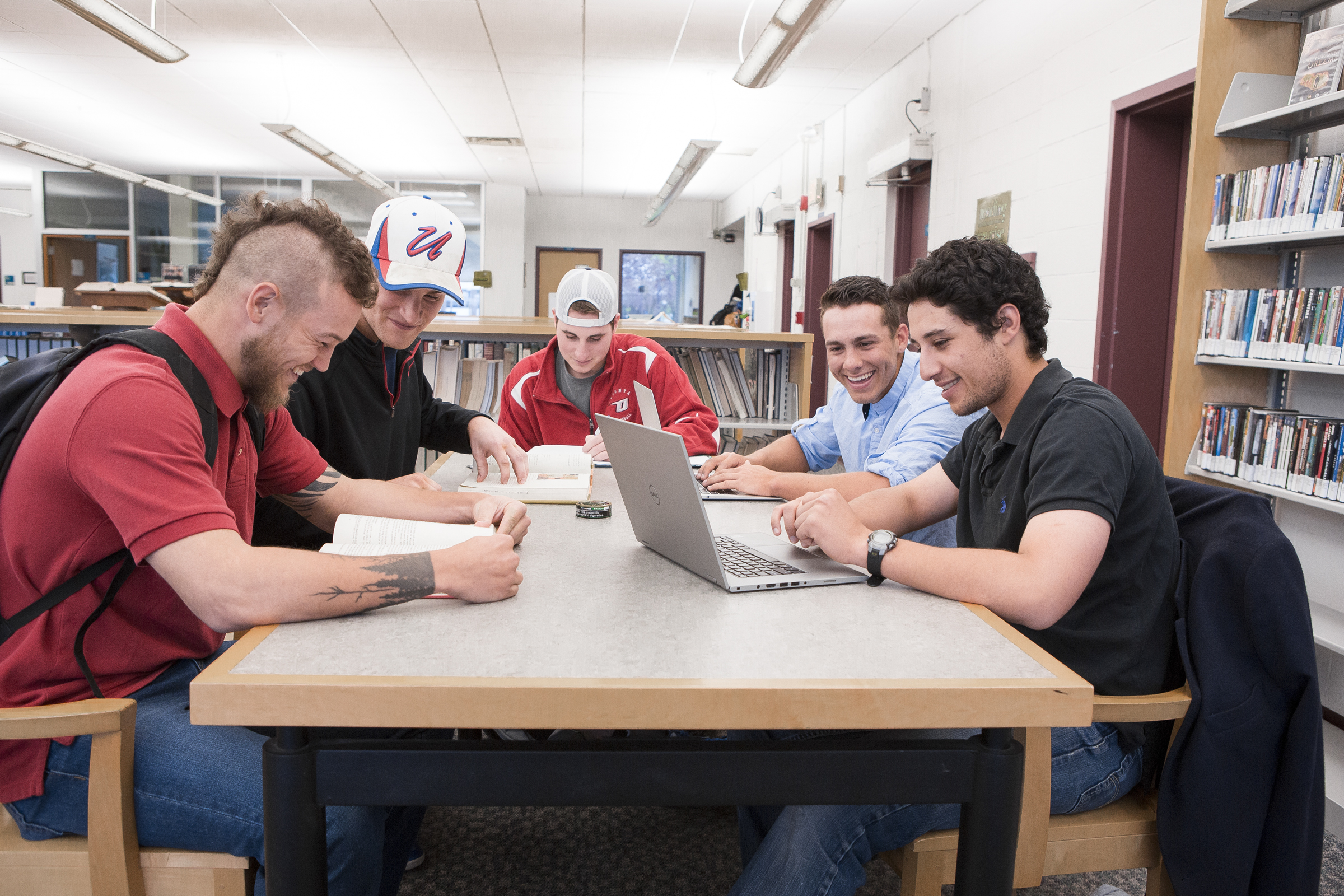
Group of students doing homework together in the library

As final exam pressure begin to mount you may find yourself looking for a place to host a group study group, or rehearse a group presentation without disturbing your peers that may be seeking quiet. Did you know that right here on our SUNY Ulster campus there are rooms you can reserve as a student?

The Macdonald Dewitt LibraryMedia Room (DEW 017) has approximately 24 chairs, a computer, LCD projector, DVD, and VCR player. The projector image is large scale predicted to be “-around 8ft by 10 ft.” by Kari Mack the Director of Library Service. This room is the perfect place to practice any presentations, or group presentations that you and your peers may have.  

At The Macdonald Dewitt Library There are 3 student group study rooms available to be booked: DEW101A – main level next to Circulation Desk, DEW012 – lower level near back exit, Mt View Room – second level adjacent to Catskill Mountain View Room. The Student Group Study Rooms have tables that comfortably seats about 6 people. 

Reservations must be made at least 1 hour in advance. There is a 2 hour time limit for each reservation. Only one reservation may be made per day. When the room is not booked, it will be available on a first-come first-served basis. Dry erase markers and eraser available for checkout at the Circulation Desk.

Step-By-Step-Guide on How to Book a Library Room.

One you have logged on to your SUNY Ulster Portal you will first CLICK Library Resources.

Scroll Down to the sectioned titled Contact the Library and CLICK Book a Room in The Library. From here you can select either the Media Room or Student Study Group Room and CLICK your option.

From here you will be presented with a page that enables you to select the desired date on the calendar. Separate days require separate bookings. 3. Click ‘Continue’ and fill in the required fields. Select ‘Submit My Booking’. To cancel a reservation, use the link provided in your confirmation email.

For more information you can contact the Macdonald DeWitt Library.
Reference Desk: 845-687-5208
Circulation Desk: 845-687-5213
Fax: 845-687-5220
askref@sunyulster.edu
http://www.sunyulster.edu/library/contact.php

Guide to Surviving Midterm Week.

Man working at homework on desk

It may seem hard to believe, but Midterm Week here on campus is quickly approaching!

Over the next few days, you may find yourself wondering how you may ever survive all the projects, and studying that needs to be completed within such a specific span of time!

To survive what may seem like “Midterm Madness” we have put together some of our top tips that can help you get ahead of the game and dominate anything that comes your way!  

Attend Study Sessions.

Attending study sessions is a great way to get a professional and in-depth look at what the upcoming midterm topics. Professors are likely to let similar questions to those on your exams slip during these sessions, and that is an excellent opportunity for you to get a full study experience!

Meet With Your Professors.

Taking advantage of your professors’ office hours as the mid-term looms closer may allow for you get a full analysis on what areas you need to work on, and you may also be able to gauge what topics will be focused on by listening closely to what topics your professor focuses on during your meeting. You can find your professors schedules on their syllabuses, or posted on their office doors.

Stay Healthy.

You may be tempted to pull an all-nighter and spend little to no time preparing healthy food options for yourself. As you increase your brain activity even further this time more than ever your body requires sleep, and nutritious food to keep a clear mind!

Manage Your Time.

As previously stated in our blog post “How to Fight Procrastination this Semester” creating a customized study plan may be an essential part of your success during midterm week. A HUGE part of this is time management- the recommended study session from University of Guelph Learning Commons is studying for 1 hours with a 5-10 break in between.

College Finals Week: No-Fail Ways to Banish Stress

Woman looking anxious with the word stress above her head

With the school year coming to an end and the promise of long, sunny days on the horizon, it’s common for a lot of us college students to get ahead of ourselves and slack off a little towards the end of the semester. The dark and dreary cloud that is “College Finals Week” is enough to vanquish even the most dedicated student. Stress is inevitable, and there might even be tears (especially if you’re opening your textbook for the first time this semester). However, there is no need to fret. Here are six ways you can combat stress during the next two weeks, to ensure a less anxiety-ridden week of cramming for exams, and get the A+ that you so desperately need.

Stress Tip #1: Go To the Study Session/Office Hours

It may not seem important (especially since you could just spend that extra time studying on your own), but study sessions are important because they’re run by your professor and you can count on the teacher to go over the material on the test, as opposed to sitting in the library, staring at your notes and wondering which topics are important. Office hours are even more important because they allow you to have one-on-one time with your professor to go over the most puzzling topics or review a subject over and over without holding back a group session or study group. Be sure to ask what the format of your exam will be. You’d be surprised how much less stress you’ll have when you know exactly what will be on the exam!

Stress Tip #2: Make a Study Plan/Time Block

For the love of all that is holy, make a plan of attack for college finals…and stick to it. It’s so easy to put off tasks until the next day (because how much longer will Gilmore Girls be on Netflix, really) but if you block out your time for the next week, and assign certain tasks to certain blocks, and stick to them, you’d be surprised at how much you get done. For instance, every day I allow myself one hour to review the material and do homework for each class I’m taking. Following that, I’ll then dedicate an extra hour a day to the class that I have an impending test in. You should take note that when you start a task, you should do ONLY that task for the time you’ve allotted yourself. This is a surefire way to focus and get it done.

Stress Tip #3: Go to Bed!

Getting enough sleep is honestly the most important thing when it comes to doing well on your finals. Sleep is vital to survival and it helps the nervous system function properly. Studies reveal that when animals and people fail to get enough sleep concentration, coordination, memory, and mood suffer. You should aim to get at least 7-9 hours of sleep a night. When you get enough sleep, not only do you need less coffee, but you also will do better on your exams. Studies have also shown that getting a full eight hours of sleep after learning a new task, such as a finger-tapping exercise or after studying a long list of words can boost recall the next day. Even a one-hour nap can improve performance on certain tasks, so if an all-nighter is mandatory, try to fit in a nap.

Stress Tip #4: Turn Off Social Media

All Millennials know that social media websites and apps like Facebook (appropriately titled Face Crack by my mom) and Twitter, will suck your soul and your free time away from you. Not only that, but if you get distracted checking a notification during the time that you’re supposed to be studying, the whole afternoon is lost. You might start off the day reviewing your Calculus I notes, but by the end of the hour, you’re watching the Top 20 Cutest Cats Falling off Tables. How you migrated from Instagram to Youtube without a direct link….no one knows. Do yourself a favor and turn off your phone (or at least the notifications to all distracting apps) and if you have access to “Parental Controls” (all MacBook users do), then get your study buddy (or parent) to set some limits for you. Also, cancel your Netflix subscription for the month. Use that money to buy a stress ball.

Stress Tip #5: Eat Nutritious Food (a.k.a. Not refined shugah)

Healthy Food = Healthy Brain. Make sure to eat plenty of foods that are high in nutrients and low in processed crap. Food is considered medicine in a lot of cultures! So, yes, you can really eat your way to health, but you have to stay away from “death in a plastic wrapper”. You know the deal. That means lots of greens, raw fruits and veggies, healthy fats (like nuts and seeds), whole grains, and lean meats. There will be more info on this topic in another blog post, so stay tuned!

Stress Tip #6: Take a Break!

Sometimes, all you need is to just close your books, go outside, and take a break. College finals stress is one of those tricky things, where you feel like you’ll only get rid of it once you complete the task that is stressing you out in the first place. However, that isn’t always the case. If stress is the thing that is keeping you from finishing the stressful task, it always helps to stop what you’re doing and take a break. This can be anything from taking a nap, to going outside and tossing a football around (or, if you can’t throw – lying in the sun.) All of these things will shift your focus out of that internal hole for doom that you put yourself into, and give you some perspective. Often times, I do this when I get the infamous “Writer’s Block.” It’s inevitable, and won’t go away until you close your computer and distract yourself with a different activity. Often times, once you’ve immersed yourself in something else, inspiration strikes!

Getting through Finals -10 Tips for Success

Woman working at finals

Yes, it’s about that time, finals! As a college student, finals are stressful and important. We’re hoping though, these ten tips below, help you be more prepared and less stressed during finals time.

1. Lower your commitments. Don’t take on any extra commitments and even put off any unnecessary social obligations or family commitments. Let your schedule have as much free time as possible within the two weeks leading up to finals. You’ll find you have a lot easier time studying if you make extra time for it. If you’re working, try if at all possible to take 10 days off for final exam period (or at least trim your work schedule). Even a few strategically placed extra hours can make the difference between doing just OK on finals and doing a really great job.

2. Understand your study needs. Some students think they should spend equal amounts of time preparing for each of their finals. Instead, distribute your study time to how hard the final is likely to be and how well you already know the material.

Insider tip: When figuring out when to start studying, count up from the day the study questions are handed out (or if your prof doesn’t do this, a week before the exam) to the day the exam will take place. “Seven days? Then divide the course into sevenths and study two weeks’ worth of lectures each day.”

3. Figure out what’s covered. One of the most important things you need to be clear about is what materials are going to be tested on the final. Are readings and discussion sections included, or is the final going to focus almost exclusively on material from the lectures? Is the final going to concentrate on materials since the midterm or is it going to be a comprehensive or cumulative final? Knowing the extent and the limits of the exam will make it much easier to organize and structure your studying.

4. Find out if you’re answering the big question or a series of smaller questions. Professors have two strategies when making up finals. Some design a single, big question or two; others give a series of more focused questions, each covering some single issue in the course. Before you start studying, make sure you’ve figured out your professor’s test-construction strategy.

5. Understand when to do group study. Many students believe (mistakenly) that a study group always is the best advantage: more brain power plus peer pressure to crack the books. This works well when your study partners are at least as smart as you. Exam time isn’t charity time.

6. Read the instructions—and make a plan. When you get to the exam and get your test sheet, take the time to carefully survey the format of the test. How many questions are you being asked to answer? Is there a choice? How much does each part count? Then make a (tentative) plan—right up front, before you start working—of how much time you’re going to devote to each question.

Insider tip: Don’t waste too much time outlining your answers, writing down formulas you’ve memorized, or (when given a choice) starting a question and then stopping and starting another question. You’re being graded on the quality of your answer, not on notes to yourself or false starts.

7. Be sure to expand your answers fully. Many students don’t realize that, on essay exams, part of what’s being graded is how well you develop and explain your answer, not just how correct it is. Consider explaining your points in more detail so that someone unfamiliar with the answer would know, just from what you say, what the answer is.

8. Don’t panic too soon. In three hours, you’ll probably be confronted with a number of questions of varying degrees of difficulty. There are bound to be ups and downs—times you’re feeling better, and worse, about how the test is going. Ignore such instantaneous feedback. Most tests are designed to have some harder questions, and in any case, such self-evaluation is often wrong.

9. Pace yourself. Two or three hours is a long time. Think of the final exam as a work session, divided into a number of sub-sessions. Take a few minute break between each question or part. Approach each question separately from the rest.

10. Stay until the end. It’s amazing to see, but many students leave before the exam is over. That’s never a good thing to do, since there are always problems to be checked over or essays to be added to or proofread. Even making a single correction to a problem, or adding a single point to an essay (don’t be afraid to pencil a paragraph into the margin or on top of the page), can spell the difference between a good grade and a not-so-good grade.