
Utilizing The SUNY Ulster Macdonald Dewitt Library.
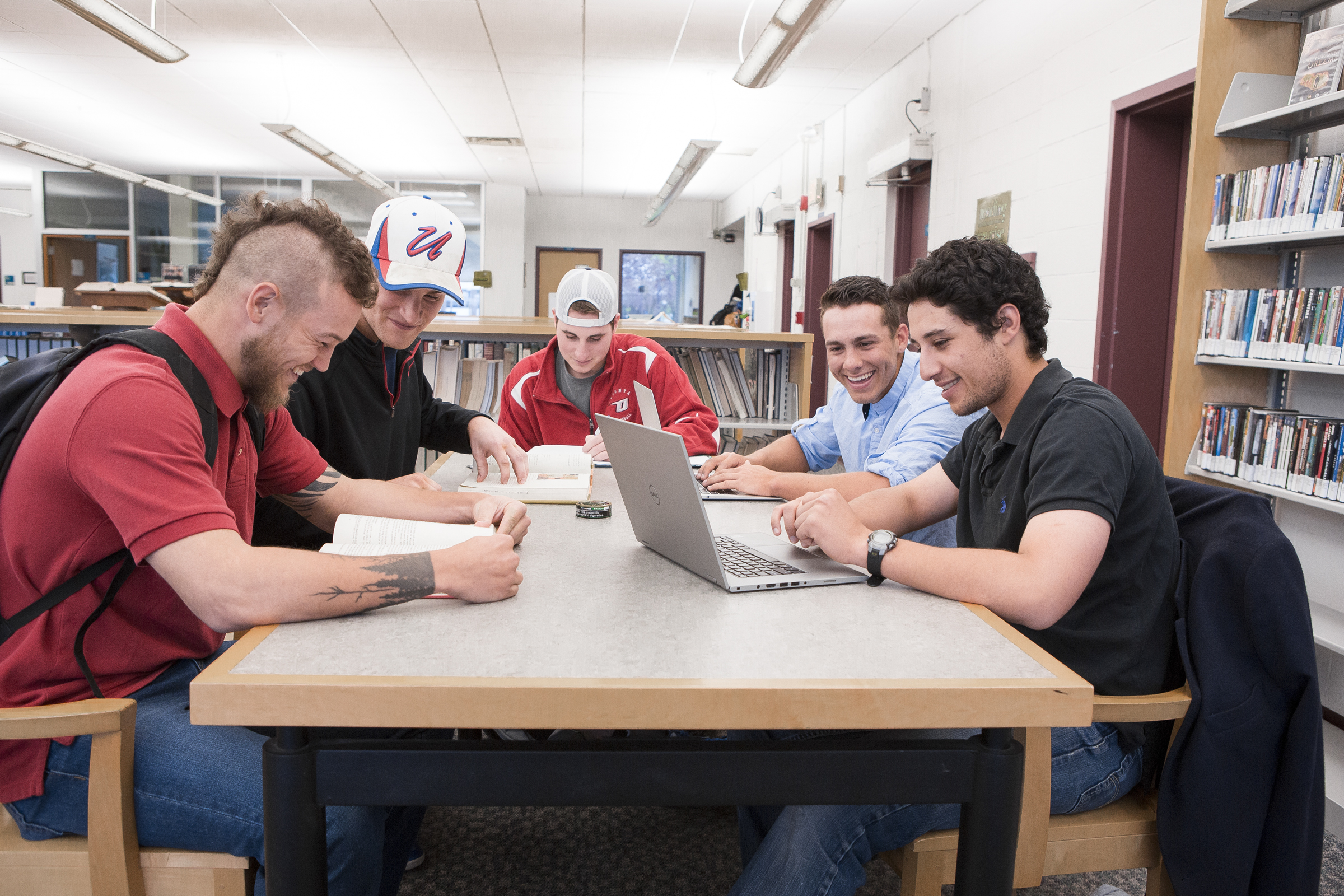
Group of students doing homework together in the library

As final exam pressure begin to mount you may find yourself looking for a place to host a group study group, or rehearse a group presentation without disturbing your peers that may be seeking quiet. Did you know that right here on our SUNY Ulster campus there are rooms you can reserve as a student?

The Macdonald Dewitt LibraryMedia Room (DEW 017) has approximately 24 chairs, a computer, LCD projector, DVD, and VCR player. The projector image is large scale predicted to be “-around 8ft by 10 ft.” by Kari Mack the Director of Library Service. This room is the perfect place to practice any presentations, or group presentations that you and your peers may have.  

At The Macdonald Dewitt Library There are 3 student group study rooms available to be booked: DEW101A – main level next to Circulation Desk, DEW012 – lower level near back exit, Mt View Room – second level adjacent to Catskill Mountain View Room. The Student Group Study Rooms have tables that comfortably seats about 6 people. 

Reservations must be made at least 1 hour in advance. There is a 2 hour time limit for each reservation. Only one reservation may be made per day. When the room is not booked, it will be available on a first-come first-served basis. Dry erase markers and eraser available for checkout at the Circulation Desk.

Step-By-Step-Guide on How to Book a Library Room.

One you have logged on to your SUNY Ulster Portal you will first CLICK Library Resources.

Scroll Down to the sectioned titled Contact the Library and CLICK Book a Room in The Library. From here you can select either the Media Room or Student Study Group Room and CLICK your option.

From here you will be presented with a page that enables you to select the desired date on the calendar. Separate days require separate bookings. 3. Click ‘Continue’ and fill in the required fields. Select ‘Submit My Booking’. To cancel a reservation, use the link provided in your confirmation email.

For more information you can contact the Macdonald DeWitt Library.
Reference Desk: 845-687-5208
Circulation Desk: 845-687-5213
Fax: 845-687-5220
askref@sunyulster.edu
http://www.sunyulster.edu/library/contact.php

Getting through Finals -10 Tips for Success

Woman working at finals

Yes, it’s about that time, finals! As a college student, finals are stressful and important. We’re hoping though, these ten tips below, help you be more prepared and less stressed during finals time.

1. Lower your commitments. Don’t take on any extra commitments and even put off any unnecessary social obligations or family commitments. Let your schedule have as much free time as possible within the two weeks leading up to finals. You’ll find you have a lot easier time studying if you make extra time for it. If you’re working, try if at all possible to take 10 days off for final exam period (or at least trim your work schedule). Even a few strategically placed extra hours can make the difference between doing just OK on finals and doing a really great job.

2. Understand your study needs. Some students think they should spend equal amounts of time preparing for each of their finals. Instead, distribute your study time to how hard the final is likely to be and how well you already know the material.

Insider tip: When figuring out when to start studying, count up from the day the study questions are handed out (or if your prof doesn’t do this, a week before the exam) to the day the exam will take place. “Seven days? Then divide the course into sevenths and study two weeks’ worth of lectures each day.”

3. Figure out what’s covered. One of the most important things you need to be clear about is what materials are going to be tested on the final. Are readings and discussion sections included, or is the final going to focus almost exclusively on material from the lectures? Is the final going to concentrate on materials since the midterm or is it going to be a comprehensive or cumulative final? Knowing the extent and the limits of the exam will make it much easier to organize and structure your studying.

4. Find out if you’re answering the big question or a series of smaller questions. Professors have two strategies when making up finals. Some design a single, big question or two; others give a series of more focused questions, each covering some single issue in the course. Before you start studying, make sure you’ve figured out your professor’s test-construction strategy.

5. Understand when to do group study. Many students believe (mistakenly) that a study group always is the best advantage: more brain power plus peer pressure to crack the books. This works well when your study partners are at least as smart as you. Exam time isn’t charity time.

6. Read the instructions—and make a plan. When you get to the exam and get your test sheet, take the time to carefully survey the format of the test. How many questions are you being asked to answer? Is there a choice? How much does each part count? Then make a (tentative) plan—right up front, before you start working—of how much time you’re going to devote to each question.

Insider tip: Don’t waste too much time outlining your answers, writing down formulas you’ve memorized, or (when given a choice) starting a question and then stopping and starting another question. You’re being graded on the quality of your answer, not on notes to yourself or false starts.

7. Be sure to expand your answers fully. Many students don’t realize that, on essay exams, part of what’s being graded is how well you develop and explain your answer, not just how correct it is. Consider explaining your points in more detail so that someone unfamiliar with the answer would know, just from what you say, what the answer is.

8. Don’t panic too soon. In three hours, you’ll probably be confronted with a number of questions of varying degrees of difficulty. There are bound to be ups and downs—times you’re feeling better, and worse, about how the test is going. Ignore such instantaneous feedback. Most tests are designed to have some harder questions, and in any case, such self-evaluation is often wrong.

9. Pace yourself. Two or three hours is a long time. Think of the final exam as a work session, divided into a number of sub-sessions. Take a few minute break between each question or part. Approach each question separately from the rest.

10. Stay until the end. It’s amazing to see, but many students leave before the exam is over. That’s never a good thing to do, since there are always problems to be checked over or essays to be added to or proofread. Even making a single correction to a problem, or adding a single point to an essay (don’t be afraid to pencil a paragraph into the margin or on top of the page), can spell the difference between a good grade and a not-so-good grade.