Choosing The Right Classes For Your Future.

A bright red apple sits atop a stack of three hard cover books, we cannot see their titles or covers. This display sits atop a table in front of a smoky grey background.

Some people dive into college with set intentions, knowing exactly what they will choose and graduate with, and that’s great! Then there’s the rest of us. It can be hard to fill up your semester’s class schedule. Especially when you aren’t sure where your time and energy would best be spent.

The big idea is to go to college and get a degree. That will give your career (and income) the kick start or boost that you want, right? That initiative alone is all you need to get started. The rest is figuring out what it is you want to study. Then finding a way to make it happen. As they say, where there’s a will there’s a way!

Students with undeclared majors are more common than you might think. The amount of choices can be overwhelming. Courses are often offered on hundreds of different subjects with varying levels of expertise. Some classes are reserved for specific students while others require more courses to be taken first. Navigating the sea of learning can be daunting!

A black and white image of someone's upper abdomen in a sweatshirt as they hold up a large piece of paper over their face depicting a large white question mark.

A study on the “Developmental Disconnect in Choosing a Major” states that an estimated 20 to 50 % of students enter college as “undecided” and an estimated 75 % of students change their major at least once before graduation (Gordon, 1995). So don’t worry, you’re definitely not alone. Turns out a lot of people get frustrated when spinning that big wheel of life. Fortunately, reality doesn’t have to play out like a game show and we have the power to choose the right courses to lead to ultimate success.

It’s completely okay to start without knowing where to begin, most people do!

A very generic picture of a stack of five thick textbooks on a white background

When first starting out, make sure to take some general education (often called “gen ed” on campuses) credits. Every student is required to take these courses regardless of major. They consist of basic knowledge stuff any collegian should know like psychology, algebra, history, etc. It can be a win-win situation; getting these classes out of the way will free up time later on for the good stuff. Not to mention there is potential to fall in love with an area of research.

An extra literature or writing class is always helpful to have under your belt. These skills are used in every class and you’ll want to hone them early on. While signing up for those general classes, be sure to review the college catalog and pick a few courses that seem fun or interesting to take. Once you start those and learn more about them from a professor, you may have found your major!

Background: A man stands in front of a wall almost covered in various pieces of visual art. He seems to be lecturing as he holds his hands in to his chest as if ready to throw them open, next to him appears to be a television. Foreground: Students sit with their head faced away from the camera, watching the man talk, we see the back of their heads.
courtesy of: 祝 鹤槐

An uncommon resource that not everyone thinks of is the professor of the class you might register for. You could always reach out to them and ask any questions you may have that an adviser can’t answer. They are typically happy to help and tend to respond pretty quickly in my experience.

It’s time to plan ahead!

Planning a semester schedule for college classes can be a tricky task. Some people prefer to have all their classes back to back in one or two days a week to coincide with other nonacademic schedules. Some prefer to have only a class or two every day to spread out the work load and study time. As long as you don’t sign up for courses that overlap or occur at the same time, you should be fine. Most colleges have advisers that would make sure that a scheduling faux pas wouldn’t happen anyway. If you have room in your schedule throw in some bonus microcredentials. Make sure to consider factors like distance from your house and your method of transportation. Schedules can be changed in the first few weeks of classes, but planning ahead, so that the first schedule you make will be a good fit, is important and saves a lot of undue hassle.

A weekly planner lays open in a table, the book lays atop a sheer piece of toole next to a scented wax melter and a handful of pens and markers. The book is littered with small posted notes and drawn on with a highlighter over all dates. The right page underneath the weekend says in bold "be happy and smile"
Photo by Bich Tran from Pexels

A good way to make sure you have the most options and opportunities available to you is to register as early as you can. More classes will be presented with available seats for students like you!

A woman stands with her hands held out, throwing glitter at the camera. She holds her head up high and wears a large smile, a graduation cap, and what appears to be a doctors jacket.

Excel with the Honors Program

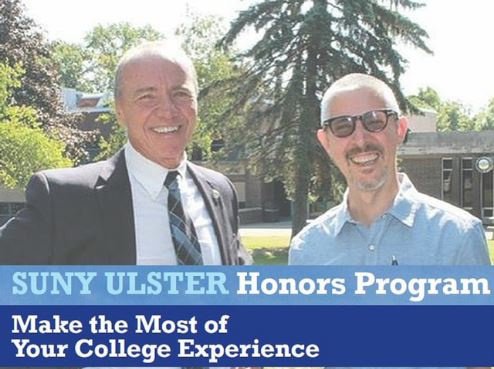
SUNY Ulster Honors Program: Make the Most of Your College Experience

Honors Program Students Jump Ahead of the Pack

SUNY Ulster’s Honors Program provides highly motivated students the opportunity to work closely with professors and other motivated students in advanced level classes that promote critical thinking, analysis, research, writing, communication, and more.

Experience a Different Kind of Learning

Forget about traditional classroom lectures and prepare yourself for active learning. In the Honors Program’s intimate, seminar-style classes, you’ll be asked to share your ideas, present your arguments and engage in lively and probing discussions of both enduring questions and contemporary issues. In Honors, you learn how to learn and think. Instead of textbooks,  primary sources and genuine scholarship are used to study the world’s greatest writers, thinkers, scientists, and critics.

group of students connecting with leadership about honor program
Professor Jennifer Kaufman and Vice President Ann Marrott connecting with current Honors Program students about their experience at SUNY Ulster.

Study with Our Honors Professors

Like our students, our faculty consider participation in the Honors Program to be a privilege. These instructors are committed to sharing their knowledge and intellectual passion with you in both your Honors courses and in personal, informal exchanges outside the classroom. Their fields of expertise span a wealth of disciplines and approaches, from medieval history and ancient languages to astrophysics and contemporary politics.

“The Honors Program at SUNY Ulster has pushed me to pursue my studies at a deeper level.” –Richard Ayers, Current SGO Vice-President and Honors Program student.

More Personal, More Tailored

The program is more personal – you get more one-on-one time and small group time in class, plus professors give a lot of direct feedback throughout your course.

With this more personal approach, students are encouraged to connect directly with each other. That deeper connection has helped create friendships as students discuss coursework among each other.

It is a good, personal experience overall. It connects students who may not, outside of class, have anything in common. They can connect and grow through Honors Program studies.

My favorite things about the Honors Program

Create Lasting Relationships of Value

“One of the best features about participating in the Honors Program is the relationships built between students. We aren’t distracted by a large numbers of students in one room and can really get to know each other on a more personal and academic level. The students are a lot more focused. This has really helped us all feel comfortable with each other.” says Second Semester Honors Program student, Richard Ayers, Liberal Arts Major at SUNY Ulster.”

He adds, “We spend a lot of time in class talking about what we’re studying, plus outside of class we’ve created constant communication methods to gain insights from each other. We also stay connected about things going on in our life outside of the classroom. Even over the summer, we all kept in contact via Facebook and checked in with each other consistently.

The relationships I’ve created with other students will last far past graduation. I’ll be transferring to SUNY New Paltz for creative writing, and as we become alumni and go further into our degree paths and careers, I’m certain our connections will last.”

You really feel like you're a pArt of A

A Cooperative Learning Experience

“Through group discussions and our Facebook group, we’ve developed the communication skills to learn from each other. Instead of the professors talking at us, we get together and discuss the topics and course work. We get to see perspective’ from others experiences that play into what we are studying. Also you’ll find that question you have, other students may have too. One students will ask the professor and share the answer with everyone, this speeds up the learning time in the class so we can stay focused on going forward in our studies.” – Mairead Briggs

Get Involved in the SUNY Ulster Honors Program

Honors Studies are open to students in all programs who meet the criteria for admission. Students who successfully complete 18 credits of Honors-level courses, fulfill the requirements of their academic programs and earn an overall GPA of 3.5 receive the Honors designation at graduation.

You can find out more at: http://www.sunyulster.edu/docs/admissions/honors_flyer.pdf

You can also reach Jennifer Kaufman at kaufmanj@sunyulster.edu.