Excel with the Honors Program

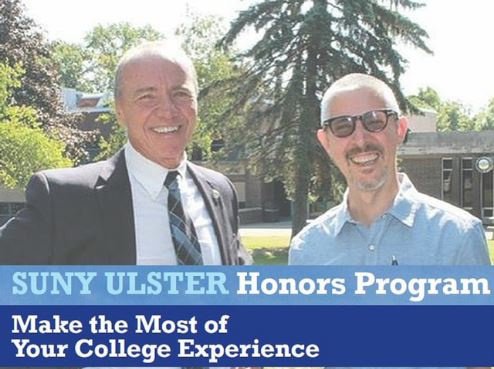
SUNY Ulster Honors Program: Make the Most of Your College Experience

Honors Program Students Jump Ahead of the Pack

SUNY Ulster’s Honors Program provides highly motivated students the opportunity to work closely with professors and other motivated students in advanced level classes that promote critical thinking, analysis, research, writing, communication, and more.

Experience a Different Kind of Learning

Forget about traditional classroom lectures and prepare yourself for active learning. In the Honors Program’s intimate, seminar-style classes, you’ll be asked to share your ideas, present your arguments and engage in lively and probing discussions of both enduring questions and contemporary issues. In Honors, you learn how to learn and think. Instead of textbooks,  primary sources and genuine scholarship are used to study the world’s greatest writers, thinkers, scientists, and critics.
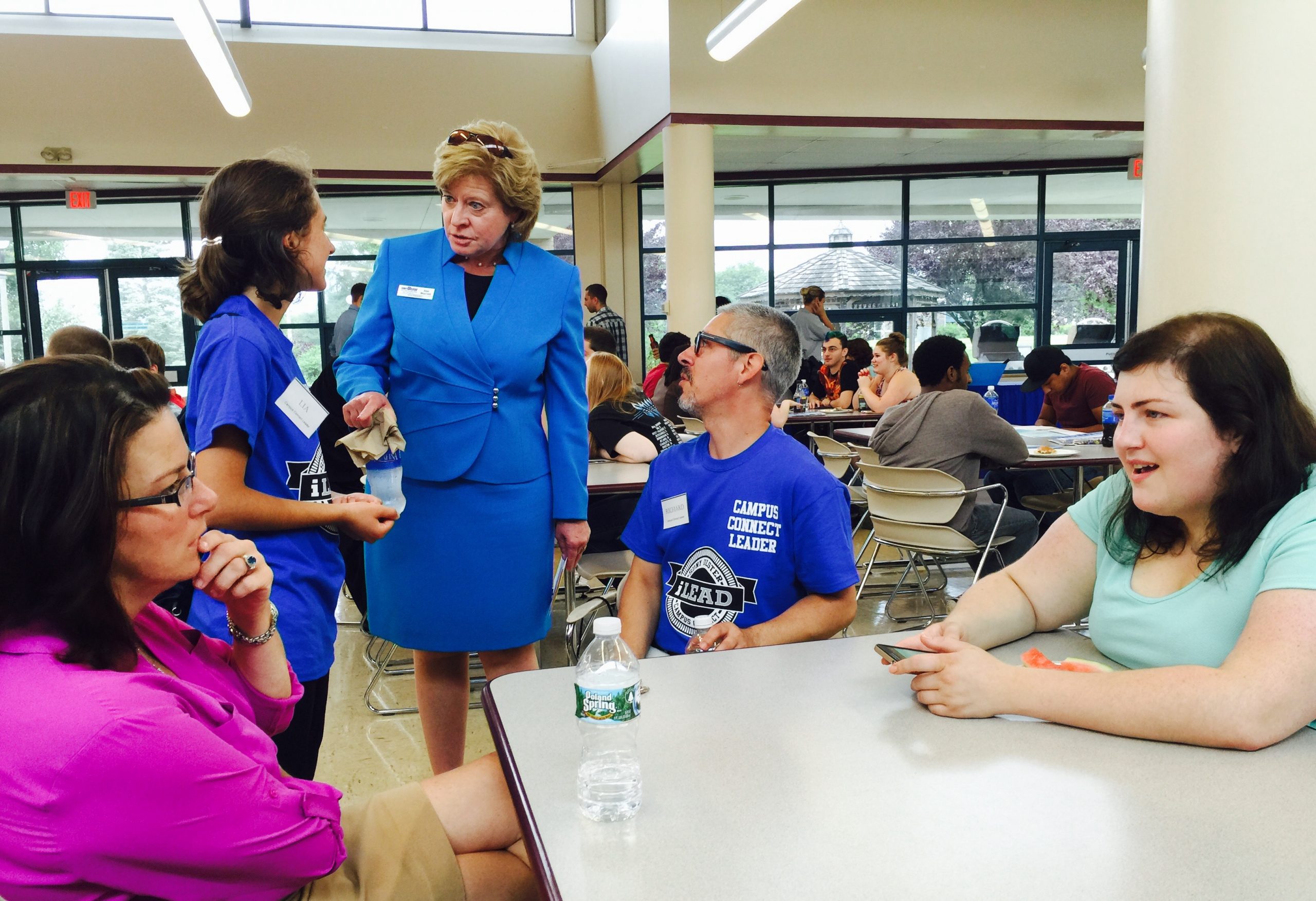
group of students connecting with leadership about honor program
Professor Jennifer Kaufman and Vice President Ann Marrott connecting with current Honors Program students about their experience at SUNY Ulster.

Study with Our Honors Professors

Like our students, our faculty consider participation in the Honors Program to be a privilege. These instructors are committed to sharing their knowledge and intellectual passion with you in both your Honors courses and in personal, informal exchanges outside the classroom. Their fields of expertise span a wealth of disciplines and approaches, from medieval history and ancient languages to astrophysics and contemporary politics.

“The Honors Program at SUNY Ulster has pushed me to pursue my studies at a deeper level.” –Richard Ayers, Current SGO Vice-President and Honors Program student.

More Personal, More Tailored

The program is more personal – you get more one-on-one time and small group time in class, plus professors give a lot of direct feedback throughout your course.

With this more personal approach, students are encouraged to connect directly with each other. That deeper connection has helped create friendships as students discuss coursework among each other.

It is a good, personal experience overall. It connects students who may not, outside of class, have anything in common. They can connect and grow through Honors Program studies.

My favorite things about the Honors Program

Create Lasting Relationships of Value

“One of the best features about participating in the Honors Program is the relationships built between students. We aren’t distracted by a large numbers of students in one room and can really get to know each other on a more personal and academic level. The students are a lot more focused. This has really helped us all feel comfortable with each other.” says Second Semester Honors Program student, Richard Ayers, Liberal Arts Major at SUNY Ulster.”

He adds, “We spend a lot of time in class talking about what we’re studying, plus outside of class we’ve created constant communication methods to gain insights from each other. We also stay connected about things going on in our life outside of the classroom. Even over the summer, we all kept in contact via Facebook and checked in with each other consistently.

The relationships I’ve created with other students will last far past graduation. I’ll be transferring to SUNY New Paltz for creative writing, and as we become alumni and go further into our degree paths and careers, I’m certain our connections will last.”

You really feel like you're a pArt of A

A Cooperative Learning Experience

“Through group discussions and our Facebook group, we’ve developed the communication skills to learn from each other. Instead of the professors talking at us, we get together and discuss the topics and course work. We get to see perspective’ from others experiences that play into what we are studying. Also you’ll find that question you have, other students may have too. One students will ask the professor and share the answer with everyone, this speeds up the learning time in the class so we can stay focused on going forward in our studies.” – Mairead Briggs

Get Involved in the SUNY Ulster Honors Program

Honors Studies are open to students in all programs who meet the criteria for admission. Students who successfully complete 18 credits of Honors-level courses, fulfill the requirements of their academic programs and earn an overall GPA of 3.5 receive the Honors designation at graduation.

You can find out more at: http://www.sunyulster.edu/docs/admissions/honors_flyer.pdf

You can also reach Jennifer Kaufman at kaufmanj@sunyulster.edu.
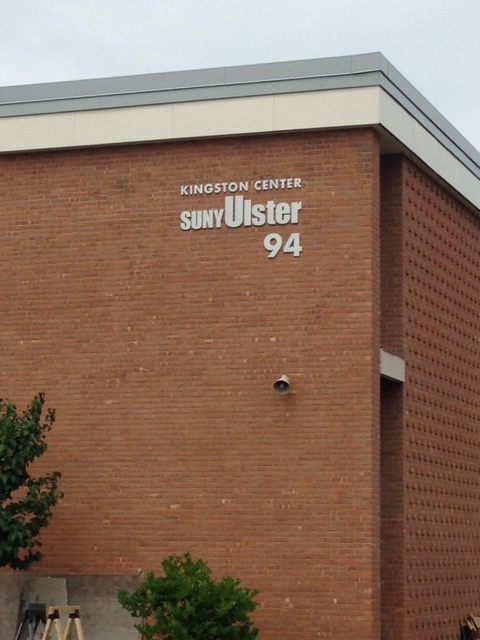
 

Kingston Center of SUNY Ulster Opens 8/18!

Kingston Center building

If you live or work in or closer to Kingston than to Stone Ridge, we have great news for you. After countless months of planning and construction, the new Kingston Center of SUNY Ulster will have its grand opening on August 18th, in time for fall classes!

The Kingston Center will be the new home of our Police Academy, and will also make it possible for many students to fulfill the general education requirements needed for most of our programs at a location closer to them. And, of course, it will also house our noncredit courses.

Some of the nicest aspects of the new building: the glass-enclosed lobby area with a great view of the Catskills and comfy furniture, ecofriendly plantings and walkways, and wifi throughoutdebphone070215 010debphone070215 002debphone070215 013

First-Time Student Leader Makes a Difference

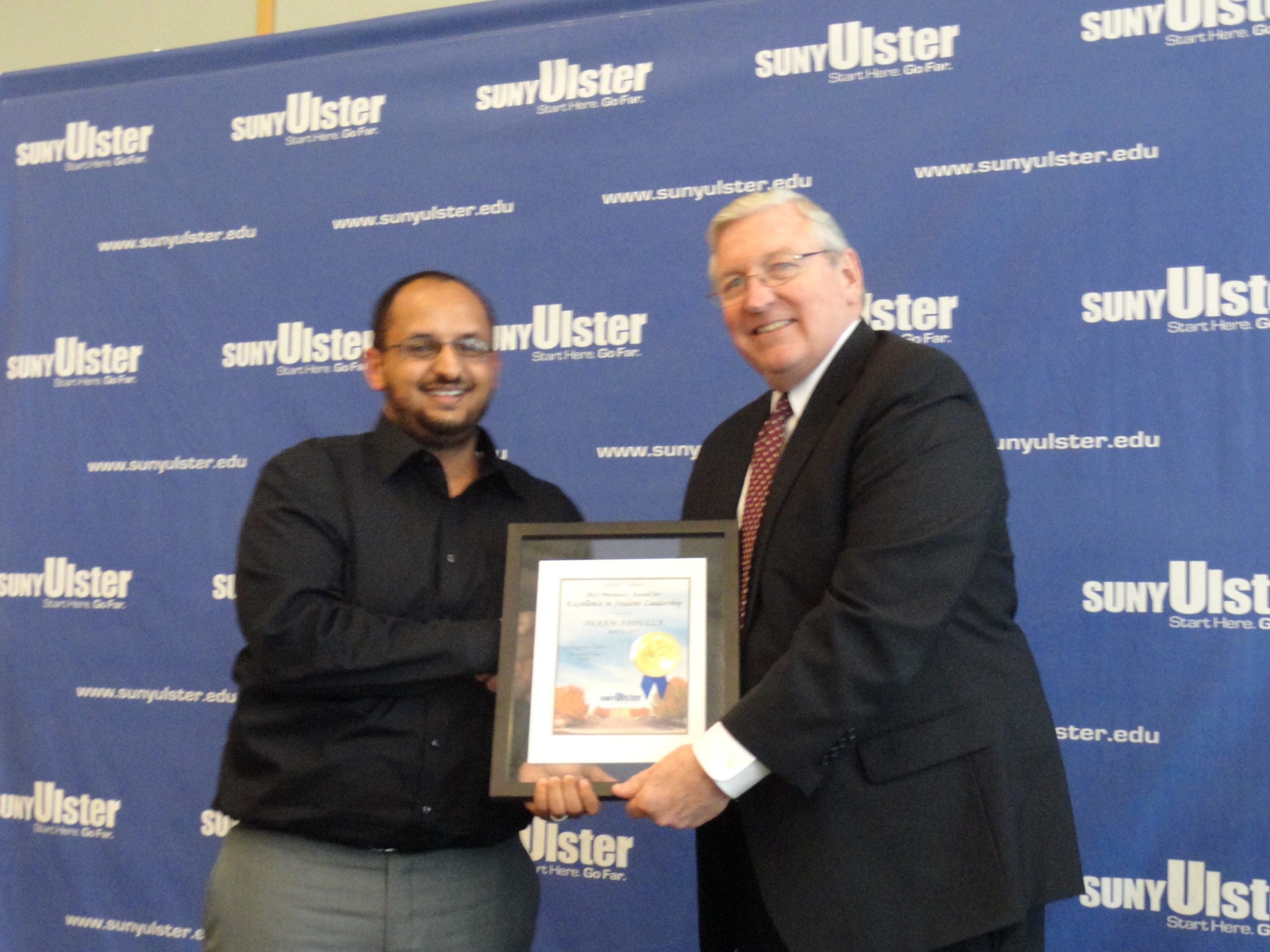
Akram Abdulla receving award from Donald Katt

“I wish SUNY Ulster was a four-year school. I wouldn’t leave to transfer.” Akram Abdulla, business administration major and SGO leader, expected graduation spring 2016

Business administration major Akram Abdulla describes a hero as someone who goes beyond to do good for a greater purpose.

He counts his older brother as well as the professors, faculty and administrators at SUNY Ulster among them.

But those that know him say the word is a description of Abdulla who has selflessly given his time and energy to student government and campus life to make SUNY Ulster a better place. Abdulla is currently serving as Student Government Vice President and previously was SGO Treasurer. He also is a Campus Connect leader.

A first-generation college student born in Yemen who came to the U.S. in 2004, Abdulla, 22, is staying focused on his studies and many involvements on campus – despite worries about the safety of his mother, fiancée and other family he still has in the country that is under seize.

For his many accomplishments, he was recognized with a 2015 President’s Award for Excellence in Student Leadership.

Abdulla enrolled at SUNY Ulster in 2014 after taking time off to work and travel. In a year, he’s come a long way in his leadership – going from never being involved in any extra curriculum activities and being intimidated asking 25 fellow students to sign a petition putting him on his first ballot.

But being in the right supportive environment surrounded by encouraging faculty and friendly students with similar interests motivated Abdulla to take a first step into getting involved in the Business Club and volunteering as the club’s representative to SGO.

“I saw how well connected the students were in SGO and how they had a voice,” he says. “It gave me a purpose.”

The many relationships he forged online with students got him nominated as CEO of the award-winning Collaborative Online International Learning (COIL) project between SUNY Ulster and Fatec Americana in São Paulo, Brazil.

He represented SUNY Ulster at a COIL conference in New York City and the SUNY Student Assembly spring conference in Binghamton. Abdulla even has a voice in who will lead the college’s future as a student representative on the Presidential Search Committee.

Abdulla is putting his leadership skills and business acumen to real-world use in his family’s grocery store, Rondout Market, and plans to transfer to get a bachelor’s degree in business after getting married in October and graduating from SUNY Ulster next spring.

“SUNY Ulster has opened up so many doors that I never thought I could achieve on my own,” he says. “And it is all because of professors and administration that have put student success at the top of their list.”

Fine Arts Student Wins Scholarship to SVA

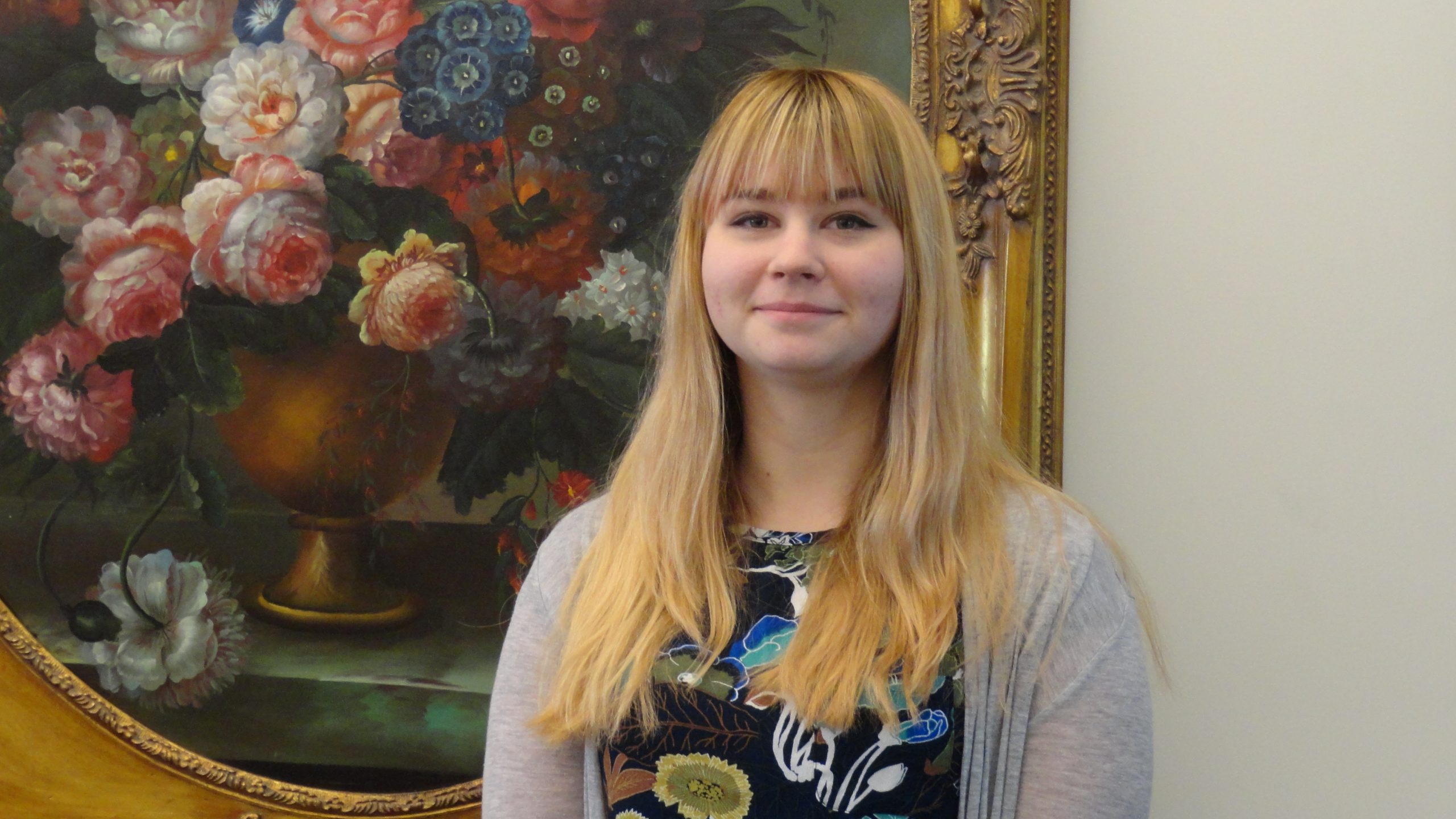
Chelsea Stingel standing in front of painting of flowers

From a young age, Chelsea Stingel wanted to be an artist. But she knew that to get into one of the leading art schools in the country that offered larger scholarships, she would have to build her portfolio.

SUNY Ulster’s Fine Arts Program helped her do just that, earning Stingel a $45,000 scholarship to the School of Visual Arts (SVA) in Manhattan.

Through the college’s new capstone art classes – Advanced Studio 1 and 2 – Stingel got the time to devote to working on independent portfolio pieces in a mentoring environment with professors and peers, which she says made all the difference for her to reach her transfer goals.

SUNY Ulster added the advanced studio offerings two years ago, after hearing feedback from the top art schools that said its students were producing high-quality work but weren’t doing enough independent projects.

Taught by adjunct arts instructor Chris Seubert and Art Department Chair Iain Machell, students learn how to photograph their work (with photographic equipment supplied by a Title 3 mini-grant), create an online portfolio, write an artist’s statement, and create a successful transfer portfolio and application for a four-year college. They also have the opportunity to work with faculty at the Woodstock School of Art through a partnership. Other community colleges now are creating similar portfolio-building classes.

After graduating in May with her Associate’s in Fine Arts, Stingel will enter SVA as a junior in Illustration and have about half of her tuition paid for by the scholarship over three years. She was awed by the artwork she saw at Acceptance Day and is looking forward to the once-in-a-lifetime opportunity to learn from gifted working artists in NYC.

Stingel will pursue a Bachelor’s in Fine Arts in illustration and aspires to work in the commercial side of art doing commissions for movies or games.

The Saugerties resident originally chose SUNY Ulster to make the transition to college life easier and excelled in the fine arts program here.

“I was really impressed with the art program at SUNY Ulster,” she says. “The professors are helpful with our work and easy to talk to outside of class.”

Stingel’s self-portrait currently is on show at the SUNY Spring 2015 Student Art Exhibition at the Plaza Gallery, SUNY Plaza in Albany. This is an exhibition that highlights the projects of art and design programs throughout the SUNY system. Her art work won a further accolade and has been selected for the Best of the Year SUNY Student Art exhibition that will take place at the NY State Museum in Albany in June.

Math Rocks At SUNY Ulster

Group photo of SUNY Ulster's Math Team in 2015

It’s not every day you hear of students volunteering to take tests. But that’s what has happened year after year with the New York State Mathematics Association of Two Year Colleges (NYSMATYC) statewide test.

This year, more than 30 students took the spring exam, continuing a trend of strong interest over recent years. Our team placed 8th in the state and Jacob Arduino came in third overall in the competition, vying against students from 32 other community colleges, including large ones in New York City.

While SUNY Ulster consistently performs high in the rankings and took top honors in the state in 2011-2012, what’s most impressive to the faculty is the voluntary participation. SUNY Ulster Math Professor Jules Albertini couldn’t be prouder of the students and campus culture here that has made math accessible to all and fun.

“These students voluntarily gave their time to work on problem solving skills, test taking strategies as well as mathematics,” said Albertini, also faculty advisor to the Math Club. “They represent a community of learners.”

Students participating were:

Caroline E. Alsdorf, Jacob Arduino, Nolan Bastianelli, Jacob Berryann, Samantha Bruck, Carrigan Buhler, John Campbell, Victoria Cymbal, Paddy Defino, Luke Duffy, Tara Fitzgerald, Juravell Fontes-Janusz, Isaac Goldowitz, Joe Gust, Kevin Hayes, Elyssia Johnan, Lia Krempl, Benson Lam, Sean McCabe, Lauren Mead, Mario Mena, Eric Milczewski, Christian Pavlov, Nathan Potolsky, Nick Ramsell, Christopher Reffelt, Alexis Ricci, Amy Rogers, Dave Rothe, Phway Sandi San, Myles Santiago, Cassidy Schuman, Thiha W. Shein, Brandon Spang, Nicole Spizzo, Ryan Staffiero, Jeremy Tremper, Maxwell Van Kleeck, William Weronick and Nicole Wronkoski.

Vassar Program Bound Student Finds New Opportunites

Michael Mulvey stands in front of white wall

“At SUNY Ulster, I found dedicated professors and TRIO counselors who have taken an interest in my personal well-being and academic success. There’s so much that can be gained in an environment like this,” Michael Mulvey, Media and Communications, Honor’s program, expected graduation spring 2016


Michael Mulvey never dreamed of the future he now sees for himself just two years. A first-time college student at the age of 55, Mulvey of Woodstock will be spending part of this summer at Vassar College as part of the highly selective “Exploring Transfer Program.”

Mulvey learned of his acceptance into the prestigious program on another milestone day – the one-year anniversary of his release from NY state prison on a repeat DWI offense.

Mulvey’s own experiences with the penal/treatment program set him on a path of redemption and personal re-invention that began with pursuing an associate’s at SUNY Ulster.

Now an honors student on the President’s List studying Media and Communications with a concentration in film and video production, Mulvey is seizing every opportunity put before him – and he’s found plenty in this diverse community college setting.

From dedicated and motivating instructors who took a personal interest in his success to pursuing his musical interests in playing bass in the SUNY Ulster Jazz Band, Mulvey has flourished in the small close-knit environment.

A high school dropout, he received student support to get his basic college requirements fulfilled for admissions and credits the counselors at TRIO Student Support Services for their tremendous support.

For his accomplishments, he also has received a TRIO award for student excellence.

Seeking Legal and Social Justice

When SUNY Ulster’s Honors Program coordinator Jennifer Kaufman, put the Vassar program before her students to apply, Mulvey was immediately intrigued by a course being offered on “Legal Justice, Social Justice: The Politics of Imprisonment.”

The essay about his own experiences flowed easily and formed an early idea for a thesis. A recovering alcoholic who struggled with dependency issues while on disability as an operating engineer in New York City’s building trade, Mulvey believes the state should devote more resources to education than prisons.

His goal is to apply what he learned as a negotiator and shop steward during 25 years in the labor movement to the political process as a media consultant and filmmaker. “I see new media and Social Media platforms as grass roots political mobilization tools with the ability to reinforce the social contract and invigorate our faltering democracy,” he says.

Mulvey credits Dr. Ray Raymond, Associate Professor of Government and History, as serving as his academic advisor and a mentor. He aspires to transfer to a four-year college to pursue Communications and Government, and apply his knowledge to the American political process.

Vassar Opportunity

The Vassar Exploring Transfer program is designed to introduce first-generation community college students from underrepresented populations to the possibilities of transfer to a wide range of four-year colleges and universities.

Over five weeks, Mulvey will take six credits of interdisciplinary liberal arts courses and live in the residence hall at the Poughkeepsie liberal arts campus. His scholarship completely covers tuition, room, board, books and all other supplies.

Mulvey wants to help other college students to focus on the opportunities before them while they can, and also serve as positive role model for his 22-year-old daughter, Alexandra. “As a parent, I can show her how people can redeem themselves when they make mistakes,” Mulvey says.

“Start here, go far is a motto for anyone at any place in their life,” he says.

Engineering Student Wins Clarkson Transfer Scholarship

Jacob Berryann stands in front of white wall

Starting at SUNY Ulster has paid off big for Jacob Berryann who has earned Clarkson University’s Transfer Leadership Award, the University’s highest honor.

The excelling engineering student from Kerhonkson will receive $15,000 per year to attend the tech university in Potsdam. Berryann says he was initially speechless and then ecstatic when he learned of the award.

Berryann credits Director of Transfer Kate Smith for opening his eyes to considering transferring to Clarkson or Rensselaer Polytechnic Institute (RPI), and his engineering professors, including Dr. Robert Cassidy, for giving him a good foundation in organic chemistry needed for his future studies in chemical engineering.

“A lot of students look past community colleges,” he says. “Community colleges are an experience you can’t get anywhere else. There’s a close atmosphere at SUNY Ulster and it’s easy to connect with anyone on campus.”

Berryann is looking forward to getting good exposure to the chemical and biomedical engineering fields at Clarkson and wants to one day own his own plant or business. He also aspires to play lacrosse at the college.

Both Berryann and his older sister, Kelsey, came to SUNY Ulster through the College Scholars Program that provided full-tuition for ranking in the top 10 percent of their graduating classes at Rondout Valley High School. Alum Kelsey, 2012, transferred to SUNY Cortland and is pursuing a teaching career.

A member of Phi Theta Kappa, Berryann was involved with the chess, math and physics clubs. He also has volunteered at the Rochester Reformed Church, where he sings in the church choir, and coaches boys and girls in the Kerhonkson Basketball Association (KBA).


Getting through Finals -10 Tips for Success

Woman working at finals

Yes, it’s about that time, finals! As a college student, finals are stressful and important. We’re hoping though, these ten tips below, help you be more prepared and less stressed during finals time.

1. Lower your commitments. Don’t take on any extra commitments and even put off any unnecessary social obligations or family commitments. Let your schedule have as much free time as possible within the two weeks leading up to finals. You’ll find you have a lot easier time studying if you make extra time for it. If you’re working, try if at all possible to take 10 days off for final exam period (or at least trim your work schedule). Even a few strategically placed extra hours can make the difference between doing just OK on finals and doing a really great job.

2. Understand your study needs. Some students think they should spend equal amounts of time preparing for each of their finals. Instead, distribute your study time to how hard the final is likely to be and how well you already know the material.

Insider tip: When figuring out when to start studying, count up from the day the study questions are handed out (or if your prof doesn’t do this, a week before the exam) to the day the exam will take place. “Seven days? Then divide the course into sevenths and study two weeks’ worth of lectures each day.”

3. Figure out what’s covered. One of the most important things you need to be clear about is what materials are going to be tested on the final. Are readings and discussion sections included, or is the final going to focus almost exclusively on material from the lectures? Is the final going to concentrate on materials since the midterm or is it going to be a comprehensive or cumulative final? Knowing the extent and the limits of the exam will make it much easier to organize and structure your studying.

4. Find out if you’re answering the big question or a series of smaller questions. Professors have two strategies when making up finals. Some design a single, big question or two; others give a series of more focused questions, each covering some single issue in the course. Before you start studying, make sure you’ve figured out your professor’s test-construction strategy.

5. Understand when to do group study. Many students believe (mistakenly) that a study group always is the best advantage: more brain power plus peer pressure to crack the books. This works well when your study partners are at least as smart as you. Exam time isn’t charity time.

6. Read the instructions—and make a plan. When you get to the exam and get your test sheet, take the time to carefully survey the format of the test. How many questions are you being asked to answer? Is there a choice? How much does each part count? Then make a (tentative) plan—right up front, before you start working—of how much time you’re going to devote to each question.

Insider tip: Don’t waste too much time outlining your answers, writing down formulas you’ve memorized, or (when given a choice) starting a question and then stopping and starting another question. You’re being graded on the quality of your answer, not on notes to yourself or false starts.

7. Be sure to expand your answers fully. Many students don’t realize that, on essay exams, part of what’s being graded is how well you develop and explain your answer, not just how correct it is. Consider explaining your points in more detail so that someone unfamiliar with the answer would know, just from what you say, what the answer is.

8. Don’t panic too soon. In three hours, you’ll probably be confronted with a number of questions of varying degrees of difficulty. There are bound to be ups and downs—times you’re feeling better, and worse, about how the test is going. Ignore such instantaneous feedback. Most tests are designed to have some harder questions, and in any case, such self-evaluation is often wrong.

9. Pace yourself. Two or three hours is a long time. Think of the final exam as a work session, divided into a number of sub-sessions. Take a few minute break between each question or part. Approach each question separately from the rest.

10. Stay until the end. It’s amazing to see, but many students leave before the exam is over. That’s never a good thing to do, since there are always problems to be checked over or essays to be added to or proofread. Even making a single correction to a problem, or adding a single point to an essay (don’t be afraid to pencil a paragraph into the margin or on top of the page), can spell the difference between a good grade and a not-so-good grade.

Three Sisters Get College Start at SUNY Ulster

The Hart sisters stand with arms around each other

While they have different career plans, sisters Jacquelyn, Chelsea and Brooke Hart from New Paltz agree on the value of starting their education at SUNY Ulster.

With three attending college at the same time and being raised by a single mother who is a veteran and works for the New Paltz Police Department, SUNY Ulster’s low tuition was a key factor in their decision.

But they each also chose SUNY Ulster for its quality education, campus activities, connections and transfer opportunities.

“I chose SUNY Ulster because it is affordable while offering a great educational opportunity,” said the oldest sister Jacquelyn, who will graduate this year.

Jacquelyn, who also works at the College’s Learning Center, plans on transferring to SUNY Buffalo or SUNY New Paltz to study communications and journalism.

The second sister, Chelsea, is pursuing Environmental Studies with plans to go to SUNY Environmental Science and Forestry in Syracuse after earning her associate’s here in May 2016.

“SUNY Ulster was the best idea for me because it is more affordable and studying here will give me a stronger foundation in my studies before transferring to a four-year college,” Chelsea said.

Both Jacquelyn and Chelsea have been active in SUNY Ulster’s Chess Club, serving as treasurer and secretary, respectively.

The youngest, Brooke, is following his sisters’ paths. She will enroll in the fall after graduating from New Paltz High School with similar career aspirations as Chelsea to better the environment.

“I am choosing SUNY Ulster because it offers a wide variety of opportunities to its students in terms of professional connections and extracurricular activities, and it is very affordable,” said Brooke, who wants to become an environmental engineer.

Having all the sisters on campus on the same time will be enjoyable for this close-knit family who is going places. “It will be fun to share the college experience with both of my sisters while also being there to support each of them through the process,” Chelsea said.


The Skinny on Scholarship Success

Student accepting award at the 2011 Scholarship Ceremony

Tips from Our Coordinator of the Scholarship Program

Overwhelmed about the thought of applying for scholarships and think you won’t win one anyway? Think again. Burnelle Roser, Associate Director & Coordinator of the Scholarship Program, shares some of the basics about scholarships that will show you how easy it really is and get you applying before you miss out on some great opportunities.

Who: You! Each year, the Ulster Community College Foundation awards over $180,000 in scholarships to more than 200 students. You might think thousands are applying and you don’t have a chance. In fact, only a small percentage of students apply so your chances are good. Scholarships are open to new students entering SUNY Ulster, returning students and those transferring to four-year colleges. “Every single student should apply,” says Burnelle.

When: Right now! The time to start thinking about scholarships for the Spring 2016 semester is December/January. The Foundation’s general scholarship application deadline for SUNY Ulster students is Feb. 6, 2015. Don’t miss out. All the deadlines are on the portal in the “Student Resources” section under “Scholarships.”

How: SUNY Ulster students should fill out the general application and essay to be considered for scholarships administered by the Foundation. You don’t have to pick and choose the ones you want to be considered for. We’ll do it for you. “Our goal is to connect students to as many of the 200 different criteria as we can,” she says. The general application is available in two formats – an electronic PDF that can be completed on a computer or a printable form. Both versions are available at:   www.sunyulster.edu/foundation/scholarships/applications.

Why: Why not? We’re talking FREE money for college that doesn’t have to be paid back. With awards generally ranging from $500 to full tuition, it’s worth the few hours it may take to apply.

Remember to meet the deadlines, carefully follow all the instructions, answer the questions as candidly as possible and go for it! Stay tuned for more scholarship tips here.

Senator Mascot 3