Writing A Great College Transfer Essay

Hands typing on a laptop

Many upcoming graduates are trying to get into their desired four-year schools before their last semester at Ulster begins. While GPAs and letters of recommendation are important, the deciding factor in students getting accepted is the admissions essay. Considering that many students may have never written one before, here are a few tips on how to craft an essay that will earn that coveted acceptance letter.

Focus On the Main Prompt

Many admissions essays have one or more prompts for you to answer. If there isn’t a main prompt, typically you should address why the college is right for you. To help with this, be sure you stick to the required word count. If there isn’t one given, a common range is 250-1000, with the ideal being 400-700. Organize by paragraphs appropriately. No matter what the prompt is, you should be able to make it unique to you and your experiences.

Write in a Natural and Engaging Way

The people reading your admissions essay will naturally expect professionalism and proper grammar, but remember that you also need to make your essay unique and absorbing. This shouldn’t read like a term paper. Use conversational, effective language. It should sound natural and showcase you in some way. Remember, you’re essentially selling your value as a student to them. Use description and examples to engage the readers. Personal anecdotes relevant to the prompt, especially in the introduction, can be a great way to hook the readers and give them a good picture of you. Be honest about why you want to attend and why you think their school is right for you.

Revise, Edit, Proofread

You can’t be too careful with this part of the writing process, as you know already as a college student. If you’ve let your writing flow and stuck to the prompt, you will often have to trim off a number of words. Edit your essay to be impactful and to the point. It’s then important to proofread, since you will be expected to have mastered English 101 style during your time at Ulster. Asking someone else (or multiple people) to proofread the paper and give you their opinion can also be helpful.

What’s After Ulster? How to Find a Transfer College

Group of students in cafeteria leaning over a laptop

It’s nearing springtime again, and, for some of you, that means graduation. But then what? If you’re in a program that requires a bachelor’s or higher for employment, it means finding another college. How do you find that college? How do you know if it’s the right one? Even if you have a dream college you know you want to go to, how do you find back-up options? Hopefully, this post will be helpful in getting you started.

Find Out What’s Available

The best way to start is by doing a Google search of colleges good for your desired major. You probably already have a decent idea of what size and location you would like, so just those three parameters can narrow your options down considerably. Once you have a list, talk to people who know the schools about their experiences. They can be friends, family, and advisors or professors from both Ulster and the schools you’re looking at. Ask people you might not think to ask, like the school’s alumni, employers in your chosen field, and people who transferred out of the school (that’s a big one, find out why they did). Remember not to depend on one particular person’s testimony too much when making decisions though, since in the end the choice is about you and your needs.

The Big Questions

There’s many important things to keep in mind when finding a school and applying, and many are the same as what you already discovered at Ulster: How much will it cost? How much financial aid will you get? Are there scholarships? If you’re a commuter, how much does a parking permit cost? How will your classes from Ulster transfer into the other school’s program? Are the professors good? What are the classes like? How difficult is it to get in? How much will it cost just to apply? By the time you get through them all, you will probably want to throw the whole idea of transferring out the window, but you don’t have to! Colleges will be more than happy to answer all of your questions and assist you with the process. Often they have brochures and tours that will help answer most, if not all, of these questions. If some branches of the college’s admissions department are less helpful than others, don’t be afraid to push for information. It’s your money and your time that will be on the line; you deserve answers.

Does the School Really Fit?

You’ve done your research. You know how good the school is for your major, you’ve talked to a few people who know the school, maybe you’ve even gone and talked to some admissions people. Now here comes a really important part: finding out if the school suits YOU. It doesn’t matter if you’re taking all online classes, going as a commuter, or living on campus, you need to know more about the school itself. Visit! Sometimes, a school will just feel right (or very not). Colleges offer guided tours around campus, both one-on-one and in a group. Many schools offer a shadow program, where you can follow a student around for a day and attend classes with them. This is obviously the ideal situation, as it will give you a real idea of what classes, students, and professors are like at your school. A school can sound great on paper and in pictures, but when you’re actually there, you might find that the “great professors” might be very boring and stuffy, the “83,000 square foot library” could have an exceptionally small amount of books, and the “welcoming commuter lounge” could be a barren corner of the basement that frequently gets used for testing. Know before you commit!

Crunch Time! The College Application

Once you’ve found a few schools you know you’ll be happy attending, it’s time to start applying! Fun fact: did you know there’s an easy, free application that you use as an Ulster graduate when applying to any of the SUNY schools? If a SUNY school is on your list to apply to, that will prove an excellent savings. Don’t forget to apply to several; even if it seems expensive in the moment. Not only could you not be accepted to your favorite one, in addition, after accepting an offer from one, you could still find out that it’s the wrong choice during the enrollment stage. Leave options for yourself.

Remember the Value of Your Decision

Lastly, my personal tip as a transfer student may seem a bit obvious, but I’ll tell it anyway. Try your best to find and go for a place you truly want to attend. In the end, it’s years of your life that you can’t get back. And college should be so much more than just getting that piece of paper at graduation; during your junior year, senior year, and beyond, it’s the opportunities through internships, travel, networking with professors and students, and just plain old friendships that make college great. These things can change the course of your life. Do your best to make a decision that counts.

You’re Not Alone!

No matter what stage of the transferring process you’re in, don’t forget that we have a SUNY Ulster Transfer Office devoted to helping you succeed! Contact Kate Smith at smithk@sunyulster.edu for more information, and stop by her office in Vanderlyn 128C to get help with any transfer problems or concerns you may be having.


Excel with the Honors Program

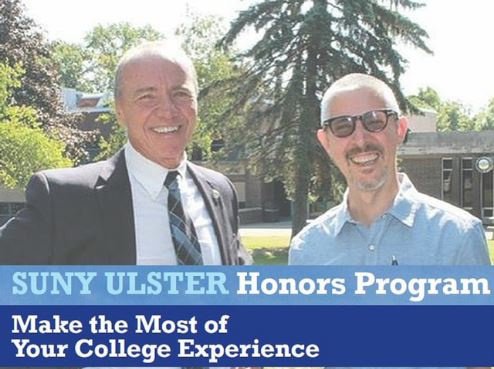
SUNY Ulster Honors Program: Make the Most of Your College Experience

Honors Program Students Jump Ahead of the Pack

SUNY Ulster’s Honors Program provides highly motivated students the opportunity to work closely with professors and other motivated students in advanced level classes that promote critical thinking, analysis, research, writing, communication, and more.

Experience a Different Kind of Learning

Forget about traditional classroom lectures and prepare yourself for active learning. In the Honors Program’s intimate, seminar-style classes, you’ll be asked to share your ideas, present your arguments and engage in lively and probing discussions of both enduring questions and contemporary issues. In Honors, you learn how to learn and think. Instead of textbooks,  primary sources and genuine scholarship are used to study the world’s greatest writers, thinkers, scientists, and critics.

group of students connecting with leadership about honor program
Professor Jennifer Kaufman and Vice President Ann Marrott connecting with current Honors Program students about their experience at SUNY Ulster.

Study with Our Honors Professors

Like our students, our faculty consider participation in the Honors Program to be a privilege. These instructors are committed to sharing their knowledge and intellectual passion with you in both your Honors courses and in personal, informal exchanges outside the classroom. Their fields of expertise span a wealth of disciplines and approaches, from medieval history and ancient languages to astrophysics and contemporary politics.

“The Honors Program at SUNY Ulster has pushed me to pursue my studies at a deeper level.” –Richard Ayers, Current SGO Vice-President and Honors Program student.

More Personal, More Tailored

The program is more personal – you get more one-on-one time and small group time in class, plus professors give a lot of direct feedback throughout your course.

With this more personal approach, students are encouraged to connect directly with each other. That deeper connection has helped create friendships as students discuss coursework among each other.

It is a good, personal experience overall. It connects students who may not, outside of class, have anything in common. They can connect and grow through Honors Program studies.

My favorite things about the Honors Program

Create Lasting Relationships of Value

“One of the best features about participating in the Honors Program is the relationships built between students. We aren’t distracted by a large numbers of students in one room and can really get to know each other on a more personal and academic level. The students are a lot more focused. This has really helped us all feel comfortable with each other.” says Second Semester Honors Program student, Richard Ayers, Liberal Arts Major at SUNY Ulster.”

He adds, “We spend a lot of time in class talking about what we’re studying, plus outside of class we’ve created constant communication methods to gain insights from each other. We also stay connected about things going on in our life outside of the classroom. Even over the summer, we all kept in contact via Facebook and checked in with each other consistently.

The relationships I’ve created with other students will last far past graduation. I’ll be transferring to SUNY New Paltz for creative writing, and as we become alumni and go further into our degree paths and careers, I’m certain our connections will last.”

You really feel like you're a pArt of A

A Cooperative Learning Experience

“Through group discussions and our Facebook group, we’ve developed the communication skills to learn from each other. Instead of the professors talking at us, we get together and discuss the topics and course work. We get to see perspective’ from others experiences that play into what we are studying. Also you’ll find that question you have, other students may have too. One students will ask the professor and share the answer with everyone, this speeds up the learning time in the class so we can stay focused on going forward in our studies.” – Mairead Briggs

Get Involved in the SUNY Ulster Honors Program

Honors Studies are open to students in all programs who meet the criteria for admission. Students who successfully complete 18 credits of Honors-level courses, fulfill the requirements of their academic programs and earn an overall GPA of 3.5 receive the Honors designation at graduation.

You can find out more at: http://www.sunyulster.edu/docs/admissions/honors_flyer.pdf

You can also reach Jennifer Kaufman at kaufmanj@sunyulster.edu.