Start Your Own Business After Your Studies

A person sits at a desk with a laptop, two books and a cell phone on the table

Originally Written by

Kayleigh Alexandra
Microstartups.org

Starting a business is a goal that lots of students share while they are getting their degree. Some have the fire and motivation to make their dream business a reality. Students who complete college to continue onto the path of entrepreneurship are bold path blazers, at least they have to be to make it out there.

After trials and tribulations, the excitement of learning, the stress of exams, and the enrichment of social exploration, your studies will inevitably come to an end (as all good things do). For many, this stage of life is intimidating, if not terrifying. The familiar foundation disappears from beneath your feet, and you drop into uncharted waters — unsure where to go.

Still, it isn’t a time for fear or despair. It’s a time for exploration! Everything prior to that point is preparation intended to build your mind and spirit. Making you into someone with the strength and character to earn the kind of life you want. You’ve already shown you have what it takes to get ahead when you finish your studies.

Your future is for you to decide, so consider all of the available options. Maybe you want a comfortable position, or there’s a company you want to work with. Then set a goal and start moving toward it as soon as possible, maybe now.

Or perhaps you’re like many people today and want to work for yourself; being able to set your own schedule, profit fully from your hard work, and never have to deal with a boss. If so, you’re in luck, because it’s never been easier to start your own business. Read on for some tips on doing just that.

Come Up With A Workable Business Concept

A group of six people sit around chatting about ideas in an office area.

This step is far easier said than done; so much so that plenty of people will never get past it. You need to think of a product or service that you can offer – and profit from selling. You can sell almost anything at a loss, so don’t assume an idea is solid because there’s demand for it. If there’s no potential for profit, it’s pointless to begin going down that path.

A good starting point when selling products is to push two existing concepts together to see what results. For instance, someone at some point had the idea of combining “the internet” and “refrigerators” to get smart fridges. Think about technologies and products already available in your chosen field, and look for gaps between them. You could easily fill those gaps and open up a new mini market.

If you want to offer a service (consulting, perhaps), then you need to pick out a unique selling point (USP) of some sort. What will make people want to work with you specifically? Your level of quality, your affordable rates, or your turnaround time? As you would when choosing products, try to choose a USP that fills a gap in the market.

Investigate Comparable Businesses

A man sits in front of a computer screen with one hand on a notepad

Next, you must conduct some market research to see what relevant types of businesses are already in operation. You’ll need to narrow things down, of course; think about what your studies have primed you to do (and what you want to do). See which brands are succeeding, or failing, doing similar things. Once you’ve picked out some brands, you can use a competitor analysis tool (like this one from Brandwatch) to learn about your ideal audience.

You can start with some simple Google searching. Type in the kind of product or service you’re planning to offer, and run through the top results. Note that your searches will likely be affected by your location, and if you plan to operate locally in another area, add the name of that location to your search. What impresses you about the results? How good or bad are the websites? What about the prices?

A good option here is to survey your target audience on the brands they like and dislike. You can use something like the online sample service from Qualtrics: define your niche, and get an appropriate sample of survey respondents. If you truly don’t feel that you can compete with existing businesses, and you don’t see enough room in the niche for everyone, then rethink your concept. Remember the GIGO principle — garbage in, garbage out. If your concept isn’t viable, then any effort to build a business around it will be an exercise in futility.

Base Your Business Online

A woman sits at a computer with an open book and cup of tea next to her.

Even freelancers used to need conventional offices to appear credible in the eyes of many prospective clients. Full businesses needed large offices, with their reputations often being heavily affected by the quality of their premises. This meant that setting up a business could be extremely expensive, to the point of most being unable to achieve it.

Today, you don’t need an office to run a business, because you can run it completely online. This is particularly true if you want to operate as a freelancer. You can set up a business website and promote your services purely through the internet, then work remotely. If you want to sell products, then it’s easy to move into the ecommerce world. You will admittedly still need to invest in sourcing, storing and shipping the products, admittedly — though there are options in the form of dropshipping and warehousing that can even make that easy.

This doesn’t mean that you have to be online-exclusive, though. Instead, you can view it as a launching pad: if you set up an online retail store that becomes hugely popular, you’ll always have the option of setting up a brick-and-mortar store to expand it. It’s actually fairly convenient at this point: for instance, Shopify has a POS hardware package that can provide the full range of tools needed to run a physical store that shares a back-end with an online store.

Alternatively, if you start making enough money through offering services, you can invest in an office to start building a team around you — or even just hire remote workers and save the office money, because that can work extremely economically when done well.

Promote Through Your Established Business Contacts

A hand holds a smart phone above the ground.

Simply getting your business up and running is just the start. If you want it to succeed, you need to promote it — and since you’re coming off your studies, why not take advantage of the contacts you made throughout that time in education? Whether it’s the friends you made in classes or the teachers who helped you, you have access to smart people with the ability to offer invaluable feedback (and possibly connections of their own). Use LinkedIn to help you piece things together since you’re unlikely to remember everyone.

You might worry about being accused of cronyism, but you’re not manipulating your way into a position of power: you’re just leaning on people who already know and trust you, and there’s nothing wrong with that. In the end, getting opportunities won’t make you a success: if your business can’t deliver results, then no number of connections will help it thrive.

After reading through this piece, do you think you’d want to run your own business? It’s very freeing, but just as stressful, and not for anyone who wants an easy life. If so, follow these suggestions to get started — you just might carve out your career path.

SUNY Ulster’s Campus Clubs

Front of library in fall with SUNY Ulster's campus clubs written in sky

You’ve been here a while now, and you’ve probably adjusted to classes and college life, but you may not feel really connected to Ulster yet. You may also be struggling to meet new people outside of class. How do you fix this? Well, one easy way is to try one of our many active clubs here on campus! Clubs are organized and run by your fellow students, with help from a faculty advisor. Here is a preview of some of the many interesting clubs on campus:

BIOLOGY CLUB

The Biology Club often works with the Environmental Club to plan and take part in events. The clubs have held panels and events on topics such as the effects of chemical spraying on farms, on the environment, and on consumers. This semester, the club hopes to take part in community volunteering, volunteering on local farms, hosting a blood drive, and possibly holding a bake sale as a fundraiser for those affected by the hurricanes. They are also trying to find a museum or event  to attend. Due to many overlapping interests, the environmental and biology club meet together in HAR 211 on Wednesdays at 1 p.m. Contact Nancy Decker at deckern@sunyulster.edu for more information.

BUSINESS CLUB

The SUNY Ulster Business Club presents an opportunity for students to experience and learn from various business-related activities. With speakers, club trips, and many club events, the Business Club can be a fun club for students pursuing a career in any field. Some of their past trips include a tour of YouTube studios and a tour of Wall Street. The meetings are held every Wednesday from 1 p.m.-2 p.m. in HAS 208. For more information, contact Mindy Kole at kolem@sunyulster.edu.


CRIMINAL JUSTICE CLUB

In the past, the Criminal Justice Club has gone to NYC to the “Bodies” exhibit and to the NYPD museum.  They have also had K9 officers and their partners come to school for a demonstrations. The Criminal Justice Club starts a charitable drive to help the less fortunate. They normally meet on the third Wednesday of the month at 1 p.m. in HAR 118. For more information, contact Thomas D’Amicantonio at damicant@sunyulster.edu.


DRAMA CLUB

Members of the Drama Club use their meetings to produce student written work, work on improvisation, and play theatre games. Their writing and acting has been on display at a number of improv shows and student productions put on for the campus community. They meet on Tuesdays at 2:30 p.m. in the Vanderlyn Rehearsal Room. For more information, contact Stephen Balantzian at balantzs@sunyulster.edu.

ENVIRONMENTAL CLUB

The Environmental Club focuses on educating the campus and surrounding community on environmental issues. They participate in community volunteer cleanup opportunities when possible, such as trail maintenance on I Love My Park Day, preparing the community garden with the Kingston YMCA Farm Project, and cleaning and restoring Kingston Point Beach. This work was recognized by SUNY’s 30 Days of Giving. They also raise money to donate to environmental groups and to preserve rain and cloud forests in areas considered to be most at risk of development. On campus, they have hosted events such as the film showing of “Open Sesame: The Story of Seeds” followed by a discussion panel, a talk by Larissa Walker on the importance of pollinators, and an Earth Day event in which they invited guest speakers and environmental groups. This semester, they will be hosting a forum on food security and the importance on getting food from our farms to the food pantries that need it. They meet at 1 p.m. on Wednesdays in HAR 211. Contact Jennifer Costello at costellj@sunyulster.edu for more information.


FASHION CLUB 

The Fashion Club promotes fashion awareness on campus and does fundraising events for field trips. In the past, they have made club t-shirts and planned fundraisers. They meet in the HAS 202 Sewing Room at 4:30 one Wednesday a month. Contact Kristin Flynn at flynnk@sunyulster.edu for more information.

FOCUS

FOCUS (Fellowship Of Christian University Students) aims to encourage spiritual growth among the college community, create an atmosphere of studying the Scriptures, establish opportunities for community service both on and off campus, and equip students with skills and experiences that will further develop leadership skills. In the past, club members have sponsored a coffee house and passed out Final Exam Survival Pack goodie bags to the campus community. The club meets on Wednesday afternoons from 1-2 p.m. in the Dining Hall, where they pray together and do a Bible study. Contact Dr. Hans Vought at voughth@sunyulster.edu for more information.


HUMAN SERVICES CLUB

The Human Services club puts their classwork into practice by helping those in need throughout the year. This year, they will be working in collaboration with the Nursing Club to do activities with older adults in a local nursing home. They also plan to help a soup kitchen prepare and serve meals on Thanksgiving Day and host a talent show in the spring. In the past, they have worked together to buy gifts for children who otherwise wouldn’t receive gifts on Christmas. The Human Services Club meets every Wednesday at 2 p.m. in Hardenbergh 117a. Interested students can contact Vicky Burgh-Harris at burghhav@sunyulster.edu.


NURSING CLUB

The nursing club is very active on campus and the local community. Members have held health fairs, blood drives, holiday card signing, health walks, and collected and distributed food for the food pantry. They also run the Salvation Army holiday angel tree that pops up in Hardenbergh every Christmas. This year, they will be running a session of holiday arts and crafts at a local nursing home around Thanksgiving. They meet at 1 p.m. the first Monday of every month in the nursing lab. Nursing students interested in participating can contact Ellen Tangney at tangneye@sunyulster.edu.

SUAA

SUAA (SUNY Ulster Art Association) gives students the opportunity to develop personal work for their portfolios.  Last year SUAA painted the mural in Vanderlyn outside of the Vice-President’s office. In the past, they have gone on a museum visit to Boston, made cards at the Woodstock School of Art, and visited the Storm King Art Center. They meet in VAN 261 at 1 p.m., typically on the second and fourth Wednesdays of every month. For more information, contact Chris Seubert at seubertc@sunyulster.edu.


VET TECH CLUB

The Veterinary Technology Club’s primary goal is to help animals in the community. They have hosted pet owner education at SUNY Ulster, raised money for Kevlar vests for Kingston’s Police K-9 unit, donated new instruments to the UCSPCA, paid for students to attend continuing ed seminars by the NYS Association of Veterinary Technicians, and hosted internationally known speaker Temple Grandin in 2012. Students have also volunteered in a TNR program for feral cats with the UCSPCA and arranged rabies and microchip clinics held at SUNY Ulster. They won an award for Collegiate Philanthropy from the Mid-Hudson Fund Raising Professionals Chapter in 2011.  The club meets every other Wednesday (when SGO doesn’t meet) in HAR 207 at 1:15 p.m. Interested students can contact Beth Alden at aldenb@sunyulster.edu or Sandy Wiltshire at wiltshis@sunyulster.edu.


WRITING CLUB

The Writing Club meets every week to share the creative writing of its members. They respond to prompts and bring in their own work for discussion and critique. Some members have published work workshopped at meetings. The club meets in DEW 104 on Wednesdays at 1 p.m. Interested students can contact Nicholas Haines at hainesn@sunyulster.edu.

First-Time Student Leader Makes a Difference

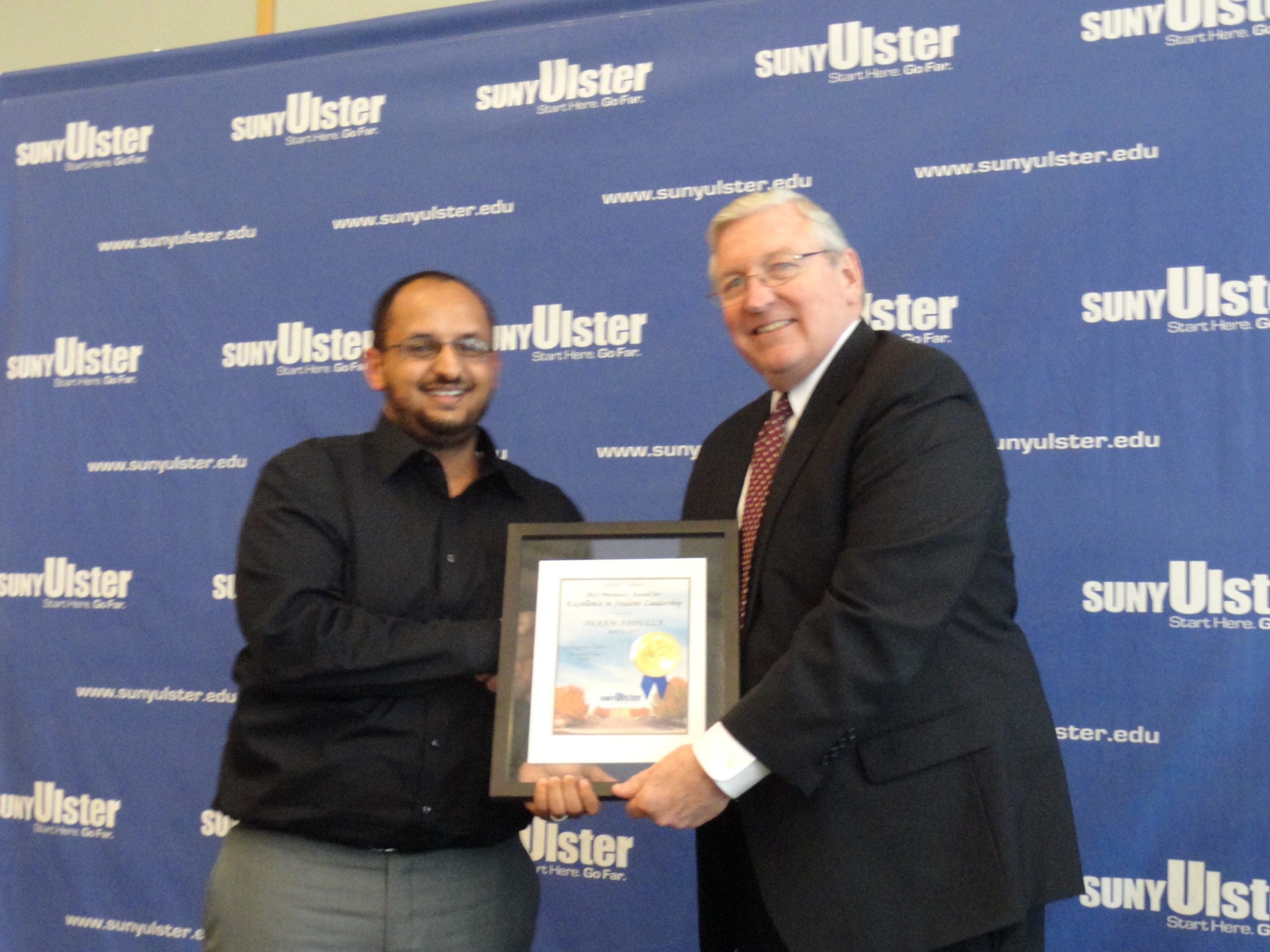
Akram Abdulla receving award from Donald Katt

“I wish SUNY Ulster was a four-year school. I wouldn’t leave to transfer.” Akram Abdulla, business administration major and SGO leader, expected graduation spring 2016

Business administration major Akram Abdulla describes a hero as someone who goes beyond to do good for a greater purpose.

He counts his older brother as well as the professors, faculty and administrators at SUNY Ulster among them.

But those that know him say the word is a description of Abdulla who has selflessly given his time and energy to student government and campus life to make SUNY Ulster a better place. Abdulla is currently serving as Student Government Vice President and previously was SGO Treasurer. He also is a Campus Connect leader.

A first-generation college student born in Yemen who came to the U.S. in 2004, Abdulla, 22, is staying focused on his studies and many involvements on campus – despite worries about the safety of his mother, fiancée and other family he still has in the country that is under seize.

For his many accomplishments, he was recognized with a 2015 President’s Award for Excellence in Student Leadership.

Abdulla enrolled at SUNY Ulster in 2014 after taking time off to work and travel. In a year, he’s come a long way in his leadership – going from never being involved in any extra curriculum activities and being intimidated asking 25 fellow students to sign a petition putting him on his first ballot.

But being in the right supportive environment surrounded by encouraging faculty and friendly students with similar interests motivated Abdulla to take a first step into getting involved in the Business Club and volunteering as the club’s representative to SGO.

“I saw how well connected the students were in SGO and how they had a voice,” he says. “It gave me a purpose.”

The many relationships he forged online with students got him nominated as CEO of the award-winning Collaborative Online International Learning (COIL) project between SUNY Ulster and Fatec Americana in São Paulo, Brazil.

He represented SUNY Ulster at a COIL conference in New York City and the SUNY Student Assembly spring conference in Binghamton. Abdulla even has a voice in who will lead the college’s future as a student representative on the Presidential Search Committee.

Abdulla is putting his leadership skills and business acumen to real-world use in his family’s grocery store, Rondout Market, and plans to transfer to get a bachelor’s degree in business after getting married in October and graduating from SUNY Ulster next spring.

“SUNY Ulster has opened up so many doors that I never thought I could achieve on my own,” he says. “And it is all because of professors and administration that have put student success at the top of their list.”