Why You Need To Read

Books line a shelf of various sizes and colors

“So often, in the past, a visit to a bookshop has cheered me and reminded me that there are good things in the world.” – Vincent van Gogh

Reading rates are at an all time low in the United States today. As someone who reads on the weekends just for fun, this baffles me. Cracking open a good book is fading into a thing of the past. Survey data from the Pew Research Center reported that almost a quarter of Americans didn’t read any books last year. That’s a huge portion of our society that doesn’t see any need or desire to get lost in a novel, keep the book economy flowing, or consult print resources when researching. To make it worse, this decline has been going steady since before things like Facebook and video games came into mainstream society. This may not seem super concerning, but is it really what’s best for society or our students? Definitely not, and I’m going to give you a few reasons why.

A book lies open on someone's lap, they hold a cup of coffee and wear a watch.

The answer to financial success might be under the cover of a book.

Books are obviously full of various types of knowledge, depending on the subject. This is an effective way of learning for our brains; reading something and processing the information in your head can change your thought process, even improve it.

Studies have shown that there is a strong correlation between household income and the amount of books that household reportedly read during that year. In fact, it’s been proven that people with more education earn a higher income on average. Spoiler: that education is deeply rooted in, yup you guessed it: books. If you’re wondering where to start your reading list, check out these 15 books that CEOs think everyone should read.

a circle of books with a book hanging in the middle

There is no limit on how much a person can learn and increase their mental capacity and ultimately success. Take for example Bill Gates, who says he reads at least 50 books a year, if not more.

Keeps your mind & memory sharp.

Just as you’ve grown your reading skills since you were a wee tot who didn’t know how to read, you can continue to improve your skills well into adulthood. Not to mention that people have reported that they feel more satisfied and fulfilled if they are a regular reader.

Reading can stimulate your brain in ways that visual entertainments just can’t match. The activity of reading stimulates areas of your brain responsible for empathy, emotion, decision-making, and autobiographical memory. Engagement with your brain in this way keeps you sharp, helping to reduce the risk of dementia and cognitive decline. The act of continously remembering the characters, plot line and sub plots, can help to improve and retain memory function.

Four stacks of books

Reading can help you stay physically healthier too.

Reading books can even improve your physical health in some ways. Sitting down with a good book can decrease tension dramatically after a long day. The stress relief can be better than other common methods such as drinking tea, listening to music, or taking a walk. According to Minnesota University, this is because your mind is invited into a literary world that is free from the stressors that plague your daily life. It’s literally a whole new world you can open and close in a minute.

two books lay on a table, one laying open with a pair of glasses on top

If you’re an insomniac, this method of winding down before bed is one you should switch to. Reading, when made into a part of your nightly ritual, provides a signal to your body and brain that it is time to relax, leading up to a good night’s sleep. Which, even though you might not think so, is much less disruptive to your natural sleep cycle than a Kindle or e-reader.

This easy activity can increase your life expectancy as well as your quality of life. Reading can develop your capacity to understand other people’s feelings and beliefs and how they may be different from your own. This leads to increased social interaction, the absence of which has been shown to be associated strongly with early death, almost at the same level as smoking cigarettes.

Go ahead and grab yourself a book.

a pile of eight books, showing the spines

As much as I appreciate you reading this article on whatever device you’re using, I reccomend planning a trip to a book store in the near future. Pick a comfortable, interesting, funny, or passionate topic that you enjoy and reap the benefits of reading today. Local bookstores I’ve visited and enjoyed around the area include some in New Paltz, Kingston, Woodstock, and Middletown. There are even more ways books can improve your life that I haven’t mentioned. Let me know your thoughts on reading books in the comments.

Computer Science Students Develop Web Application for Vet Tech Program

Logo for Computer Science Team Ellie ++

Each spring, second year Computer Science students in Theory and Practice of Object Oriented Programming work on a team project to develop a software application for a SUNY Ulster campus customer. This course, taught by Professor John Sheehan and Dr. Lou Thomason, provides an opportunity for students to gain practical experience in software development while also giving back to the college community. This semester, Team Ellie ++, which consisted of students Leonard Carcaramo, Dominic Cerchia, and Eryk Cole, worked with the faculty in the Veterinary Technology program to update a web-based tool for tracking student veterinary skills assessments.

The Vet Tech program is required to keep track of which students have completed a set of veterinary skills and must be able to provide these records when they have accreditation reviews by the AVMA. They previously tracked these records on paper and kept large binders of books for all their students, which needed to be kept on file for a long time. The Vet Tech faculty were unable to enter student skill information into the existing electronic system fast enough for it to be worth using over the paper records.

With this problem in mind, the Computer Science students built a web application that tracks these students’ accredited skills online, providing the Vet Tech program with a much more efficient and environmentally friendly record keeping system. The project was first started by a team of students in 2018, but required some fine tuning. This spring, the new team made some critical improvements to the project by adjusting the existing system so that entering student skill information could be done easily and quickly. They also made a number of small fixes to make the application more robust. Throughout the project, the team worked closely with all the Vet Tech faculty to ensure the system would meet their needs.  

Leonard Carcaramo, student leader of Team Ellie ++, says, “The Theory and Practice of Object Oriented Programming course goes above and beyond how to code, and teaches Computer Science students how to work in a software development team similar to how software development teams work in the industry.”

A big thank you to these students for their hard work helping the SUNY Ulster community! Check out some of the other ways Computer Science students are going far.

Meet the Kingston Center Enrollment and Success Team

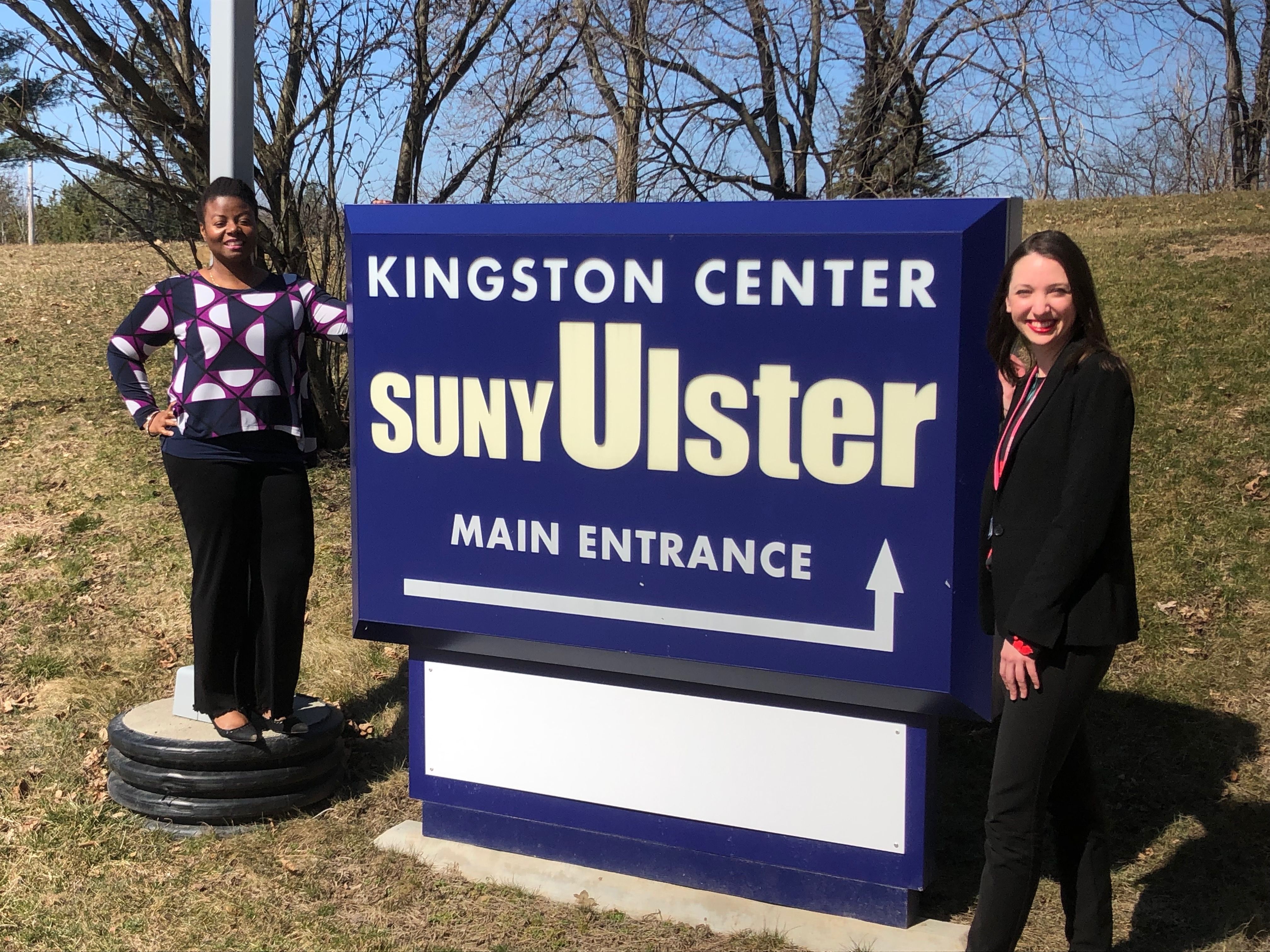
Celeste Hackenberg and Charnikia Pinesett with KCSU sign

Charnikia Pinesett, Student Success Program (SSP) Counselor


“Your success is directly proportional to the number of lives you have touched for the better.” 

This quote by Vishwas Chavan sums up my philosophy for both my personal and professional life. I have worked with students throughout the Hudson Valley region for over 13 years to help them reach their academic and career goals. To date, I have had the privilege of assisting over 1,500 students with pursuing higher education. I currently oversee the Student Success program of SUNY Ulster as the College Entry and Student Success Counselor. The Student Success Program (SSP) is designed to guide students through the college application process, as well as help them access scholarships and develop leadership and social skills. SSP is currently offered at Kingston, Ellenville, and Onteora high schools. I can unequivocally say that mentoring, encouraging, and inspiring students to reach their highest potential is one of my greatest passions.
 
When I’m not working with students, I am writing and singing gospel songs, binge watching Forensic Files and Family Feud, or catching up on much needed rest. I also enjoy special, soul food family dinners with my seven siblings and amazing mother.

Celeste Hackenberg, Enrollment & Success Counselor


I came to SUNY Ulster in December 2018 from Borough of Manhattan Community College, where I worked as an academic advisor and teacher for two and a half years in a pre-college program called CUNY Start. My driving force in working at a community college is having experienced firsthand what a life-changing experience it can be. Earning good grades and making connections at community college can literally take you anywhere you want to go—a rewarding career, your dream school, you decide. After a lot of false starts and stop-outs because of limited financial resources and indecision, I finally completed my Bachelor’s degree in Psychology at UC Davis in 2014 and my Master’s degree in Writing at Sarah Lawrence College in 2016. Prior to that, I attended two different community colleges—one in British Columbia, Canada and another in Sacramento, California. When I am not at work, I am working on my poetry manuscript, cuddling with my cats, and going on adventures with my fiancé, exploring the gorgeous Hudson Valley with all of its natural beauty.

My office is in Room 208A. Come by, have a cup of coffee or tea, and chat with me about your goals and how a SUNY Ulster education, with all of its financial, academic, and advisement supports, can help you reach them! You can also reach me at (845) 688-1560 or hackenbc@sunyulster.edu.

SUNY Ulster Nursing Students and Alumni Study Abroad in Durban, South Africa

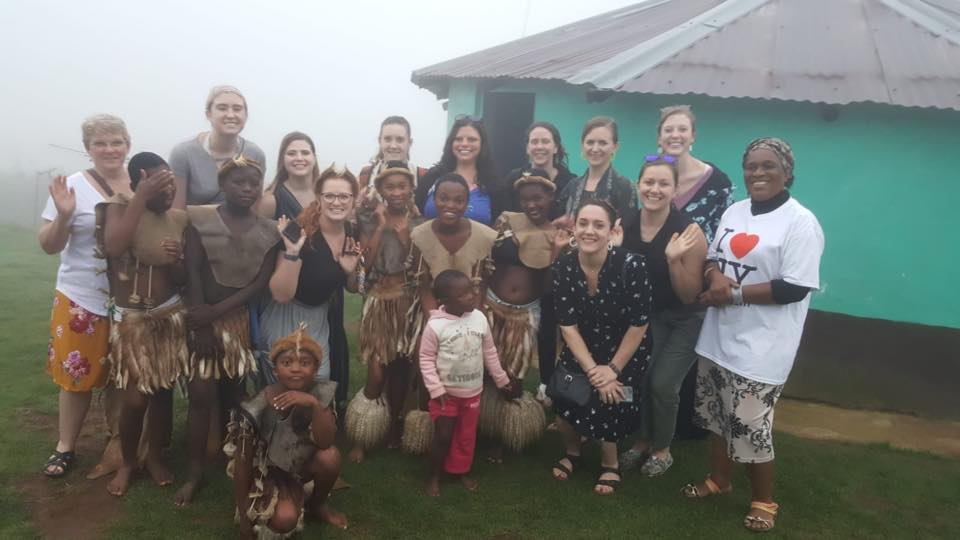
SUNY Ulster students and alumni pose with members of a South African village

From March 9-17, 2019, a group of nine SUNY Ulster nursing students and alumni traveled to Durban, South Africa with Dr. Ellen Tangney, Associate Professor of Nursing, for a study abroad opportunity. While they were there, they visited fellow COIL collaborating students at Durban University of Technology (DUT), traveled to nearby health clinics, met traditional village healers, and visited a few of the local attractions!

SUNY Ulster students and alumni with Auntie Connie and Elliot Makhathini
SUNY Ulster nursing students and alumni meet Auntie Connie and DUT Nursing Professor Elliot Mqansa Makhathini at DUT Pietermaritzburg campus.
Students and alumni at a South African radio station
The group participates in a radio talk show with host Ingelosi Engenamaphiko, discussing the integration of traditional healers in western medicine.
SUNY Ulster students and alumni participating in a Zulu dance
The travelers are entertained and educated on Zulu dance.
 Dr. Dudu Sokhela, DUT, Dr. Ellen Tangney, SUNY Ulster, Professor Elliott Makhathini, DUT, and SUNY Ulster Nursing Student Chelsea VanKleeck outside a clinic
Dr. Dudu Sokhela, DUT, Dr. Ellen Tangney, SUNY Ulster, Professor Elliott Makhathini, DUT, and SUNY Ulster Nursing Student Chelsea VanKleeck outside Cato Ridge rural clinic.
Students and alumni hand out bags at a South African clinic
SUNY Ulster students and alumni at a South African clinic. People walk 2-3 hours to arrive at this clinic, which has a western medical doctor, nursing, homeopathy, and chiropractic services.
Students and alumni pose in front of Cato Ridge in South Africa
SUNY Ulster travelers at Cato Ridge, South Africa.
Students and alumni eating dinner at their bed and breakfast
The group prepared and enjoyed an African-style beef stew with the assistance of Lillian, the B&B cook.
Students, alumni, and Durban locals in front of the Nelson Mandela capture site
The travelers visit the Nelson Mandela capture site in Howick, South Africa.
Students, alumni, and Durban locals at a picnic table by the Indian Ocean
SUNY Ulster students and alumni join Durban friends for an evening meal by the Indian Ocean.
Students and alumni in front of sea creatures at the Ushaka Marine aquarium
Before leaving for home, the travelers visit Durban’s Ushaka Marine.
Students and alumni pose on airplane steps
The group heads back home!

4 Tips to Power Through Textbook Reading

Three walls of books are shown leading up to a bright invisible sky, the book shelves are slightly covered by clouds and books protruding from the sky. It gives the viewer a feeling of standing in a library nook and looking up to see the heavens.

For most students, getting through that weekly textbook reading can be a real challenge. Believe it or not, there are a few ways to make that nonfiction assignment easier. Learning the ways to power through reading that can feel daunting or impossible is a great skill, a skill that is bound to follow you through life wherever you may need it, for another degree or just a relaxed educational reading session. Here are some tips to boost your GPA through the roof with the power of effective studying.

A teal hard covered book is laying with the pages open on a table, as if someone was reading, pictured with two pages folded up and together toward the  seam that looks like a heart. The backdrop is a bold yellow.

#1. Start Your Engines, Prepare to Learn

When sitting down with your book make sure you are ready to learn. You should have a writing tool and some note paper. No one that I’ve ever heard of was sorry that they took too many notes. You want to be ready to learn, but you also don’t want to dive in headfirst. Ease your way into submersion. Preview the topic and material you intend to research. Read the front cover, back cover, the preface, the inner flaps, boldfaced prints, pictures, and diagrams so you are aware of what you’re supposed to learn. You should gather a clear picture of what the text is about, if not, predict what you will be learning. Write your ideas down and see if your initial feeling is right later.

According to Live Your Legend this step is “akin to warming up before a big game.” You wouldn’t hit the field without a good warm up. Why then would you skip these equivalent steps for a research project? Being prepared when you start your research can help you perform better, just like a good stretch! Take the time to prep your brain and your grades will thank you.

#2. Use The Author’s Organization to Understand

Start off by separating the facts from opinion in the text as you read. Remembering that facts are only the stuff that you can prove, opinions just tend to float around and cannot be proven. Finding the facts is a good practice because that’ll likely be where the answers you seek are living.

Four cartoon looking textbooks are shown with various colors and objects on the cover. One shows a math equation, one an atom, one a microscope and the other a simple pattern. No words are visible anywhere.

Next, look at the way the author presents the material, it may be pretty informative. The order of events can vary as well as the style it’s put together in. In biographies and autobiographies, events are usually in chronological order. Other pieces may have an arrangement that is centered around the main idea (a.k.a. the topic you need to learn). If you can pick up on the organization and utilize it, you can predict what will come next. Pick up on the arrangement of info and where the important bits are, what the point is, and what to study for the big test!

#3. Stop, Drop, Summarize

After each section you read you should stop and put the book down for a minute to summarize the main point(s). This not only keeps you from falling asleep from reading the same book for a while, it also sticks that information you just read, but almost forgot, down in your mind.

A portion of a dark table top is pictured with sticky notes, flashcards, highlighters, markers, pencils and pens scattered across it. The office supplies are very brightly colored. There is also a roll of tape and a small compass in the picture.

Another sweet tip: if you create questions to summarize by and put your answers on the other side, it makes the most amazing study flashcards later on. The most bang for your study bucks, I like to say. I don’t know about you, but I like to remember what I read the first time and not have to search the whole book or chapter for answers down the road.

#4. Ask Questions & Analyze Your Work

Two cartoon heads look at each other, the space where their brains should be are filled with a white space. One head has a light bulb in the space and light bulbs rising from the head. The other head has a question mark in the space and more question marks rising up from his head. They could be having a fascinating conversation about reading a textbook.

Go big or go home, right? So finish strong by reaching for that notebook you have nearby and jotting down some thoughts. ASK QUESTIONS! Get those thinking muscles warmed up and actually ponder a little bit about what you just read. Check and see if those initial topic predictions we covered in Step 1 were right. One of my favorite things to do is to go discuss what I just learned with someone and have a good conversation about the subject. They can help provide some questions that might make you want to hop back into reading that book.

This is the ultimate adhesive to your brain for study material. The bread to your test’s butter. One of the more important steps, I assure you.

When you move on to the next section, read and repeat steps 3 & 4. You won’t get lost in timelines and jargon if you understand the chain of events, organization, and topic.

Good Luck!

If things between you and the textbook start to get hairy, take a breather. I’m not suggesting getting lost down the rabbit hole of social media. I am suggesting that you take less than five minutes to relax your mind and refresh your perspective. Get out of your chair, stretch your arms and legs, breath in and out deeply. If you’re not ready to jump back in, try taking a short walk or tidying up the house a bit by completing a chore. Your mood tends to improve with such activities and enables you to jump back into the ring with that textbook and win with a knockout.

Being a student and having to study informational material is not always the most fun thing you have to do, but skirting around the knowledge by only skimming texts will ultimately not benefit you. It might only waste your time, honestly. If you really learn the material, you can’t go wrong.

A cartoon looking man is shown wearing a graduation cap and gown. He points to a piece of paper that looks like a diploma with his left hand and points to a phone with the other. Around his is  circle that has various objects surrounding the man. There is a pen, a tablet with a pencil, another phone with headphones and a small pile of books that will encompass a lot of reading. The background is bright teal and a portion of an atom is shown in one corner, a portion of a gear set is pictured in the opposite bottom left corner.

What Are Microcredentials? How Can They Benefit Me?

Woman presenting at a business meeting

Both locally and nationally, today’s employers are now looking for candidates with more than a college degree. Employers are looking for personnel that have detailed credentials with a proven and tailored skill set to fit a specific job description. A combination of applied learning experiences, credentialing, and a quality degree stack the competencies needed for graduates to succeed in today’s highly competitive job market. SUNY Ulster is one of the growing number of colleges providing these credential options for individuals and students looking to enhance their skill sets with highly marketable qualifications.  

What is a Microcredential?

At the most basic level, microcredentials verify, validate, and attest that specific skills and/or competencies have been achieved. They differ from traditional degrees and certificates in that they are generally offered in shorter or more flexible time frames and tend to be more narrowly focused. Microcredentials can be offered online, on campus, or via a hybrid of both.

Who Needs a Microcredential?

The industries with the most common use or requirement of microcredentials are in Industry Trades (including technology and advanced manufacturing); Health Care, Computers, Networking, and Engineering. The majority of licensure‐related offerings are within Education and Health Care. Others who may be interested in microcredentials are individuals working in fields such as Business, Entrepreneurship, Human ResourcesParalegal Studies, Mental Health, Protective Services, Veterinary Sciences, and more!

MicroCredentials at SUNY Ulster

SUNY Ulster currently offers four microcredentials, with several more currently in development. The four currently offered are Accounting Computer Skills, Computer Game Design, Mobile Application Developer, and Web Application Developer. Each consists of four classes which, when finished, earn the student a 14 or 16 credit microcredential. Accounting Computer Skills is designed primarily for Business majors, while the other three are geared toward those with a Computer Science background.

Start Your Creative Career with the SUNY Ulster Graphic Design Program

Graphic Design students holding the bee brochures they designed

Are you a creative person? Do you dream of making money from your art or designs? If so, a degree in Graphic Design may be for you!

Perfect for traditional and adult students who are looking for more employment options or a career change, students can find themselves on a path to success when they start with the Advertising Design and Graphic Technology Program at SUNY Ulster, also known as the Real World Classroom.

The Real World Classroom is a unique opportunity for SUNY Ulster Graphic Design students. Each semester they are paired with local clients who are in need of design help. Recently, these classes have designed a brochure for the Ulster County Jewish Federation and created packaging for SOUL, a socially responsible coffee company supporting farmers in Rwanda. In addition to classroom work, students have the opportunity further their education in specific disciplines by participating in local internships.

Numerous graduates have transferred to four-year programs or gone directly on to employment within the fields of Print Media, Multimedia, Video, Web Design, and Illustration. Design careers combining graphic design and technology, including Video and 3D Printing, have become especially popular.

Students from a variety of backgrounds find a great fit in the Graphic Design program. SUNY Ulster student Sharon Wasko received her bachelor’s degree in Fine Arts in the past. She came to SUNY Ulster after learning about the Real World Classroom, as she wanted directly employable skills with real clients. Graphic Design alumna Leanna White has had an exciting career since her 2012 graduation, designing album covers, patrol car wraps, and advertisements featured in magazines right after graduation.

No matter what stage of life you’re currently in, you have to take the first step to begin your career if you want to make a living doing what you love. For artists and designers, the Graphic Design Real World Classroom can be the perfect place to start.

Top Five Tips for Winternet Class Success

Cat laying by keyboard

The fall semester is over and the holiday season is in full swing, which means it’s just about time for Winternet classes! If you’ve signed up for one of these intersession classes, you’ll be taking an online course that covers all the information covered in a 15 week in-person or online course in about 3 weeks instead. Though that may sound overwhelming, it is manageable, and you can greatly benefit from taking one! Since we’ve already discussed what Winternet is and why you should take one of these classes, today we’ll jump right in to how to succeed at Winternet courses this break!

#1: Check Early, Check Often

Your email and course site on Blackboard, that is. Normally professors will post information about the course, including necessary textbooks, introductions, and sometimes even icebreakers and class content before the technical “start” of the class. At the absolute minimum, you should read the syllabus, have your textbook, and familiarize yourself with the course site before the start of class. Finding out this information as soon as possible will put you on the path to success, especially when working with such a small window of time to begin with. If you can’t find something or it doesn’t make sense….

#2: Don’t Be Afraid to Talk to Your Professor

Remember, your professor wants you to succeed as much as you do. Reach out to them via their email or online office hours with any questions you have, and be sure to let them know of any problems you’re having with the material or logistics of the course sooner rather than later.

#3: Have A Strict Daily Schedule

A common estimation for a winter session class is that students should set aside 30-40 hours per week to do all that needs to be done if they’re taking a 3-credit course. It’s not recommended that students try to work at full-time jobs while taking Winternet classes. For optimal results, log in daily to check and make sure there are no new assignments or readings.

#4: Maintain a Distraction-Free Environment

Ideally, you will have a consistent space to use each day for Winternet work. This could be your bedroom, a home office, or the local coffee shop, but it needs to be somewhere where you can focus and not be distracted during the time you’re working. Put your phone on silent, turn the TV off, close the door and put a “Keep Out” sign up… do whatever needs to be done so that you can work efficiently! Remember, it’s just three weeks!

#5: Complete ALL Assignments (On Time)

Since Winternet classes are short and online, your professor has even less to go on, which means every forum post, test, and paper counts even more toward your grade. One missed post or late quiz can be the difference between an excellent and mediocre final score. Keep an updated planner with ALL due dates, no matter how insignificant they may seem, so that you can maximize your time on projects and hand things in when they’re due.

Now Go Check Out Your Own Course Site!

By following these tips and working hard on your Winternet course for three weeks, you’ll likely pass with flying colors! Even though it’s a lot of work, the short time frame can be a blessing, especially if you’re not particularly interested in the subject matter. Have you developed any helpful tips and tricks for Winternet or online courses in general? Comment them below!

Fashion Students Create Apparel Designs for Guatemalans in Need

Fashion students working on their apparel designs

SUNY Ulster fashion students are participating in a great service learning opportunity and gathering intercultural experiences this semester! Students in Professor Angela Kunz’s FAS 220: Apparel Design II class are working on a set of pattern designs that two Guatemalan women’s groups, one a shelter for survivors of domestic violence and the other part of a small rural community who recently lost all their crops, can use to create fashionable, export-friendly clothing to sell.

The project began when Angela took a trip with a SUNY New Paltz professor and students to Antigua, Guatemala to work with local women. While the group was there, they visited one of the three domestic shelters in the country, where Angela discovered that the shelters were given limited funding. After finding a local with a large warehouse of traditional Guatemalan shirts, she decided to bring a few back for a class project that would give her students a chance to help others in need.

The students have refashioned the Guatemalan shirts that Angela brought back into new, easy-to-sew attire that the Guatemalan women can easily recreate on a larger scale and export. When finished, the students will be able to use the sample they created in their professional portfolio. In December, Angela and one of her students will return to Guatemala to deliver the finished concepts and help teach the steps to the women so they can recreate the garments.

Angela hopes that this exciting new project will build longevity and financial security for these women. She hopes to return in the future with more students from SUNY Ulster and create an ongoing collaboration between the women of Guatemala, SUNY New Paltz students, and SUNY Ulster students.

Angela Kunz poses with several Guatemalans


Study Abroad with SUNY Ulster in 2019!

Benbulbenmount in Sligo, Ireland

It may still be 2018, but that’s no reason not to get excited about what next year will bring! And what could be more fun than having an exciting trip to look forward to? This spring and summer, SUNY Ulster has two study abroad opportunities, one to South Africa and another to Ireland! Read on to learn more.

Explore Durban, South Africa with NUR 254

Are you interested in seeing South Africa, particularly through the lens of the country’s healthcare system? If so, be sure to sign up for this trip, running during Spring Break from Friday, March 8 to Saturday, March 16, 2019. This trip, which is open to students, alumni, health and human services professionals, and the community, allows participants to work with nursing students from the Durban University of Technology in South Africa.  SUNY Ulster Nursing Professor Dr. Ellen Tangney will lead and instruct the course.

The class will include:

  • An opportunity for students to connect with Durban University of Technology’s
    nursing student culture first hand
  • A visit to psychiatric clinics to view local mental health services
  • A visit to Community Health Clinic Centers
  • A visit to traditional healers and health practitioners who practice a holistic
    approach to healing
  • A day visit to deep rural clinics
  • A service learning component and the opportunity for all participants to act as
    international ambassadors

Those interested are encouraged to register soon, as seats are limited. For more information on the trip, travel guidelines, or to reserve your space, visit www.sunyulster.edu/durban or contact Christopher Seubert, Academic Travel Program Coordinator, by phone at (845) 687-5134 or by email at seubertc@sunyulster.edu.

Visit Ireland with ENG 206 Topics in Literature

Get ready to explore the Emerald Isle from a literary point of view with this trip in June and July! Experience a hundred years of Irish literature as it spans “The Three Arts:” Prose, Poetry, and Drama. The trip runs from June 21-July 3, 2019. SUNY Ulster Professor of English Nicholas Haines will lead and instruct the three-credit course. In addition to students and alumni, the program is open to all community members, veterans, and adult learners.

Participants will be learning about the history and works of Irish authors over the last 100 years, such as Yeats, Joyce, Samuel Beckett, and Roddy Doyle. There will also be visits to a number of historical attractions throughout the country, including Sligo, Galway, Limerick, and Dublin. Participants will tour a variety of cultural destinations including the Trinity College Library, Sligo Abbey, the Cliffs of Moher, and Bunratty Castle.

Included in the cost of the class is transportation to and from SUNY Ulster and the airport, airfare, shared accommodations including breakfast, some site fees, and the three SUNY Ulster credits. Registration for the class in now open. For more information, visit www.sunyulster.edu/ireland or contact Chris Seubert, Program Coordinator of Academic Travel, by phone at (845) 687-5134 or email at seubertc@sunyulster.edu.