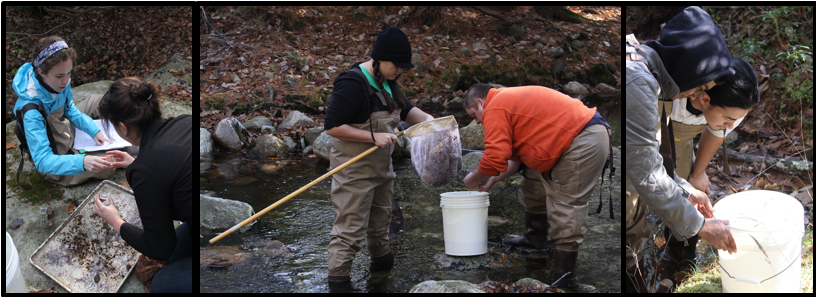
Do you love the outdoors? Are you passionate about nature and wildlife? Would you like to make a difference for the ecosystems that make up our world? If so, an Environmental Studies A.S. degree might be for you!
With environmental issues continuing to grow in severity and importance, Environmental Studies graduates leave Ulster prepared for a field with a steadily expanding job market. Graduates can use their knowledge to help with any issue they’re passionate about, whether that’s food insecurity, climate change, pollution, wildlife endangerment and extinction, resource depletion, or anything else.
Graduates have found jobs at the NYC Department of Environmental Protection, the NYS Department of Environmental Conservation, the Ulster County Department of Health, as well as at private companies and local municipalities. The demand for environmental expertise is very high in the Hudson River Valley and Catskills Watershed region, so this career path can be great for students who want to stay local.
In the program, students gain skills in and out of the classroom. Students have the opportunity to explore nature and get hands-on experience as part of their classes. The program includes comprehensive courses in biology, environmental science, mathematics, and chemistry, so students are prepared for a variety of careers in environmental and scientific fields. In addition to the program itself, students can join the SUNY Ulster Environmental Club, which has taken part in several exciting sustainability and restoration activities in the last few years.
Students can take part in studies relating to stream management, wetlands, forestry, invasive species, pollinators, and fisheries through a variety of field‐based internships. Environmental Studies students also have exclusive access to paid internships with the NYC DEP.
Program graduates who decide to begin working immediately after graduation are qualified for jobs as environmental technicians, laboratory technicians, wetland field technicians, and environmental trainees. For those who want to continue their education, the program prepares students for fields like environmental law and environmental engineering. The program is also a terrific foundation for students who choose to pursue careers in other science fields, such as biology. The program affords easy transfer to schools such as SUNY ESF, SUNY Plattsburgh, and SUNY New Paltz, as well as many private colleges.
One recent graduate began a very meaningful project for the local community! Michael Burke, a 2018 program graduate, was awarded a 2017 Barnabas McHenry Hudson Valley Award from the Open Space Institute to work with the Rondout Valley Growers Association to address food insecurity in Ulster County. The culmination of his work was a forum on campus in which local organizations and the community were invited to discuss the issue of food insecurity and potential solutions.
Another alum, 2016 program graduate Alex Lemus, transferred to SUNY Albany to study biochemistry and molecular biology. He is now a graduate research assistant at SUNY Albany and is pursuing a doctorate. He has already published his first research article!
Whether your goal is to improve pollution policies, study renewable energy resources, or help wildlife in their natural habitats, an Environmental Studies degree can be the perfect place to start! Learn more about the program by contacting admissions@sunyulster.edu.
Starting a business is a goal that lots of students share while they are getting their degree. Some have the fire and motivation to make their dream business a reality. Students who complete college to continue onto the path of entrepreneurship are bold path blazers, at least they have to be to make it out there.
After trials and tribulations, the excitement of learning, the stress of exams, and the enrichment of social exploration, your studies will inevitably come to an end (as all good things do). For many, this stage of life is intimidating, if not terrifying. The familiar foundation disappears from beneath your feet, and you drop into uncharted waters — unsure where to go.
Still, it isn’t a time for fear or despair. It’s a time for exploration! Everything prior to that point is preparation intended to build your mind and spirit. Making you into someone with the strength and character to earn the kind of life you want. You’ve already shown you have what it takes to get ahead when you finish your studies.
Your future is for you to decide, so consider all of the available options. Maybe you want a comfortable position, or there’s a company you want to work with. Then set a goal and start moving toward it as soon as possible, maybe now.
Or perhaps you’re like many people today and want to work for yourself; being able to set your own schedule, profit fully from your hard work, and never have to deal with a boss. If so, you’re in luck, because it’s never been easier to start your own business. Read on for some tips on doing just that.
Come Up With A Workable Business Concept
This step is far easier said than done; so much so that plenty of people will never get past it. You need to think of a product or service that you can offer – and profit from selling. You can sell almost anything at a loss, so don’t assume an idea is solid because there’s demand for it. If there’s no potential for profit, it’s pointless to begin going down that path.
A good starting point when selling products is to push two existing concepts together to see what results. For instance, someone at some point had the idea of combining “the internet” and “refrigerators” to get smart fridges. Think about technologies and products already available in your chosen field, and look for gaps between them. You could easily fill those gaps and open up a new mini market.
If you want to offer a service (consulting, perhaps), then you need to pick out a unique selling point (USP) of some sort. What will make people want to work with you specifically? Your level of quality, your affordable rates, or your turnaround time? As you would when choosing products, try to choose a USP that fills a gap in the market.
Investigate Comparable Businesses
Next, you must conduct some market research to see what relevant types of businesses are already in operation. You’ll need to narrow things down, of course; think about what your studies have primed you to do (and what you want to do). See which brands are succeeding, or failing, doing similar things. Once you’ve picked out some brands, you can use a competitor analysis tool (like this one from Brandwatch) to learn about your ideal audience.
You can start with some simple Google searching. Type in the kind of product or service you’re planning to offer, and run through the top results. Note that your searches will likely be affected by your location, and if you plan to operate locally in another area, add the name of that location to your search. What impresses you about the results? How good or bad are the websites? What about the prices?
A good option here is to survey your target audience on the brands they like and dislike. You can use something like the online sample service from Qualtrics: define your niche, and get an appropriate sample of survey respondents. If you truly don’t feel that you can compete with existing businesses, and you don’t see enough room in the niche for everyone, then rethink your concept. Remember the GIGO principle — garbage in, garbage out. If your concept isn’t viable, then any effort to build a business around it will be an exercise in futility.
Base Your Business Online
Even freelancers used to need conventional offices to appear credible in the eyes of many prospective clients. Full businesses needed large offices, with their reputations often being heavily affected by the quality of their premises. This meant that setting up a business could be extremely expensive, to the point of most being unable to achieve it.
Today, you don’t need an office to run a business, because you can run it completely online. This is particularly true if you want to operate as a freelancer. You can set up a business website and promote your services purely through the internet, then work remotely. If you want to sell products, then it’s easy to move into the ecommerce world. You will admittedly still need to invest in sourcing, storing and shipping the products, admittedly — though there are options in the form of dropshipping and warehousing that can even make that easy.
This doesn’t mean that you have to be online-exclusive, though. Instead, you can view it as a launching pad: if you set up an online retail store that becomes hugely popular, you’ll always have the option of setting up a brick-and-mortar store to expand it. It’s actually fairly convenient at this point: for instance, Shopify has a POS hardware package that can provide the full range of tools needed to run a physical store that shares a back-end with an online store.
Alternatively, if you start making enough money through offering services, you can invest in an office to start building a team around you — or even just hire remote workers and save the office money, because that can work extremely economically when done well.
Promote Through Your Established Business Contacts
Simply getting your business up and running is just the start. If you want it to succeed, you need to promote it — and since you’re coming off your studies, why not take advantage of the contacts you made throughout that time in education? Whether it’s the friends you made in classes or the teachers who helped you, you have access to smart people with the ability to offer invaluable feedback (and possibly connections of their own). Use LinkedIn to help you piece things together since you’re unlikely to remember everyone.
You might worry about being accused of cronyism, but you’re not manipulating your way into a position of power: you’re just leaning on people who already know and trust you, and there’s nothing wrong with that. In the end, getting opportunities won’t make you a success: if your business can’t deliver results, then no number of connections will help it thrive.
After reading through this piece, do you think you’d want to run your own business? It’s very freeing, but just as stressful, and not for anyone who wants an easy life. If so, follow these suggestions to get started — you just might carve out your career path.
One of the most exciting opportunities at college is the chance to play sports. Students can play sports from volleyball to football and most things in between. Generally teams are broken up by sex and the season runs for about a semester, or around 15 weeks.
There is a full list of SUNY Ulster sports teams on our website, at the bottom of this article, and on your portal. The school’s athletic website can be found here, with all the details to everything SUNY Ulster athletics. In case you didn’t know, our mascot is the beloved Senator Sam, seen above, and all sports teams are known as the SUNY Ulster Senators.
There are plenty of reasons why sports help you stay sharp in mind as well as in body. The mental benefits of sports are numerous; including memory boosting, gaining leadership qualities, and improving self-confidence. There are a few more reasons why athleticism is beneficial to being a student that we’ll go over in more detail; like getting better sleep, reducing stressors, and helping with concentration.
Stress Reducer and Depression Aid
Sports are an all-natural stress reducer that is easily accessible to you and all students. Getting your tension out on a field or a court can be much better than letting it bottle up, or worse, come out in unintentional ways. The brain produces extra serotonin when the body is involved in physical activity. This chemical is known as the happy chemical because it’s most often associated with the good feelings it brings forth. This chemical is complicated and having more of it can positively affect learning, memory, and sleep quality. Exercise and other physical activity will also produce endorphins which can improve the ability to sleep which, in turn, reduces stress.
Athleticism can also reduce depression and is a popular way of managing anxiety disorders, according to the Anxiety and Depression Association of America. A sports player that regularly does conditioning and practice is less likely to suffer mood imbalance. Using working out as a healthy coping mechanism may reduce other unhealthy habits that can lead to more depression. Instead, physically producing those feel good chemicals for yourself can be a positive way of dealing with negative emotion. Compared to other ways of dealing with stress, using exercise to ease symptoms of depression can be the best route to take for a busy student.
Though it takes a while to feel the difference, it’s proven that better sleep and regular physical activity are correlated. It makes sense that doing exercise normally can improve your sleep. It does so by increasing the amount of deep sleep you receive. After long periods of regular exercise were added to test subject’s lives, they had more long-wave sleep at night, which is the most restorative form of rest.
Effective rest does the brain good and it’s well known that more sleep is always better for students. A good hard practice session of any sport can be tiring and helpful to get some great sleep! Being well rested can help you remember more and can also prevent bodily stress the next day from being tired.
Concentration & Focus Booster
Getting involved in sports can actually help you focus in the classroom. After children in this study had a daily dose of exercise they showed improved attention spans. Just another one of the ways that physical exercise helps your brain work better. “They became more adept at ignoring distractions, multitasking, and holding and manipulating information in their minds” says neuroscientist Ben Martynoga.
Reach out to a coach on campus, find a gym near you, join a self-defense class, or just jump into the next sports season when it starts! There are far fewer ways that sports could do you wrong than how they could improve your life. The benefit of being an athlete is NOT limited to academia, it could improve multiple facets of your life. It can’t hurt to try, that’s for sure!
I realize that sports aren’t for everyone, and that doesn’t mean that there aren’t other outlets you can try. Getting involved in making some kind of art is always a good idea too, see why.
It can be hard to readjust to a studying mindset once you’re out of the habit for a few years, but with a few tips and some helpful resources, you’ll be studying effectively in no time!
Manage Your Time Wisely
Adult students tend to have more work and family obligations than the traditional student, and that can make it difficult to get classwork done. The solution? Plan ahead. Set aside a quiet time and place each day to catch up on your work, even if it’s just to study your notes and complete textbook readings. Start on your assignments as soon as you get them, just in case anything comes up closer to the due date.
Know Your Computer
If you aren’t confident in your computer abilities, then it’s time to learn to use one! Almost every class you take in college will require using a computer for studying and completing assignments, and online classes are, well, fully on a computer. Get familiar now. Learn how to use Microsoft Word, an internet browser, your course sites, and the Portal, at the very least.
Use a Variety of Resources
Remember that you have more than just your textbook if you need assistance. Many services and programs are available through the Macdonald DeWitt Library. Professors will often post extra information, links, and notes for studying on your class Blackboard site, so make sure you check course sites regularly. You can also take a look at some other great online resources we’ve curated for you.
Get Tips for Memorization
There are lots of different methods for learning and memorizing information, including using mnemonics, mapping, and more. Many suggest that physically writing down notes is an effective way to familiarize yourself with information, so don’t be afraid to use a notebook and pen, even if you’re trying to use your computer more often. Check out some of our other tips for boosting your memory skills.
Get Help if You Need It
Remember: there are special resources on campus if you need extra assistance! Visit the Writing Center and Math Center for help with English or math. Tutoring, study help, and other services are available through the Center for Academic Planning & Support (CAPS), formerly known as the Learning Center. If you need assistance with any course, don’t be afraid to reach out to caps@sunyulster.edu or stop by their offices in VAN 247. The staff and peer tutors in these departments are always happy to help!
Maintain a Balance
Don’t forget to take a breather once in a while! It’s easy to feel overwhelmed by your coursework and other responsibilities, which only makes studying that much harder. Take advantage of on and off campus opportunities to relax, and make sure you’re eating right and sleeping well. Keeping your mind sharp will do wonders for your grades!