Common Grammar Mistakes

Scrabble tiles on a scrabble board

We’re all guilty of making errors from time to time. Some mistakes are more typical than others and can happen to the best of us, even those of us who go to college. This article is a quick run down of some common grammar mistakes that happen pretty often according to both the web and my personal experience; give it a gander.

Type blocks for an old printing press, each of them depicting a different letter. Grammar mistakes were far moer common in the hay day of these tools.
Image by Free-Photos from Pixabay

Let’s talk about what it is first.

Let’s go over what the term grammar means, according to the Cambridge Dictionary. It’s a noun that means “the study or use of the rules about how words change their form and combine with other words to express meaning”. Put simply, it means the correct way to use words in speech. It’s not a simple concept, the English language can be tricky as I’m sure you know. Frequently people who speak English as their first and only language are known to fumble their words. Getting to know a few frequently occuring misused terms could save you from your own fumble some day. In both speech and writing, correct use can give you more opportunities and better impressions.

A close up of a page from a dictionary

1. An Affect vs. The Effect

The word Affect is almost always used as a verb (an action word) while the word Effect is a noun (a person, place, or thing) and means the result. To put it another way, the Effect a.k.a. consequence or outcome is what happened because something was Affected, a.k.a. impacted, influenced or changed. A good example of this from Writer’s Digest uses someone who likes to be a pirate. “Acting like a pirate has had a negative effect on my social life”. Where effect is a noun. Or “the eye-patch affected my vision” where affect is a verb because it’s doing something. It may seem confusing at first, since one letter makes all that difference and they are sort of related as words. However, it’s not as difficult as you might think.

2. Than vs. Then

Probably the most typical of common grammar mistakes to make, this one is an easy fix. The trouble most people have knowing when to use then or than is remembering which is which. Avoid this grammar faux pas by remembering that than is a comparison and then is talking about time.

An example would be when you prefer one fruit over another, let’s say apples versus oranges. You like apples more than oranges, or you may prefer apples less than oranges. When you compare something to another thing, including people or places, you use than.

For the latter, an example would be going over a schedule. Let’s say this Saturday you have a family fun day planned; you’ll go to the beach, get some lunch, and then go to the circus. We’re discussing the timetable of events and when things are happening so we use then.

A person holds a book by the edge of one cover, making the other cover and the pages fall down in front of the camera.
Photo by Nicole Honeywill on Unsplash

3. Is It To or Too?

This is a fierce competitor for most common mistake, since we use these words so often. Let’s make it easy and get it right from now on, more knowledge equals less confusion. When we only use one O we are talking about movement of some kind. Whether it be moving through time, space, or the matrix. For example: you go to the grocery store, and when you’re done, you go back to your home.

The double O version is exclusively used for additional information and should, at all times, be replacable with as well. It is usually placed at the end of a sentence or list. For example, if you’re writing a grocery list you may decide you need: cherries, ketchup, bread, and eggs too. You can tell it’s correct because if I had written -eggs as well– it still works.

4. The Rest of Those Pesky Homophones

A picture breaking down one of the most common grammar mistakes, the difference between they're, their, and there.
Courtesy of Reddit.com

A homophone is a word that sounds like another word but has a different meaning. Number one of this post is considered a homophone, and I bet you didn’t even realize!

One of the ones we see most frequently is they’re, their, and there. If you glue this helpful infographic someone made into your head, you should do fine. To reiterate what it says: they’re means they are, there is talking about a location, and their is reffering to a person

In the same ballpark are the words your and you’re. The rules above apply to this so like I said before, glue that picture to your brain and this one is easy. You’re is a contraction of the words you are, saying someone is known a certain way or is doing an action of some kind. “You’re doing a great job at this!” is an example of this contraction. Your refers to a possession or belonging, for example: “is that your car?”. A good way to double check this one is to ask yourself if you are would make also sense, if it wouldn’t, use the other form of the word.

A red pen sits on top of a graded paper, where all common grammar mistakes are marked up.
Image by Anne Karakash from Pixabay

Don’t Let Common Grammar Mistakes Get You Down

Take control of the way you communicate by learning the ins and outs of the English language, that sneaky trickster. These mistakes are easy to make and finagle their way into everyday life. Instead of feeling bad about it, we’re getting ahead; that’s the spirit!

Fun, Free Events at SUNY Ulster this Fall

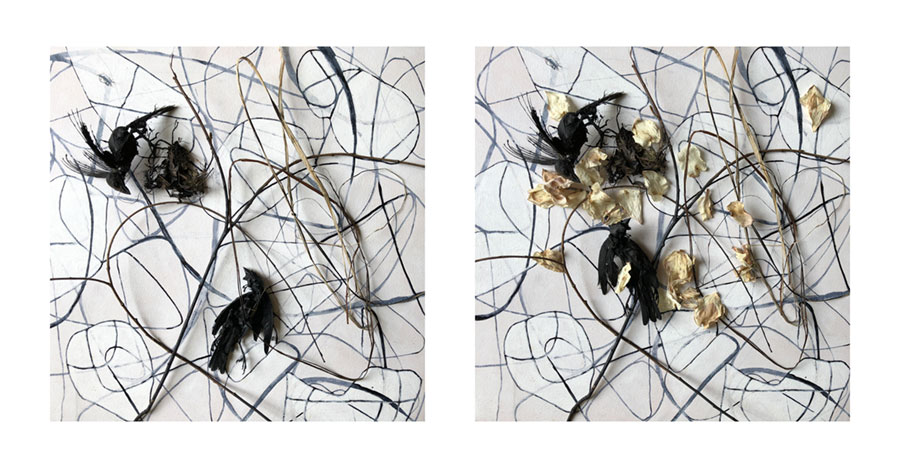
Ernie Shaw's Artwork

As the days grow shorter and colder, you may find yourself wondering what to do, especially if you’re on a budget. Good news: there’s always something enriching to enjoy and learn from at SUNY Ulster! The following is a list of upcoming events happening over the next few months that are open to students AND the community, so even if you’ve never been to SUNY Ulster before, you should come by!

New Immigrant & Refugee Visions: Screening and Discussion

Wednesday, September 26, 1:00 p.m.,
College Lounge, Vanderlyn Hall

This event features documentary films by immigrants from around the world who came to America, followed by an audience-led discussion of immigrant issues. Find out more about this series by visiting Community Supported Film’s site. You can also find more events like this one by checking out the Diversity page on our website.

Visiting Artist Andrew Zuckerman: A Message from the Exterior

Thursday, October 11 – Friday, November 2, Slide Lecture/Opening Reception: October 11, 7:00 p.m., College Lounge

Visiting Artist Andrew Zuckerman is an award winning photographer, filmmaker, and curator. Much of his work is concerned with the intersection of nature and technology. Zuckerman’s ongoing portrait practice utilizes both photography and filmed interview formats to examine human perspectives. With the support of Archbishop Desmond Tutu, he released WISDOM in 2008 as a book, a feature length documentary film, and a global traveling exhibition. For this exhibition, Andrew will show a selection of works from his series “A Message from the Exterior,” an installation of photographic works from his continued investigation of the human relationship to the natural world.

The Art Force 5

Wednesday, October 24, 9:00 a.m.,
Student Life Center (Cafeteria)

The Art Force 5 uses the accessibility of art and the popularity of superheroes to explore issues of equality, violence, history, community, and empathy. The Art Force 5 is partnering with SUNY Ulster SGO, Multicultural Club, COIL, and Academic Travel to engage the community by inviting students and community members to paint one tile of a 250-piece mosaic tribute. The completed mosaic will be on display on the SUNY Ulster campus.

Annual Project Presentations for COIL

Thursday, October 25, 1:30 p.m.,
Burroughs Hall

For the past two years, SUNY Ulster has collaborated with students from Universidad de la Salle NoroEste from Obregon, Mexico. For a week in October, the students get a chance to meet face-to-face and work on presentations of their projects. This year, we open the doors to the SUNY Ulster community and the public to celebrate these student collaborations and to listen to their presentations.

Library Writers Series: Bruce Littlefield

Thursday, November 8, 1:15 p.m.,
College Lounge

Bruce Littlefield is a best-selling author, lifestyle expert, and an arbiter of American fun. He shares his passionate curiosity (and occasional mischievousness) through his books and TV appearances. Bruce has appeared on NBC, CBS, ABC News, FOX News, MSNBC, The Rachael Ray Show, NPR, Sirius, and numerous other programs and publications.

Tropical Seas & First Forests – New York
400 Million Years Ago

Thursday, November 15, 7:00 p.m. – 8:30 p.m.,
College Lounge

A drive through the rocks of the Hudson Valley and Catskill Mountains tells the history of New York long before the dinosaurs. Marine shells and coral reefs in the valley indicate an environment of shallow tropical seas. Fossil trees and strata of the Catskills record a history of some of Earth’s earliest forests and an Andes-scale mountain belt in New England. Time travel to a very different New York State with Dr. Chuck Ver Straeten of the New York State Museum. Part of the John Burroughs Natural Science Lecture Series.

Ernie Shaw: Form of Shadows

Friday, November 16 – Friday, December 14, Opening Reception: Friday, November 16, 5:00 p.m. – 7:00 p.m., Muroff Kotler Arts Gallery

Local resident Ernest Shaw will be exhibiting recent photography in his show, THE FORM OF SHADOWS. This exhibit is primarily focused on photography, a “new” medium in his 50 year career with sculpture, paintings, and drawings. The photographs integrate his lifelong concerns with mortality, the nature of the “self” and shadow, and the relentless search for integration and wholeness, particularly in the consequences of action and gestures, of moments and eons. These themes resonate with Shaw’s other career as psychiatrist, psychotherapist and long-time teacher of mindfulness meditation practices.

SUNY Ulster musicians performing a concert

Holiday Concert Series

WIND ENSEMBLE & PERCUSSION ENSEMBLE CONCERT
Tuesday, November 27, 7:30 p.m.

HONORS RECITAL
Friday, November 30, 3:00 p.m.

STRING ENSEMBLE CONCERT
Monday, December 3, 7:30 p.m.

COMMUNITY BAND & JAZZ ENSEMBLE CONCERT
Wednesday, December 5, 7:30 p.m.

CHORAL CONCERT & GUITAR ENSEMBLE CONCERT
Thursday, December 6, 7:30 p.m.

To see more of our events, visit our Calendar of Events page or pick up one of our special events brochures located around campus!