
Why Taking Hand-Written Notes Makes You a Better Student

A bouquet of flowers sits in the corner of the image of a table top from an aerial view. Also on the table is two notebooks, one of which says, "make it happen".

When you take good notes in class, you have a study tool that’s sure to help you get better grades. The way you take those notes can also determine your likelihood to sink or swim in a class. As it turns out, the old-fashioned method, using a pen and pad, is superior in terms of the learner retaining more information. So to shorten that up: paper notes are good and laptop or phone notes are not so good, and I’ll tell you why.

Benefits of Good Paper Notes

It seems a little obsolete to bring a notebook to class in this world of readily available technology that we live in. When we’re talking about being a successful student, however, paper the best resource available! One of the reasons for that is that laptops and phones tend to be too distracting. A student is far too tempted to play a game or take a gander at social media from any computer device; whereas with paper, you’re forced to stay on track.

five notebooks rest on a table with a string of lights and a small bottle of what looks to be perfume or make-up
Photo by Brittany Neale on Unsplash

On top of that, more mental processing takes place with the information when you’re taking hand-written notes. That’s one great reason to put your laptops away, but let’s break that down a bit.

When students take notes on devices such as laptops, they try to take down every word and detail, verbatim. When students hand-write their notes as opposed to typing them, they’re forced to find keywords and summarize the lecture. This means that they had to think about what was said, process it and write it down in a way that they understand. Doing that leads to the subject being better remembered by the writer. We write a lot slower than we can type, so we end up taking fewer notes but they’re more effectively learned.

Mental processing power booster aside, benefits of of hand-written notes go even further in helping you as a student. Pen and paper notes can keep you more alert and engaged during class. It helps to emphasize and organize specific information, and of course creates a more condensed version of the lecture to study.

Successful Note Taking Methods

A woman sits in grass with only her knees and hands visible, she is holding a slim pen to a notebook resting against her knees.
Image by StockSnap from Pixabay

There are different methods of taking notes for everyone. You might already have a way that works for you and that’s great. If you need some ideas on how to better your note taking, I’ve got some suggestions.

First of all, most instructors have no problem with you recording the audio of their lecture. This IS NOT me advising you to substitute this for taking notes, but merely a suggestion of a supplement to your notes that might come in handy later. Just ask your teacher or professor, they might be surprised by your initiative (bonus!).

A Few Methods to Try

The three major note taking methods are widely used and taught among college students. The first is a system of outlining all the material by identifying the main topic. Then make a list of details about it under the topic. This can be good if the lecture is staying with one topic and not jumping around a lot. If you are working on retaining a lot of information, you may want to try another method.

A light bulb is surrounded by bubbles
Image by Gerd Altmann from Pixabay

A different method to try is called mind-mapping, this is something you’ve probably seen before as it’s pretty common in high schools. The idea is to write the overall main topic in the middle of a page in a circle and branch ideas off of the middle circle. For example you might write “water cycle” in the middle and branch off of it with subtopics like “condensation”, “evaporation”, or “water tables”. This can be good for keeping up with a fast lecture but lots of details can fall through the cracks.

Finally, the last well-known method of note taking I have for you is called the Cornell system. This is where you start of the lecture by dividing your page into three sections with lines. Make it so there are extra small spaces on the sides or top and bottom. You take notes as you normally would in the middle, but the extra sections are there to get you a little more involved. After the lecture you are supposed to write keywords or questions in one of the smaller sections. In the other small section, you should write a summary of the whole lecture while it’s still fresh in your mind.

How Do You Know If You’re Doing It Right?

Two hands reach out onto a notebook, holding a pen and marking the paper. On the table next to the notebook is a croissant and a cup of black coffee.
Photo by Cathryn Lavery on Unsplash

Good grades and teacher satisfaction is always a good method of measuring your success in a class. However, knowing if you’ve taken good notes or not can be difficult until the test comes. If you think you got all the important stuff written down then you’re finished, right? Wrong, you need those notes for the purpose of studying and ultimately passing the class with good grades. If your notes can’t help you with that, you might need to consider the five tips below from Dartmouth college’s website.

5 Essential Steps for Mastering Your Notes:

  1. Record the information
  2. Reduce the ideas to a key word or phrase in the left-hand margin
  3. Recite it without looking at it, and if you can’t, you don’t know it
  4. Review to get a complete picture of the ideas that were recited
  5. Reflect by speculating on the implications of the facts and concepts

P.S.

How you fuel your body also plays a huge part in how successful you and your brain are academically. Take a glace at our other articles about drinking enough water and the best brain food for college students.

Water: the Most Important Liquid in Your Life.

Three glasses of water sit on a table with fruit sitting in them, the closest glass has a raspberry splashing into the water in the glass.
A single droplet bounces off the surface of a container of water.
Image by rony michaud from Pixabay

Water makes up most of our bodies so, needless to say, it’s pretty important. While it may be something you shrug off when you’re told that you need more of, read on for some surprising reasons why drinking more water can improve your life fast and easily.

Brain Function Booster = Water

Photo by Daria Shevtsova from Pexels

There is one word to describe the relationship between your brain and water: essential. Your brain is made of more water than the rest of your body is. Your total percentage of H20 in your body is 60%. While just your brain is made of about 75% water. It helps to keep the mind sharp while also helping the brain itself stay healthy and strong. The reason being that when your brain is hydrated and healthy, water plays an essential role to carry nutrients in and carry toxins out.

What about the flip-side?

A black silhouetted head with colorful cogs inside it in the shape of a brain.
Image by Gerd Altmann from Pixabay

Dehydration can lead to terrible brain-related side effects and can affect how you think and physically function. There’s a long list of the mental symptoms caused by not having enough water in your system. They include brain fog, afternoon fatigue, focus issues, depression, anger, exhaustion, headaches, sleep issues, stress, and a lack of mental clarity and acuity. Source: Your Brain on H20.

These are things we all experience from time to time, and frankly, could do without. What’s a super simple solution that’s backed by science, you ask? Drink water until you see signs that you’re drinking enough! I’ll tell you more on how to tell if you’re well hydrated later.

Energy & Mood Improvements, Brought to You by Water

Scientific studies have been conducted to reveal that increased water consumption resulted in a significant decrease in fatigue, confusion and thirstiness, plus a trend of subjects feeling less sleepy. Next time you get that “2:30 feeling” at work, maybe the results of grabbing a glass of H20 will beat out your afternoon coffee.

Image by engin akyurt from Pixabay

A study isn’t needed to figure out that when people are lacking food or water, they can get pretty cranky. So naturally, drinking water can improve your mood as it hydrates you and can help you feel more full when it’s consumed before eating a meal. When you’re fully hydrated, the chances of your mood swinging for the worse are diminished by far.

Help With a Heart as Strong as a Lion

Your heart is an incredible organ that is always working, pumping around 2,000 gallons of blood a day. This superstar body part is more easily able to do it’s thing when you’re well hydrated. Meaning it can pump blood to your muscles and all over your body more efficiently. This is critical to your overall health as the muscles and organ systems that are receiving more blood are more effective when you need to use them.

An outline of a heart is filled with the silhouettes of a family, a man, a woman, and a small child.
Image by Gerd Altmann from Pixabay

Can Drinking Water Result in Disease Prevention?

Well, yeah it can actually. Did you know that drinking water at certain times in the day, such as right before bed, can help to prevent a heart attack? An American Journal of Medical Epidemiology study found that subjects “who drink five or more glasses of plain water per day have a much lower risk of fatal coronary heart disease, compared to those who drink less than two glasses per day.”

The importance of water in our lives goes far beyond staying hydrated, it can help to prevent a list of sicknesses and diseases. This magical liquid is the basis for all toxin release in your body, the more water you drink, the more bad stuff comes out. Drinking water regularly can help prevent and lower the risk of colon and bladder cancers. You can also lower your risk for hypertension, or high blood pressure, with enough water. When you drink water it thins your blood making it easier for your body to keep it regulated in terms of pressure.

You can prevent kidney, bladder and gallbladder by keeping the water flowing. Methods of removing these stones can involve pain, medicine and sometimes even surgery. Prevent them from being a problem in the first place by drinking up. Consuming more water and eating more moisture rich foods can also help promote the healthy growth, survival, and reproduction of your body’s cells.

So, How Much is Enough?

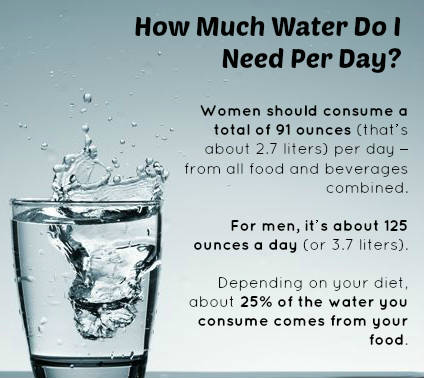
The National Academies of Sciences, Engineering, and Medicine has determined what the adequate daily fluid intake for the average, healthy adult living in a temperate climate is. For women it’s about 11 cups (~2.7 liters), and for men the daily total is about 15.5 cups (~3.7 liters). Before you run to the water cooler, know that about a quarter of that comes from the food and beverages you already consume.

Drinking water is especially important to athletes, people who consume a lot of sugar and/or caffeine, and those who are sick. Since they are at the most risk of water loss.

If plain drinks are something that makes you frown, never fear! There are lots of alternative methods to staying just as hydrated as the next guy. You can try adding fruit to your water via an infuser bottle or a pitcher in your fridge. Some popular mix-ins are lemons, limes, raspberries, strawberries, and cucumbers.

Photo by Caju Gomes on Unsplash

There is also the option of adding more hydrating foods to your diet such as fruits and veggies. Watermelon is an excellent example, consisting of about 92% water.

Whatever your way of drinking more H20 is, more power to you! It’s the liquid that makes the world go ’round, more than just figuratively. Try drinking a few more glasses of this good stuff each day and see how your life and health improve.