
How Making Art Affects You as a Student

Brushes on a canvas covered in paint

“I don’t listen to what art critics say. I don’t know anybody who needs a critic to find out what art is”.

~Jean-Michael Bassquiat
A piece of art where a woman's face is covered in color as she holds her face with her hands.

It’s the first thing to be underfunded and ignored in terms of educational value. Is this societal disregard for art justifiable? As a matter of fact, no. Having art programs present at educational institutions creates exciting places for learning and discovery. Research by the Americans for the Arts and Vans Custom Culture shows that low income students who are engaged in the arts are more than twice as likely to graduate college compared to their peers with no arts education, proving that creative classes as a part of your education can drastically increase your chances for success. Here’s how:

The Academic Boost of Art

As you can imagine, making art of any kind requires diligent focus and discipline. Which means the practice of turning creativity into a product is enhancing those skills. Focus and discipline are then going to transfer into other aspects of the artist’s life. For example, studying for a final exam is a bit easier when your brain has already been trained to have laser focus and not slack off.

A study on art in schools done in 2006 by Solomon R. Guggenheim Museum study showed a link between arts education and improved literacy skills. During the study, students were working with an artist to make a masterpiece. They then developed better critical thinking skills. By pondering and discussing different pieces and works, these students were establishing vital life skills. This could then be applied to understanding and analyzing literary material later on in different situations.

Outside of School Benefits

hands reach over a desk to sketch an art drawing of a fashion design

Art can benefit you life in more ways than just in the classroom. Creativity can often act as a bridge between two people of different walks of life. All forms of art can help to significantly improve community cohesion. A study done in 2005 by the Rand Corporation showed that art can connect students. These students might otherwise be culturally isolated, to each other and to the world at large.

A study by Anna Bernadska & Kelly Leroux describes the impact of the arts on individual contributions to US civil society. According to which, among adults, arts participation is related to behaviors that contribute to the health of civil society. These contributions include increased civic engagement and greater social tolerance. Put simply, when you create things for others you’re getting more involved with your community. You’re also learning how to better understand and accept thoughts and opinions of others, even if they may not agree with your own.

A man sits at a computer making graphic designs, the desk also has a coffee and a mug of coffee sitting next to the computer.

Art Is Available To You Everywhere

SUNY Ulster offers several types of art degrees such as fashion or advertising design, theater, music, and fine arts. Learn more information on the programs SUNY Ulster offers here. If a full-fledged art degree is not for you, arts classes can be taken with any degree program. They would siply be classified as an elective during any one of your semesters at SUNY Ulster. The next semester coming up is Fall 2019, and there are plenty of art classes to be had, check it out on the website. Some people may even qualify for free tuition with the college scholars program.

Common Grammar Mistakes

Scrabble tiles on a scrabble board

We’re all guilty of making errors from time to time. Some mistakes are more typical than others and can happen to the best of us, even those of us who go to college. This article is a quick run down of some common grammar mistakes that happen pretty often according to both the web and my personal experience; give it a gander.

Type blocks for an old printing press, each of them depicting a different letter. Grammar mistakes were far moer common in the hay day of these tools.
Image by Free-Photos from Pixabay

Let’s talk about what it is first.

Let’s go over what the term grammar means, according to the Cambridge Dictionary. It’s a noun that means “the study or use of the rules about how words change their form and combine with other words to express meaning”. Put simply, it means the correct way to use words in speech. It’s not a simple concept, the English language can be tricky as I’m sure you know. Frequently people who speak English as their first and only language are known to fumble their words. Getting to know a few frequently occuring misused terms could save you from your own fumble some day. In both speech and writing, correct use can give you more opportunities and better impressions.

A close up of a page from a dictionary

1. An Affect vs. The Effect

The word Affect is almost always used as a verb (an action word) while the word Effect is a noun (a person, place, or thing) and means the result. To put it another way, the Effect a.k.a. consequence or outcome is what happened because something was Affected, a.k.a. impacted, influenced or changed. A good example of this from Writer’s Digest uses someone who likes to be a pirate. “Acting like a pirate has had a negative effect on my social life”. Where effect is a noun. Or “the eye-patch affected my vision” where affect is a verb because it’s doing something. It may seem confusing at first, since one letter makes all that difference and they are sort of related as words. However, it’s not as difficult as you might think.

2. Than vs. Then

Probably the most typical of common grammar mistakes to make, this one is an easy fix. The trouble most people have knowing when to use then or than is remembering which is which. Avoid this grammar faux pas by remembering that than is a comparison and then is talking about time.

An example would be when you prefer one fruit over another, let’s say apples versus oranges. You like apples more than oranges, or you may prefer apples less than oranges. When you compare something to another thing, including people or places, you use than.

For the latter, an example would be going over a schedule. Let’s say this Saturday you have a family fun day planned; you’ll go to the beach, get some lunch, and then go to the circus. We’re discussing the timetable of events and when things are happening so we use then.

A person holds a book by the edge of one cover, making the other cover and the pages fall down in front of the camera.
Photo by Nicole Honeywill on Unsplash

3. Is It To or Too?

This is a fierce competitor for most common mistake, since we use these words so often. Let’s make it easy and get it right from now on, more knowledge equals less confusion. When we only use one O we are talking about movement of some kind. Whether it be moving through time, space, or the matrix. For example: you go to the grocery store, and when you’re done, you go back to your home.

The double O version is exclusively used for additional information and should, at all times, be replacable with as well. It is usually placed at the end of a sentence or list. For example, if you’re writing a grocery list you may decide you need: cherries, ketchup, bread, and eggs too. You can tell it’s correct because if I had written -eggs as well– it still works.

4. The Rest of Those Pesky Homophones

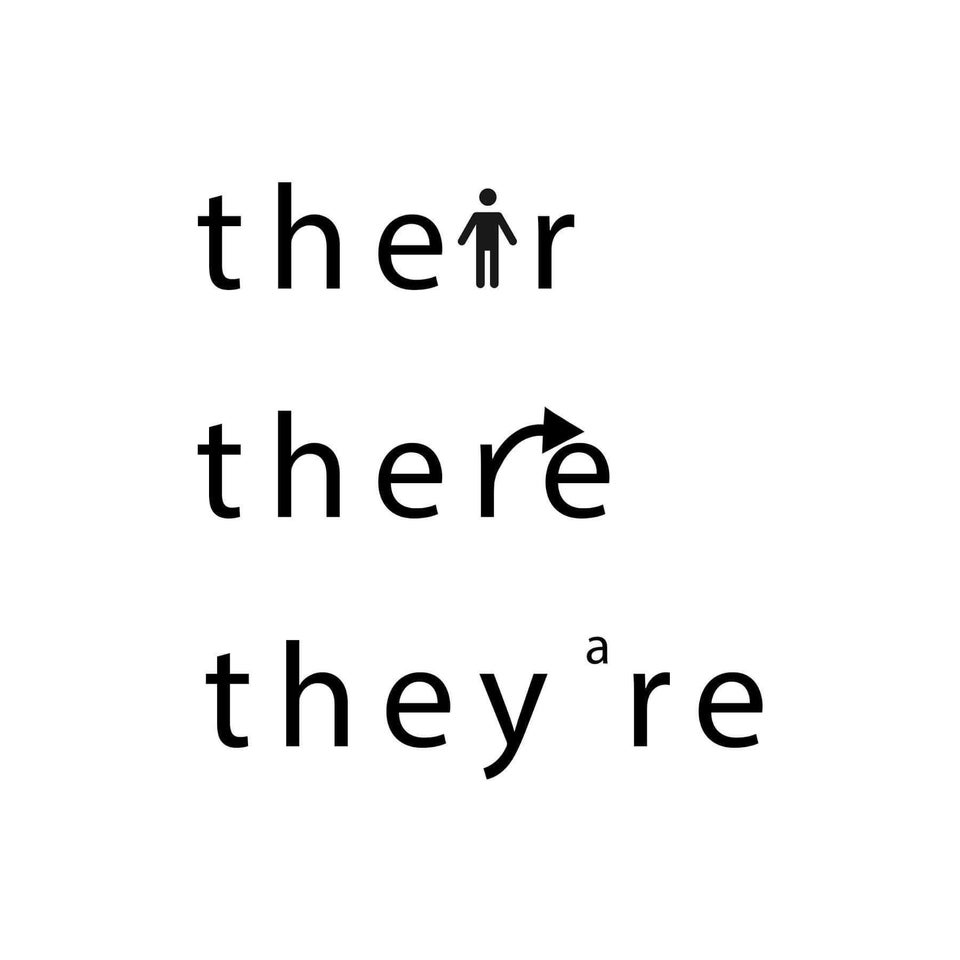
A picture breaking down one of the most common grammar mistakes, the difference between they're, their, and there.
Courtesy of Reddit.com

A homophone is a word that sounds like another word but has a different meaning. Number one of this post is considered a homophone, and I bet you didn’t even realize!

One of the ones we see most frequently is they’re, their, and there. If you glue this helpful infographic someone made into your head, you should do fine. To reiterate what it says: they’re means they are, there is talking about a location, and their is reffering to a person

In the same ballpark are the words your and you’re. The rules above apply to this so like I said before, glue that picture to your brain and this one is easy. You’re is a contraction of the words you are, saying someone is known a certain way or is doing an action of some kind. “You’re doing a great job at this!” is an example of this contraction. Your refers to a possession or belonging, for example: “is that your car?”. A good way to double check this one is to ask yourself if you are would make also sense, if it wouldn’t, use the other form of the word.

A red pen sits on top of a graded paper, where all common grammar mistakes are marked up.
Image by Anne Karakash from Pixabay

Don’t Let Common Grammar Mistakes Get You Down

Take control of the way you communicate by learning the ins and outs of the English language, that sneaky trickster. These mistakes are easy to make and finagle their way into everyday life. Instead of feeling bad about it, we’re getting ahead; that’s the spirit!

The Secret To An Awesome Website: Design Your Dreams With UI & UX

Hands reach over a desk that is scattered with markers, pens, papers, and a smart phone that lay on front of a computer screen. The papers show scribbled designs of buttons and maps.

Everything we use is designed by someone. The clothes you wear, the car you drive, your coffeemaker, and all the websites you visit. The practice of designing for different things goes by various names. However, when it comes to a computer website design, we use the terms UI & UX, meaning User Interface & User Experience. Whether or not this sounds familiar to you, you more than likely encounter it everyday. I’m going to explain both of them quite briefly as it’s a complex and exciting thing that you may just need to take a whole class in to fully understand, but more on that later.

UX – User Experience

A smart phone, half of which only shows outlines and the other half of which shows buttons, image, and colors. UI UX
Source: http://netaq.ae E solution blog.

The two jobs go hand in hand but are two different things. One relies on the other to function properly. User Experience usually comes first and deals with mechanics of a webiste, how it functions and feels to a user. It is a structure or foundation for the site that should optimize how a person feels about a company. A website with a good UX design should feel smooth and easy to interact with. A good designer takes into account how a user thinks and architects information in a way that is easy to find. On the other hand a website with bad UX is: hard to use, confusing to navigate, and clunky feeling in general. If you’re intrigued, here’s a preview of a cool book all about User Experience by Jesse James Garrett.

UI – User Interface

User Interface design is making the aesthetic elements of that website. UI designers manage everything visual in regard to appearance and how that affects the user’s feel for the site. Meaning colors, theme design, the look of the menus and can include logos, buttons, scrolling and other interactive elements. It’s an important part of the job that can influence a user, usually a customer, and what their opinion is of that brand that’s being represented by the webite. If you’re looking for more info on that check out this full explanation of the UI, UX, and the difference between them by Emil Lamprech.

UX and UI design are specialized trades that can involve marketing, computer science, research, some sociology and analytical skills. It’s knowledge that few have; and those who do are able to apply it to all kinds of situations, and clients.

An arm holds up a piece of paper with dsigns for an iPhone blueprint
Image by William Iven from Pixabay

Why It Matters

Good user experience and design can impact an organization in so many ways. It’s beneficial for the obvious reasons; people spend more time (and maybe money) on your site when it is alluring to see and fun to use. Plus more people While also being beneficial in the long-term, especially for certain feilds such as education. Studies have shown that learning institutions who utilize modern user experience design strategies can better support current student learning styles. A website or application should be a good reflection on a company that makes them stronger. Having a good UX and UI design is important, if not integral, in making a company shine amongst all the competition out there. To increase sales and growth continually is no easy feat, and with these skills it’s quite literally made into a science.

Alright, now it’s later.

“I’m In!” You Say, “Teach Me More!”

Gladly. Your complete guide to UI & UX is right here. SUNY Ulster is holding a class all about this speciallized knowledge. It’ll take place at our Stone Ridge campus for the Fall 2019 semester. It’s an elective for the web development degree program, but anyone who’s qualified with the basics can take it.

Serve and Protect Your Community with the Criminal Justice A.A.S.

Police Academy graduate receives diploma

If you’re interested in a rewarding career where you can make a real difference in the world, consider earning a Criminal Justice A.A.S.! This program differs from the traditional A.S. program, as it is designed for graduates to go directly into police and security work. The degree is often combined with a 30-credit Police Basic Training program.

According to the U.S. Department of Labor, employment of police and detectives is expected to increase by 7% between 2016 and 2026. The A.A.S. Criminal Justice degree prepares students for this with the knowledge, skills, and abilities necessary for entry-level positions as police officers, corrections and community supervisors, and security guards in the private sector. This program is also ideal for corrections or police professionals already working in their chosen fields who are looking to earn a degree for self-improvement and advancement.

More than 80% of graduates who also completed the Police Basic Training program are currently employed as police or corrections professionals. Completion of both programs leads toward New York State municipal police certification. The combined programs provide an ideal situation where students graduate already prepared for employment, saving their communities significant time and community resources for training.

Many Criminal Justice A.A.S. graduates do exceedingly well as developing professionals and are now in leadership positions. Graduates perform meaningful work in their community while also earning attractive salaries and benefits. Potential earnings in New York State average $78,930 at the 50% mark, which increases if employment is found with state or federal entities.

Sophie Epstein, a recent graduate, says, “I loved the Criminal Justice program at SUNY Ulster. I strongly feel that the program helped to better prepare me for success in both Police Basic Training and my career in law enforcement! The professors teach you so much more than what is in the textbooks – they teach based on their experiences in law enforcement, which made class very enjoyable! I would recommend the program to anyone who is considering entering the law enforcement field, or anyone who is looking to learn more about the criminal justice system!”

5 Tips for Managing Your Finances While in College

Dollar bills sticking out of soil

College is expensive. Even with great scholarships and programs like Excelsior, College Scholars, and federal aid, you still have to pay for housing, food, transportation, textbooks, and more. How can you make sure that you can afford it? Learn about managing finances! Here’s how:

Figure Out Your Budget

Take a realistic look at all your expenses. If this is your second year of college, figure out how much you spent last year, and plan to need at least as much this year, if not a little more. If you haven’t started college yet, just figure out your current budget and research common costs for college for others with your major/living situation. Don’t hesitate to overbudget; it’s better to have too much than too little.

… And Stick to It!

If you can’t pay for it and it’s not in the budget, don’t buy it! Things like new gadgets and electronics, clothes, and getting food and drinks at restaurants should be put on the back burner at this time. Buy used and dependable electronics on eBay, find clothing and room decor at thrift stores, learn to cook, and make your own coffee. These simple changes can save you a lot of money in the long run.

Plan to Save

If you expect to pay out of pocket for tuition at a four year school, start saving now. Every bit you set aside will lower the cost of the loan you have to take out, be it for tuition, housing, or something else. Check out our tips for saving money to get started! Even if you don’t have something you need to save for anyway, try to set aside a little bit as an emergency fund. If you don’t have emergency money and you find yourself in financial trouble while at SUNY Ulster, contact the SUNY Ulster Foundation about Lights for Learning.

Pay Attention to Your Credit Card

Credit cards are usually good. Some offer great rewards programs, and it’s nice not to have to carry a bunch of loose change around all the time. Where you may run into trouble is the “credit” part; just because your card has a super high limit doesn’t mean you should hit it! You should use your credit card just like you would a debit card: be careful where you use it, and don’t spend more than you have available in your bank account. You should be paying off your bill in FULL each month to avoid charges and make the most of your credit card benefits. Doing so will also earn you an excellent credit score for when you actually need to take out a loan or apply for a new apartment.

Manage Your Debt

This is something you want to avoid if it all possible, but you may have to take out a loan, or you may have already accrued some credit card debt. How should you tackle it? It’s recommended that you pay off at least your interest each month, so you prevent unnecessary compounding. Avoid debt by getting scholarships; there’s one for almost everything you could need while a student! Check out SUNY Ulster scholarships whether you’re a new, current, or graduating student, and contact the SUNY Ulster Foundation in Clinton 203 if you need help or have questions!

It can be hard to establish good financial habits, especially if you’re not used to careful budgeting. With a little bit of effort and practice, however, you can achieve all your financial goals and come out ahead!