
How to Build a Great LinkedIn Profile

Resume graphics with the LinkedIn logo

Now that you know why you should join LinkedIn, you may be wondering where to begin. If you’ve signed up for the site and glanced over your profile, you can see that the information you include and the layout of a profile page differs a bit from other social media sites. That said, it’s pretty simple to fill in once you know what to do with each section!

Use a Picture

As long as you have no privacy concerns, you should add a nice, professional picture of yourself to your page. The key is professional, but that doesn’t necessarily mean boring! For most careers (think business, computer science, accounting, marketing, etc.), the ideal profile picture will be a clear and well lit picture of you in business attire, but there may be leeway with some other careers. For example, someone in vet tech may have a picture in scrubs with an animal, and an artist or someone working in arts may be dressed in clothing appropriate to their work and have some filters or edits to their image.

Complete Your Introduction and About Section

The first thing people will see after your name on LinkedIn is your introduction, which includes a headline, relative location, and a summary bio. Your headline is generally what you do, but you can spruce it up by adding pertinent adjectives. If you’re between positions, say something like “Accounting Professional in Transition” or “Marketing Specialist Seeking Challenging Employment Opportunity.” Your summary “About” section should detail your history and skills, as well as what your goals are for the future. This is possibly the hardest section to write, but there are many tips and guides for what to write out there, and you can always look at your connections and others in your industry to see what people are using for this section!

Work and Education History

Naturally, one of the most important parts will be your work and education history. Design this similarly to your resume: keep details simple, and use bullet points to give added information. There is even an option to import your resume, if you want it to be identical. If you have any pictures or websites you can link to, be sure to do so. For Education, you should add any significant clubs, student government positions, honors programs, or awards you may have received, and if you did exceptionally well, you may want to add your GPA. Make sure you add SUNY Ulster to this section! In addition to the main two sections, you can also add languages, volunteer, and projects sections to better highlight your skills and accomplishments.

Skills & Endorsements

Think about what you do at your job. What can you confidently say you’re good at? Are you a videographer who knows Premiere and Vegas inside and out? Put that down. Are you a business student with team management skills? Put that down too. If you’re a writer with great editing and grammar skills, add that. Really any program, competency, or specific skill you’ve acquired can be put down here. Your connections can vouch for ones that you have put down through endorsements, so don’t hesitate to put yourself out there!

Now Make It Yours!

It’s important that your profile reflect who you are as an employee and individual, as well as what you bring to the table. Don’t hesitate to write about your skills, positions, and activities that make you unique and which you are passionate about.

How are you using your LinkedIn profile? What tips and tricks do you have for other users? Let us know in the comments!


New Customer Service Microcredential with Mohonk Mountain House

Mohonk Mountain House Hotel overlooking pond

SUNY Ulster has opened registration for a new 15-credit Customer Service Microcredential!  We’ve collaborated with Mohonk Mountain House to offer students and community members the opportunity to earn and learn by taking a series of five classes, including a paid Mohonk internship! This is a fantastic opportunity for those interested in the hospitality field.

The Customer Service microcredential consists of five courses, including the paid internship (based on interview). All classes other than the internship can be taken online, at the Stone Ridge Campus, or at the Kingston Center of SUNY Ulster, so there’s always a fit for your needs and schedule.

Mohonk Mountain in the fall

Just like with our other microcredentials, students will receive a web-based Digital Badge which allows employers to learn about the skills the student has gained through the program. Microcredentials like this one can give you an edge over the competition when applying for jobs. Check out one of our past blog posts to find out what else microcredentials can do for you!

Find out more about the Customer Service Microcredential or our other microcredentials by visiting our microcredentials page, contacting Admissions by phone at (845) 687-5022, or emailing admissions@sunyulster.edu. Students are now being admitted for the fall 2019 semester, so register today!

Computer Science Students Develop Web Application for Vet Tech Program

Logo for Computer Science Team Ellie ++

Each spring, second year Computer Science students in Theory and Practice of Object Oriented Programming work on a team project to develop a software application for a SUNY Ulster campus customer. This course, taught by Professor John Sheehan and Dr. Lou Thomason, provides an opportunity for students to gain practical experience in software development while also giving back to the college community. This semester, Team Ellie ++, which consisted of students Leonard Carcaramo, Dominic Cerchia, and Eryk Cole, worked with the faculty in the Veterinary Technology program to update a web-based tool for tracking student veterinary skills assessments.

The Vet Tech program is required to keep track of which students have completed a set of veterinary skills and must be able to provide these records when they have accreditation reviews by the AVMA. They previously tracked these records on paper and kept large binders of books for all their students, which needed to be kept on file for a long time. The Vet Tech faculty were unable to enter student skill information into the existing electronic system fast enough for it to be worth using over the paper records.

With this problem in mind, the Computer Science students built a web application that tracks these students’ accredited skills online, providing the Vet Tech program with a much more efficient and environmentally friendly record keeping system. The project was first started by a team of students in 2018, but required some fine tuning. This spring, the new team made some critical improvements to the project by adjusting the existing system so that entering student skill information could be done easily and quickly. They also made a number of small fixes to make the application more robust. Throughout the project, the team worked closely with all the Vet Tech faculty to ensure the system would meet their needs.  

Leonard Carcaramo, student leader of Team Ellie ++, says, “The Theory and Practice of Object Oriented Programming course goes above and beyond how to code, and teaches Computer Science students how to work in a software development team similar to how software development teams work in the industry.”

A big thank you to these students for their hard work helping the SUNY Ulster community! Check out some of the other ways Computer Science students are going far.

Noteworthy Keynote Address by Dr. Ray Raymond

Portrait photograph of Raymond Ray

Dr. Ray Raymond has been a well-known professor at SUNY Ulster since 2005. He teaches government, politics, international relations, and American history. In addition, he is an adjunct professor of comparative politics and international relations at the US Military Academy. He is known for riveting lectures complete with an eloquent English air about them.

Teaching students at SUNY Ulster is one of many commitments Dr. Raymond is regularly engaged in. He is also a regular visiting lecturer at the US Air Force Academy and Fellow of the Pell Center for International Relations and Public Policy. He is also the Director of the Katt Institute for Constitutional Studies. His efforts have been recognized numerous times, including by the Times Herald Record Online.

An Address of Importance

On Saturday, April 13, Dr. Raymond gave the keynote address at the World Affairs Council of the Hudson Valley’s 6th annual student conference. He illuminated the diffusion of power in the international system since the turn of the century and suggested that that US international leadership has to be collaborative, not unilateral.

The outline of an eagle is filled with red and white stripes and a blue pattern containing white stars

Dr. Raymond suggested that the US does not have the power it once did. He also defended the liberal rules-based world order and recommended reforms in the US intelligence process to ensure that we avoid blind spots, in hopes that this will improve our understanding of the new strategic political environment.

Curious about this man and what the feel of his lectures are? Worry not, because he has contributed mini-lectures to AcademicMinute.org which are broadcast on WAMC Public radio from Albany. His broadcasts set out his views on US foreign policy and explain some key points of commitment and co-dependence between the United States and the United Kingdom. Listen to one of his broadcasts below.

The U.K.’s and The U.S.’s Special Relationship

Dr. Raymond’s Background

So where does our noteworthy professor get his skills from?
First, he is a former British diplomat who held a Post-Doctoral Fellowship at Yale University in American History. Secondly, before coming to SUNY Ulster, Dr. Raymond spent twenty years in Her Majesty’s Diplomatic Service as a specialist on the United States. During that time, he analyzed US government and politics, US defense and national security issues as well US trade policy. Between 1997 and 2005, he advised then British Prime Minister Tony Blair on US politics as well as secondary and higher education. He also served as policy adviser and speech writer for High Royal Highness, The Duke of York. In recognition of his diplomatic work, he was honored by Her Majesty Queen Elizabeth II with the Order of the British Empire.

A flag is bisected diagonally, the upper half depicting a partial american flag and the lower half depicting a aprtial uk flag

 As political officer of the British Consulate General, New York he played an integral role in the UK’s response to the terrorist attacks of September 11th, 2001 when 77 British nationals were killed in the World Trade Center. This included organizing events and giving speeches conveying the message to the United States that the United Kingdom would support it fully in the war on terror. One of them was at SUNY Ulster when Dr. Raymond gave the Howard St. John Lecture in late September 2001.

Dr. Raymond’s research  has been published by The Atlantic Council and the National Interest. Currently, Dr. Raymond is working on a new book which will be published late next year by the US Naval Institute Press. It is about five of West Point’s most courageous young officers and their heroic service in Iraq and Afghanistan.  

Political Influence Aside

Dr. Raymond’s top priority has always remained his students, however.  In addition to teaching, he has mentored many SUNY Ulster students long after they graduated, helping them win places and often scholarships at the Fletcher School of Law and Diplomacy at Tufts University, Columbia University, the University of Pennsylvania, Cornell University, and New York University among others.

This influential man also has a high satisfaction rating from his students. He has multiple inspiring reviews on sites such as RateMyProfessors.com. One anonymous reviewer, a political science student, left a rating of five out of five, saying, “Dr. Raymond always remained very professional, and he is thorough. He will explain it a second or third time if needed and always responds to my emails in a timely manner… I personally enjoyed learning from him. A stand up man/professional if there ever was one.”

His Method

A student in cap and gown puts his thumb up with a wide smile

Dr. Raymond says he gets students into history by making it stimulating. He stresses the importance and relevance of political history in ways that ensure students will be able to make an argument using facts long after they’ve forgotten details of the lesson. “If you’re not excited about it yourself, you can’t expect students to be excited,” he commented.

Free Tuition With the College Scholars Program

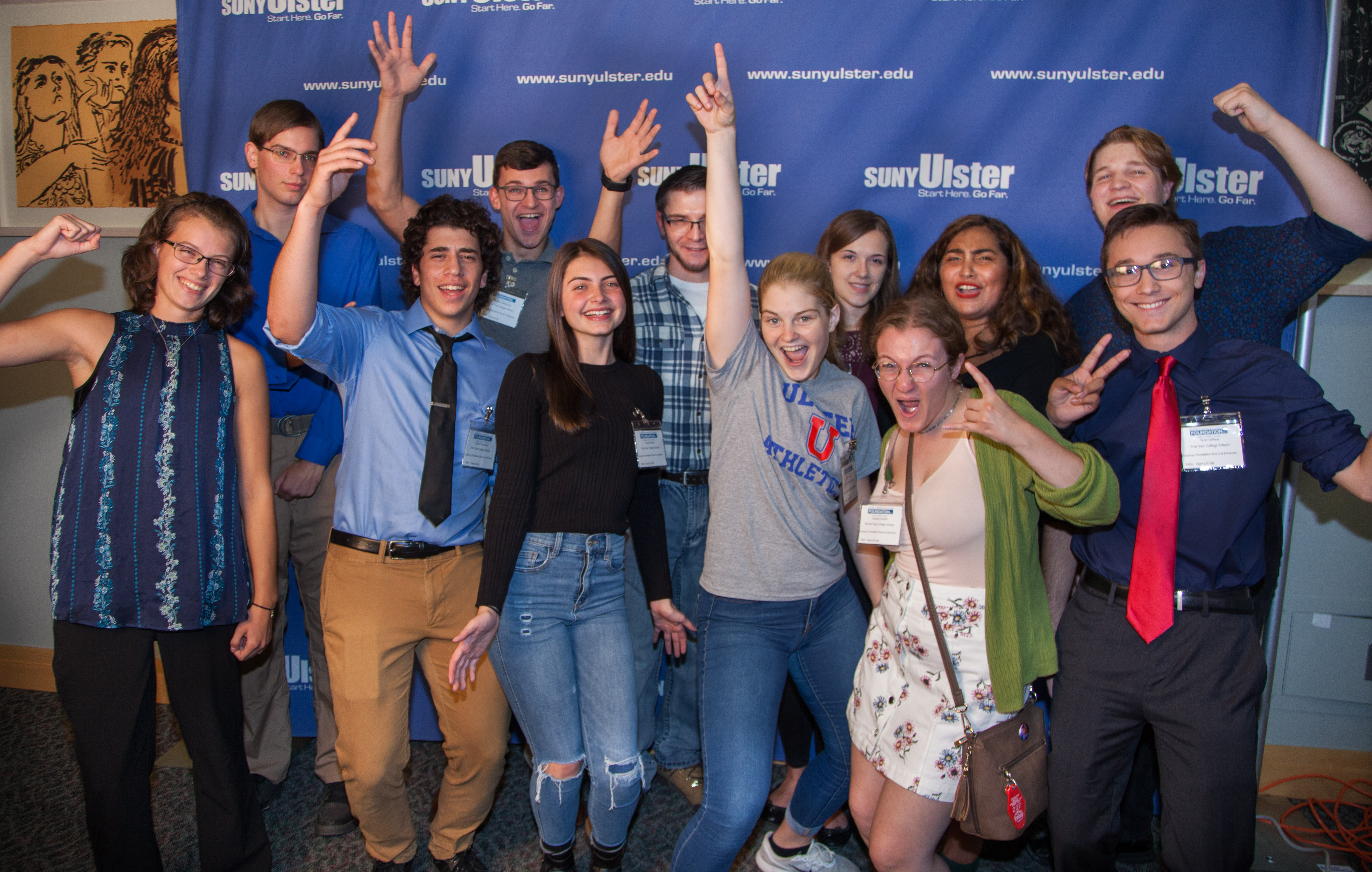
An excited group of twelve students from various ulster county high school hold action poses and smiles.

Getting good grades in high school doesn’t just look good to colleges. It can also get you a free ride to SUNY Ulster with the College Scholars Program. Students who maintain a status in the top 10% of their high school class qualify for free tuition upon getting their diploma.

A fair skinned girl with blonde hair sits in a brick walled reading room. She wears a deep blue hoodie with stars on it and has a pair of green headphones hanging around her neck. She sits at a desk with a pile of books to her left and leaning her head on her hand which is propped on the desk. In front of her she has an open faced, large, hardcover book with a small bright green apple sitting on top of one of the open pages.

College scholars have a significant step ahead of the other students they are joining at college. Not only are they extraordinarily studious and devoted to learning. They’ve also earned the chance to get up close and personal with Dr. Al, our college president. While all other students eventually have the same opportunity, it’s a bit different for these few. College scholars are privy to a small meeting with executives. During which everyone is introduced and the program awards are given out. Their footholds on campus are strong before they start courses since they’ve made like-minded friends ahead of time.

Get Your Head in the Game Early

Mary Sommers was a recipient of this scholarship thanks to her hard work and diligence. Before she became a collegiate, she always made sure to maintain the best grades and study habits. She says, “It’s something that I’ve always worked for; the option to go to SUNY Ulster for free was so important and attainable.” Her family inspired her from a young age to be an excellent student and make the most out of her potential. They’ve given her the foundation she needs to attain her desired masters degree in child development so she can become a guidance counselor one day. As for where she will end up, she says, “I don’t know exactly where it will take me, but it’s going to be far.”

Stay Focused on What’s Important

A dark skinned man sits at a mac computer and holds his hands on the mouse touch pad and keyboard. He is wearing a grey shirt with a dark blue collar, a watch, and has an earring in his right ear. We cannot see his face

Another conscientious college scholar, Bradley Westervelt, currently uses the program’s funding toward his music degree at SUNY Ulster. He realizes that the program has had a big impact on his education and life. He says, “I definitely believe I was able to achieve more as a student because of my tuition being funded by the school. I think SUNY Ulster is a great place to go to college. I’ve had really wonderful teachers and many cool experiences since coming here.” The time Bradley spends at SUNY Ulster is in preparation to transfer. He wants to earn a Bachelor’s degree before starting his career as a music instructor.

Something to Aspire To

So for those of you high school students and parents out there, make sure to keep those grades up and the motivation high! The chance to attend one of the top five community colleges, as ranked by BestColleges.com, is nothing to pass up on. The even bigger opportunity to attend that college for free is certainly something to pursue. Mary summed it up well when she stated: “I strived and worked hard to make it into the program, and I think that anyone can set the same goal. As long as you make your deadlines and do what you need to do, you can do it too.”

See the application here.

a cartoon notepad lays open with two arms laying on top of it, one holding a pen. There is also a cup of coffee present and a white smart phone with a dark blank screen. The notepad is blank.
Photo by Mohamed Hassan from Pixabay

Meet the Kingston Center Enrollment and Success Team

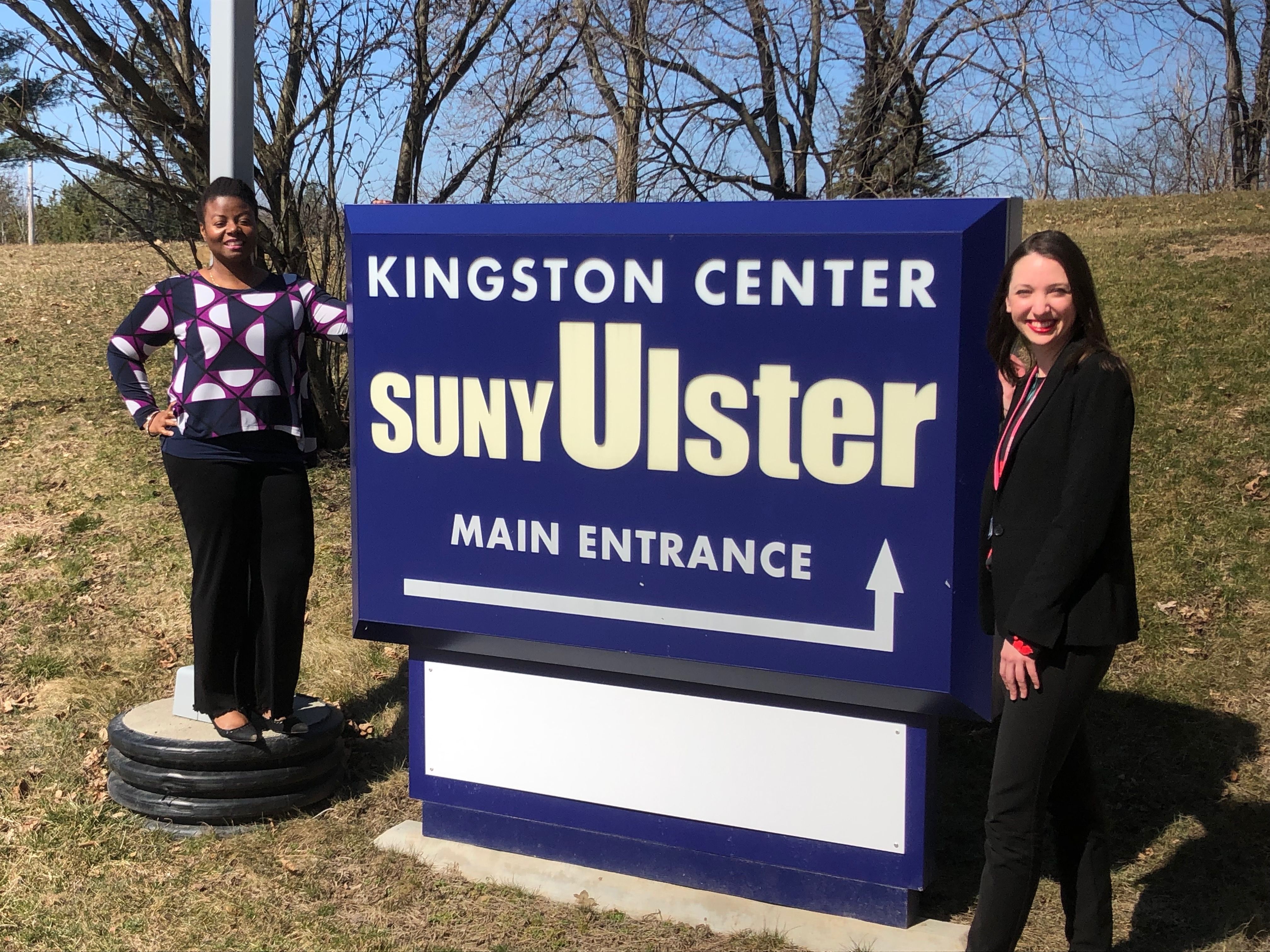
Celeste Hackenberg and Charnikia Pinesett with KCSU sign

Charnikia Pinesett, Student Success Program (SSP) Counselor


“Your success is directly proportional to the number of lives you have touched for the better.” 

This quote by Vishwas Chavan sums up my philosophy for both my personal and professional life. I have worked with students throughout the Hudson Valley region for over 13 years to help them reach their academic and career goals. To date, I have had the privilege of assisting over 1,500 students with pursuing higher education. I currently oversee the Student Success program of SUNY Ulster as the College Entry and Student Success Counselor. The Student Success Program (SSP) is designed to guide students through the college application process, as well as help them access scholarships and develop leadership and social skills. SSP is currently offered at Kingston, Ellenville, and Onteora high schools. I can unequivocally say that mentoring, encouraging, and inspiring students to reach their highest potential is one of my greatest passions.
 
When I’m not working with students, I am writing and singing gospel songs, binge watching Forensic Files and Family Feud, or catching up on much needed rest. I also enjoy special, soul food family dinners with my seven siblings and amazing mother.

Celeste Hackenberg, Enrollment & Success Counselor


I came to SUNY Ulster in December 2018 from Borough of Manhattan Community College, where I worked as an academic advisor and teacher for two and a half years in a pre-college program called CUNY Start. My driving force in working at a community college is having experienced firsthand what a life-changing experience it can be. Earning good grades and making connections at community college can literally take you anywhere you want to go—a rewarding career, your dream school, you decide. After a lot of false starts and stop-outs because of limited financial resources and indecision, I finally completed my Bachelor’s degree in Psychology at UC Davis in 2014 and my Master’s degree in Writing at Sarah Lawrence College in 2016. Prior to that, I attended two different community colleges—one in British Columbia, Canada and another in Sacramento, California. When I am not at work, I am working on my poetry manuscript, cuddling with my cats, and going on adventures with my fiancé, exploring the gorgeous Hudson Valley with all of its natural beauty.

My office is in Room 208A. Come by, have a cup of coffee or tea, and chat with me about your goals and how a SUNY Ulster education, with all of its financial, academic, and advisement supports, can help you reach them! You can also reach me at (845) 688-1560 or hackenbc@sunyulster.edu.

Why You Should Be Using LinkedIn

Cartoon heads connecting to a LinkedIn logo

You’re probably familiar with major social networking sites like Instagram, Twitter, Snapchat, and Facebook. One other platform that you might hear about is LinkedIn. LinkedIn is possibly the most valuable of all the social networking sites when used correctly, as it focuses on something that young adults need when getting a job: connections in their industry. Whether you’re just beginning your college journey or you’re graduating this semester, you should join LinkedIn right away! Here’s just a few reasons why:

Connect with Professionals in Your Field

You may enjoy checking your friends’ stories on Instagram or catching up with far-away family members on Facebook, but in most cases that won’t be too helpful when getting jobs after graduation. That’s where LinkedIn comes in. LinkedIn works similarly to these “just for fun” platforms in its ability to connect, but while it could be awkward to add your boss on Facebook, on LinkedIn, that’s exactly what you SHOULD do. You see, LinkedIn gives you the chance to connect with people who can help you throughout your career, be it old or current bosses and coworkers, professors you established good relationships with, or other professionals you met through networking events in person or online. These are all people you can count on when applying for jobs, and in many cases their shared knowledge pool can help you while you’re employed, too.

Find Jobs or Internships (and Apply for Them!)

LinkedIn has a space in its site just for job seekers. In this area, you can find, view, and even apply for jobs posted on the site. It works like Indeed, Glassdoor, Monster, or any one of the other job seeking sites out there, as you can search for a variety of jobs based on profession and area. If you want jobs to come to you, you can always turn on the “Let Recruiters Know You’re Open” feature.

Get Extra Info for an Interview

As every good job applicant knows, you should do some background research on an organization and your potential boss before the interview. LinkedIn gives the perfect opportunity for that! Find out more about your interviewer or future employer by visiting their LinkedIn page. LinkedIn will alert a person when you view their profile (which isn’t necessarily a bad thing, they often take it as a sign you’re doing your research), but if that makes you nervous, you can always turn on Private Mode.

Keep in Touch with Your Alma Mater

After graduation, it’s easy to get caught up in everyday working life, but it’s good to see what’s going on at your old college so you don’t miss out on job fairs, networking events, and other opportunities geared toward alumni. LinkedIn will help you connect with your college as well as other alumni and students, so you can stay updated with what’s going on and meet others in your field with the same educational background. That’s important, because you never know when you could find a great job just because you went to the same college. When you make an account or update your current one, make sure you follow SUNY Ulster!

Kickstart Your Tech Career with a Computer Science Degree

Student working on a computer project in class

If you’re interested in technology and want to work in a field with great employment and financial opportunities, a Computer Science degree from SUNY Ulster may be for you! Computer Science students prepare for a variety of software related careers, including Artificial Intelligence, Cyber Security, Game Design, Mobile Application Development, Web Development, and many others. The job market for Computer Science graduates has always been excellent, and projections show future demand will continue to outpace the number of students receiving Computer Science degrees. As a result, starting salaries for computer science and engineering graduates are among the highest of all majors.

The Computer Science program at SUNY Ulster offers an Associate’s degree in Computer Science which can be taken on campus or fully online. This degree prepares students to transfer and pursue further Computer Science degrees or go directly into the workforce. Alumni have gone on to complete Bachelor’s degrees at schools such as SUNY New Paltz, SUNY Albany, Brooklyn College, RIT, and RPI. Alumni going straight into the workforce can be hired for a variety of positions through both traditional routes and SUNY Ulster partnerships, including the one recently developed with IBM as part of their New Collar Jobs Initiative.

Computer Science alum Jesse Thibault graduated in 2014 and went on to earn a Bachelor’s from SUNY New Paltz; while there, he participated in an internship at IBM that led to a full-time position. He now works at Microsoft in Washington as a software engineer. He says, “I still follow the principles taught in the software engineering class even now, and I refer to the notes from the foundation classes when I refresh my data structures knowledge. Thank you for the education!”

Students who want to take a small number of courses within computer science can earn up to three microcredentials in Computer Game DesignMobile Application Development, and Web Application Development. SUNY Ulster Continuing Education also offers a Web Developer / Fast Track Mini Boot Camp program that’s ideal for working professionals who would like one or more evening courses in topics important to Web Development. Students interested in computer topics may also find their place in two other closely related majors at SUNY Ulster: Computer Engineering and Computer Networking.

John Sheehan, Computer Science Department Coordinator, says, “The SUNY Ulster Computer Science program is a great option for any student, whether just graduating high school, seeking a new career, or just enhancing skills in an existing career.  Between on campus, online, and continuing education, we have options available for all scheduling needs. This is a great opportunity for anyone, anywhere, to become a part of the exciting and ever changing world of computer technology!”

4 Tips to Power Through Textbook Reading

Three walls of books are shown leading up to a bright invisible sky, the book shelves are slightly covered by clouds and books protruding from the sky. It gives the viewer a feeling of standing in a library nook and looking up to see the heavens.

For most students, getting through that weekly textbook reading can be a real challenge. Believe it or not, there are a few ways to make that nonfiction assignment easier. Learning the ways to power through reading that can feel daunting or impossible is a great skill, a skill that is bound to follow you through life wherever you may need it, for another degree or just a relaxed educational reading session. Here are some tips to boost your GPA through the roof with the power of effective studying.

A teal hard covered book is laying with the pages open on a table, as if someone was reading, pictured with two pages folded up and together toward the  seam that looks like a heart. The backdrop is a bold yellow.

#1. Start Your Engines, Prepare to Learn

When sitting down with your book make sure you are ready to learn. You should have a writing tool and some note paper. No one that I’ve ever heard of was sorry that they took too many notes. You want to be ready to learn, but you also don’t want to dive in headfirst. Ease your way into submersion. Preview the topic and material you intend to research. Read the front cover, back cover, the preface, the inner flaps, boldfaced prints, pictures, and diagrams so you are aware of what you’re supposed to learn. You should gather a clear picture of what the text is about, if not, predict what you will be learning. Write your ideas down and see if your initial feeling is right later.

According to Live Your Legend this step is “akin to warming up before a big game.” You wouldn’t hit the field without a good warm up. Why then would you skip these equivalent steps for a research project? Being prepared when you start your research can help you perform better, just like a good stretch! Take the time to prep your brain and your grades will thank you.

#2. Use The Author’s Organization to Understand

Start off by separating the facts from opinion in the text as you read. Remembering that facts are only the stuff that you can prove, opinions just tend to float around and cannot be proven. Finding the facts is a good practice because that’ll likely be where the answers you seek are living.

Four cartoon looking textbooks are shown with various colors and objects on the cover. One shows a math equation, one an atom, one a microscope and the other a simple pattern. No words are visible anywhere.

Next, look at the way the author presents the material, it may be pretty informative. The order of events can vary as well as the style it’s put together in. In biographies and autobiographies, events are usually in chronological order. Other pieces may have an arrangement that is centered around the main idea (a.k.a. the topic you need to learn). If you can pick up on the organization and utilize it, you can predict what will come next. Pick up on the arrangement of info and where the important bits are, what the point is, and what to study for the big test!

#3. Stop, Drop, Summarize

After each section you read you should stop and put the book down for a minute to summarize the main point(s). This not only keeps you from falling asleep from reading the same book for a while, it also sticks that information you just read, but almost forgot, down in your mind.

A portion of a dark table top is pictured with sticky notes, flashcards, highlighters, markers, pencils and pens scattered across it. The office supplies are very brightly colored. There is also a roll of tape and a small compass in the picture.

Another sweet tip: if you create questions to summarize by and put your answers on the other side, it makes the most amazing study flashcards later on. The most bang for your study bucks, I like to say. I don’t know about you, but I like to remember what I read the first time and not have to search the whole book or chapter for answers down the road.

#4. Ask Questions & Analyze Your Work

Two cartoon heads look at each other, the space where their brains should be are filled with a white space. One head has a light bulb in the space and light bulbs rising from the head. The other head has a question mark in the space and more question marks rising up from his head. They could be having a fascinating conversation about reading a textbook.

Go big or go home, right? So finish strong by reaching for that notebook you have nearby and jotting down some thoughts. ASK QUESTIONS! Get those thinking muscles warmed up and actually ponder a little bit about what you just read. Check and see if those initial topic predictions we covered in Step 1 were right. One of my favorite things to do is to go discuss what I just learned with someone and have a good conversation about the subject. They can help provide some questions that might make you want to hop back into reading that book.

This is the ultimate adhesive to your brain for study material. The bread to your test’s butter. One of the more important steps, I assure you.

When you move on to the next section, read and repeat steps 3 & 4. You won’t get lost in timelines and jargon if you understand the chain of events, organization, and topic.

Good Luck!

If things between you and the textbook start to get hairy, take a breather. I’m not suggesting getting lost down the rabbit hole of social media. I am suggesting that you take less than five minutes to relax your mind and refresh your perspective. Get out of your chair, stretch your arms and legs, breath in and out deeply. If you’re not ready to jump back in, try taking a short walk or tidying up the house a bit by completing a chore. Your mood tends to improve with such activities and enables you to jump back into the ring with that textbook and win with a knockout.

Being a student and having to study informational material is not always the most fun thing you have to do, but skirting around the knowledge by only skimming texts will ultimately not benefit you. It might only waste your time, honestly. If you really learn the material, you can’t go wrong.

A cartoon looking man is shown wearing a graduation cap and gown. He points to a piece of paper that looks like a diploma with his left hand and points to a phone with the other. Around his is  circle that has various objects surrounding the man. There is a pen, a tablet with a pencil, another phone with headphones and a small pile of books that will encompass a lot of reading. The background is bright teal and a portion of an atom is shown in one corner, a portion of a gear set is pictured in the opposite bottom left corner.

How Joining Clubs In College is Good For Your Career

Several young people are gathered around a table and appear to be studying. they sit next to a window, no faces are visible.

Those clubs you see posters for all around campus could really help you boost your own success!

Get to Know Your Fellow Students

Meeting new people during your studies could lead to success-promoting network connections later on in life. Plus, everyone needs study buddies! Clubs are quite an effective way to make new friends, making the jump to college an easier one. A club meeting typically has a fun atmosphere where people are happy to chat about upcoming events or club motivations.

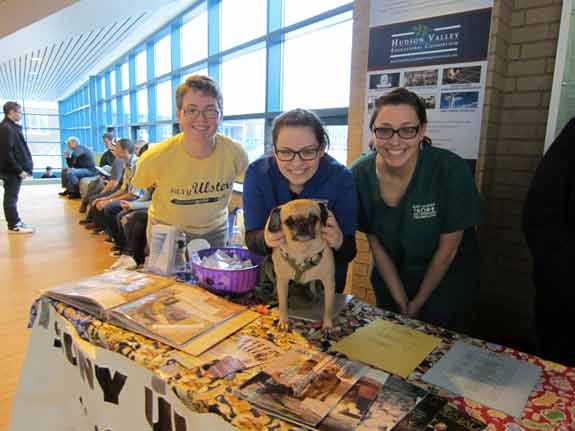
Three young women stand bowed over a table that has a dog sitting on top being held by the middle woman. The table is decorated and filled with veterinary information. Behind them is a hallway of windows with many people seated in front of them.
SUNY Ulster Vet Tech Club members represent their club at a college activities fair.

You could find out about a life changing experience to take part in by merely mentioning your interests to the right person or being vigilant about posters for meetings and events. Almost all colleges have a long list of special programs that you should explore. Clubs also tend to work with the community outside the college a little more than your classes will. Meet everyone you can, and make the most out of your college experience. The more people you know the merrier, especially for students intending to become successful entrepreneurs. The importance of networking is undeniable in most career fields. Joining clubs in college is a lot like getting a head-start on building those business connections.

Your Ticket to Less Stress

You won’t need that spa day this semester! Another reason that clubs will boost your overall success is that they can be a major stress reliever. While course work can cause you to feel pressure or tension, going to a club meeting after class is like a getaway, a place to talk to people in the same situation (and maybe even classes) as you. No pressure of academia to be found, just friends willing to get involved in projects based on something you both care about.

Gold for Your Resume

The more impressive material you have to present to someone you want to work for, the better. Volunteering and having extracurricular commitments are always a pleasant surprise for a potential employer. This may be one of the easiest opportunities you have to boost your resume.

Remember while you’re busy with all your class work that volunteering and campus involvement are great factors for a resume. Clubs are a prime opportunity to get involved in those activities. You’re unlikely to regret making new friends or becoming part of something greater than yourself. One of the most important things to do when attending college is to enjoy yourself and the experience along the way as much as you can. Do yourself a favor and join a club or start your own, and let me know, I might want to join!

a blue background with three resumes pictures, no type is visible